CRM for Ecommerce: Turning One-Time Buyers Into Repeat Customers

Acquiring a new customer almost always costs more than keeping an existing one, yet most SMB ecommerce sellers still spend the bulk of their marketing effort chasing first time buyers rather than turning them into repeat ones. A detailed breakdown of retention metrics from HubSpot puts ecommerce repeat purchase benchmarks around twenty five to thirty percent, meaning roughly seven out of ten customers who buy once never come back at all. A CRM, used well, is one of the more direct ways to close that gap without needing a completely new marketing budget.
Why Most Sellers Miss the Repeat Purchase Opportunity
A typical SMB ecommerce store tracks orders, inventory, and payments closely, but customer behaviour after the first sale often lives nowhere in particular. Without a CRM pulling this data into one place, there is no easy way to notice that a customer browsed the same category three times, opened every email, or reached out to support and never heard back with a resolution. Each of these moments is a signal that a repeat purchase was within reach, and each one gets missed when customer data sits scattered across a payment gateway, an email tool, and a support inbox that never talk to each other.
This gap tends to widen as a store grows, since the first fifty customers can be tracked mentally by a founder who remembers names and past orders, but that approach breaks down completely once order volume climbs into the hundreds or thousands. What used to be an intuitive sense of who buys often and who needs a nudge turns into guesswork, right at the point where retention starts mattering most for overall revenue.
What a CRM Actually Adds to an Ecommerce Store
At its simplest, a CRM connects three things: who a customer is, what they have bought, and how they have interacted with the brand since. This sounds basic, but very few SMB stores have all three pieces visible in a single record for each customer. Once that record exists, patterns that were invisible before start showing up clearly, and a store can begin reacting to customer behaviour instead of only reacting to abandoned carts or generic time based email blasts.
It also changes how a small team spends its limited time. Instead of manually checking spreadsheets or scrolling through a payment gateway’s dashboard to guess who might be worth a follow up call, the CRM surfaces that list automatically, ranked by whatever criteria matters most, whether that is order value, time since last purchase, or engagement with recent campaigns. For a lean SMB team, this difference alone often justifies the switch, since it turns retention from a task nobody has time for into a short daily or weekly review.
Reading the Signals That Predict a Repeat Purchase
Not every customer interaction means the same thing, and a CRM becomes genuinely useful once a team starts interpreting the signals rather than just collecting them. The table below covers a few common patterns worth watching.
| Signal in Your CRM | What It Usually Means |
| Customer opened three emails but never purchased again | Interested, but something at checkout or pricing is holding them back |
| Repeat browsing on the same category, no repeat order | Right intent, wrong timing or missing nudge |
| First order value far above average, no second order | High potential customer who needs a follow up, not a discount blast |
| Support ticket followed by silence | Unresolved friction that is quietly costing you the relationship |
None of these signals require complex analysis. They simply need to be visible somewhere, which is the part most sellers are missing before they adopt a CRM properly. A support ticket that went unanswered, for instance, is often sitting in a completely separate helpdesk tool with no connection back to that customer’s purchase history, so nobody on the marketing side even knows a frustrated customer exists until the churn has already happened.
Turning Signals Into a Simple Retention Workflow
Once signals are visible, the next step is building a small number of automated responses rather than manually reacting to every customer. A basic starting workflow might trigger a personalised follow up email fourteen days after a first purchase, a check in message if a support ticket goes unanswered for more than a day, or a light nudge when a high value customer has not returned within their usual purchase window. Sellers exploring what this looks like inside Zyfoo’s platform can walk through a live setup during a product demo, which typically covers CRM configuration alongside store setup.
Matching CRM Features to Retention Goals
Not every CRM feature needs to be switched on at once. Starting with the features that require the least setup effort but still move the needle on retention is usually the fastest path to seeing results, before layering in more advanced scoring or segmentation later.
| CRM Feature | Retention Use | Effort to Set Up |
| Purchase history tagging | Segment one time buyers from repeat customers | Low |
| Automated follow up sequences | Re engage buyers after a set number of days | Medium |
| Customer lifetime value scoring | Prioritise who gets personal outreach first | Medium |
| Support and order data in one view | Spot unresolved issues before a customer churns | Low |
A sensible rollout order is tagging purchase history first, since it takes the least setup and immediately makes segmentation possible, followed by connecting support data so unresolved issues stop hiding in a separate tool. Automated follow up sequences and lifetime value scoring can come once the basics are in place and the team has a feel for how customers are actually behaving, rather than trying to build every workflow on day one before there is enough data to make it meaningful.
Personalisation Without Overcomplicating It
A CRM makes personalised outreach possible, but personalisation does not need to mean a different message for every single customer. Segmenting buyers into a handful of groups, such as first time buyers, repeat buyers, and high value customers, and writing one thoughtful message for each group, covers most of the value without turning retention into a full time content operation. The goal is relevance, not volume, and a well timed message to the right segment consistently outperforms a broad blast sent to everyone at once.
A simple test many SMB teams run is comparing a segmented follow up sequence against their existing generic newsletter over a single month, tracking open rates, click rates, and most importantly repeat purchases generated from each. The segmented version usually wins by a meaningful margin, not because the copy is dramatically better, but because it arrives at a moment that is actually relevant to where that customer sits in their buying journey.
Measuring Whether It Is Actually Working
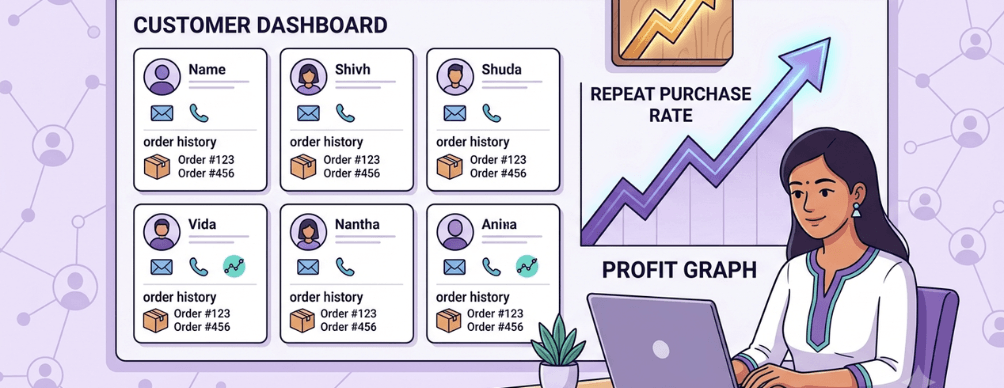
Repeat purchase rate is the clearest number to track over time, calculated simply as the percentage of customers who buy more than once within a set period. Reviewing this monthly, alongside average order value and the time gap between first and second purchases, shows whether retention efforts are moving in the right direction. Sellers running their storefront through a platform like Zyfoo’s D2C ecommerce tools often find these numbers easier to track when order history and customer communication already sit inside the same system, rather than being pieced together from separate exports each month.
It helps to give any new retention workflow at least six to eight weeks before judging its impact, since customer purchase cycles rarely move fast enough to show results within days. A workflow that looks unremarkable in its first two weeks can still be working exactly as intended, simply because most customers have not yet reached the point in their cycle where a second purchase becomes likely.
Turning a one time buyer into a repeat customer rarely comes down to a single clever email or a steep discount. It comes from noticing the small signals a CRM makes visible and responding to them consistently, which over time builds the kind of customer relationship that keeps buying without needing to be won over again from scratch. For most SMB sellers, the biggest shift is not technical, it is simply choosing to look at customer data as a source of retention opportunities rather than only a record of past sales.