
Multi-Vendor Marketplace Setup: A Practical Guide for Indian Platforms

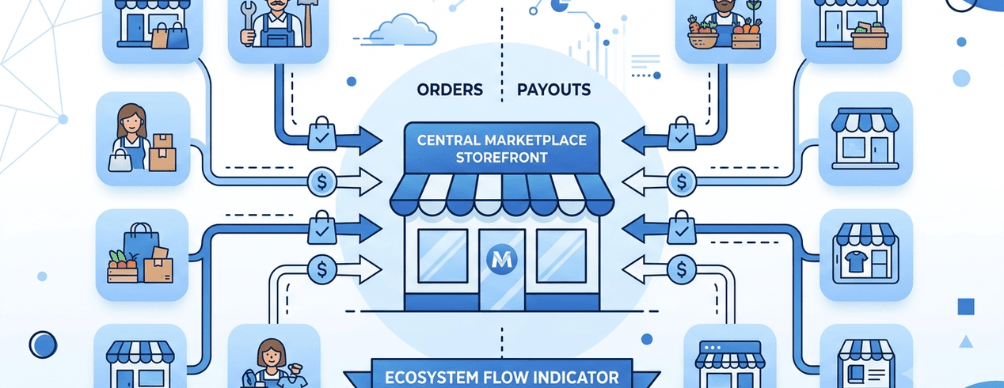
Every founder who has run a single seller online store eventually asks the same question. What would it take to let other sellers list on the same platform, and turn a store into a marketplace. The idea is appealing because it scales revenue without scaling inventory, but the execution trips up more Indian D2C teams than almost any other platform decision. This guide covers what actually needs to be in place before you onboard your first external vendor, from commission logic to order routing.
What Separates A Marketplace From A Storefront
A single vendor storefront is straightforward. One catalogue, one set of shipping rules, one bank account collecting revenue. A marketplace introduces a second party into every transaction, and that changes far more than the visible product listing page. Orders now need to be split and routed to the correct seller, commissions need to be calculated and tracked per sale, and payouts need to reach vendors on a schedule they can rely on. None of this is visible to the shopper, but all of it has to work correctly from day one, since vendor trust is difficult to rebuild once a payout goes missing or a commission is miscalculated.
Deciding Your Commission Structure Before Anything Else
Commission logic shapes almost every other decision that follows, so it needs to be settled before you touch onboarding flows or vendor dashboards. Indian marketplaces typically choose between three approaches, each with a different effect on vendor behaviour.
| Commission Model | How It Works | Best Fit |
|---|---|---|
| Flat percentage | A fixed percentage taken from every sale, regardless of category or volume | Simple marketplaces with a narrow product range |
| Category based | Different commission rates per product category | Marketplaces spanning categories with different margins |
| Tiered by volume | Lower commission rates for high performing vendors | Platforms trying to retain and reward top sellers |
A flat percentage is easiest to explain to new vendors and easiest to audit internally, which makes it a reasonable starting point even if you plan to move to a tiered model once you have enough sales data to set fair thresholds.
Vendor Onboarding That Does Not Create A Support Bottleneck
The single biggest operational risk in early stage marketplaces is underestimating how much manual support new vendors need. Every seller you onboard will have questions about catalogue formatting, payout timing, and what happens when a customer requests a return. Building a short, specific knowledge base before you onboard your tenth vendor saves far more time than answering the same five questions repeatedly over chat or email.
A clean onboarding flow typically walks a new vendor through business verification, bank account linking for payouts, product catalogue upload with your platform’s required fields, and a short review period before their listings go live. Keeping this process to a single sitting, ideally under twenty minutes, noticeably improves how many vendors actually complete onboarding rather than abandoning halfway through.
Order Splitting And Fulfilment Routing
When a single customer order contains items from two different vendors, the platform needs to split that order automatically and route each line item to the correct seller for fulfilment, while still presenting the customer with one unified checkout and one tracking experience. Getting this wrong shows up immediately as delayed shipments or vendors fulfilling the wrong items, so it is worth testing thoroughly with genuinely mixed cart orders before opening the marketplace to real customers rather than only testing single vendor purchases.
Branded order tracking matters more than most first time marketplace operators expect. Customers do not think in terms of which vendor shipped their item, they think in terms of the platform they bought from. A tracking page and notification flow that stays consistently branded to your platform, regardless of which vendor is fulfilling the order, reduces support tickets asking where an order has gone.
Setting Up Automated Payouts
Manual payouts work for a handful of vendors and break down almost immediately once you cross ten to fifteen active sellers. Reconciliation errors creep in, payout delays frustrate vendors, and the operational overhead grows faster than the revenue does.
Automated payout infrastructure, most commonly built on split payment tooling such as Stripe Connect’s marketplace payment model, handles commission deduction and vendor payout on a fixed schedule without manual calculation for every order. Setting this up correctly before your marketplace scales past a small pilot group of vendors avoids a painful mid flight migration later, when live vendor balances and pending orders make switching payout systems far riskier.
Quality Control Without Slowing Down Growth
Marketplaces live or die on catalogue quality. A single vendor listing poor product photos or inaccurate descriptions reflects on the entire platform, not just that seller. A lightweight review step before new listings go live, checking for correct categorisation, adequate product images, and complete descriptions, catches most quality issues without introducing a slow manual approval bottleneck for every single product update.
As vendor count grows, this review step is usually the first process worth automating with rule based checks, such as flagging listings missing required fields, while reserving human review for genuinely ambiguous cases like miscategorised products.
Marketing A New Marketplace To Both Sides
Early marketplace growth requires marketing on two fronts simultaneously, since a marketplace with products but no buyers is just as stalled as one with buyers but no vendor variety. Most successful Indian marketplace launches start with a tightly defined niche, recruiting a small number of strong vendors in one category first, building buyer trust and repeat purchase behaviour there, and only then expanding into adjacent categories once the operational playbook is proven.
SEO focused content, structured product data, and consistent category naming all help buyer side discovery, while transparent commission terms and fast, reliable payouts remain the strongest lever for vendor side recruitment and retention. Neither side of the marketplace grows sustainably if the other is neglected.
What A Realistic Setup Timeline Looks Like
For a founder building on an existing ecommerce foundation rather than from scratch, a working multi-vendor setup, covering vendor onboarding, commission logic, order routing, and automated payouts, typically takes two to four weeks of focused configuration and testing. The technical setup is often the faster part. Writing clear vendor policies, testing genuinely mixed cart orders, and running a small pilot group of vendors before a public launch usually takes longer than the platform configuration itself, and skipping that pilot stage is where most avoidable launch problems come from.
If you are evaluating whether to build this on your existing store or move to a platform designed around marketplace operations from the ground up, Zyfoo’s pricing page outlines what is included at each plan tier, and the D2C ecommerce overview covers how vendor management fits alongside standard storefront features.
Handling Returns And Disputes Across Vendors
Return and dispute handling is one area where marketplace operators frequently copy single vendor storefront policies without adjusting for the added complexity of multiple sellers. When a customer requests a return on an order containing items from two vendors, the platform needs clear rules on who absorbs return shipping costs, how refunds are split back through the payment system, and what happens to the vendor’s commission on a refunded item. Deciding these rules upfront, and stating them clearly in vendor agreements before onboarding, prevents a large share of the disputes that otherwise land directly in your support queue.
A consistent return window applied uniformly across all vendors, rather than allowing each seller to set their own policy, also makes customer communication far simpler. Buyers rarely read the fine print on which specific vendor fulfilled their order, so inconsistent return policies across sellers tend to generate confusion and negative reviews that reflect on the marketplace as a whole rather than the individual vendor.
Choosing Between Building In House And Using A Platform
Some founders choose to build marketplace functionality entirely in house on top of their existing storefront, while others move to a platform with vendor management, commission logic, and payout automation built in from the start. Building in house offers more control but demands ongoing engineering resources to maintain order routing, commission accuracy, and payout reliability as vendor count grows. A platform built around marketplace operations from the ground up typically gets a founder to a working, tested multi-vendor setup faster, since the core plumbing around vendor accounts and split payments does not need to be built and debugged from scratch.