AI in Inventory Forecasting: Reducing Overstock and Stockouts

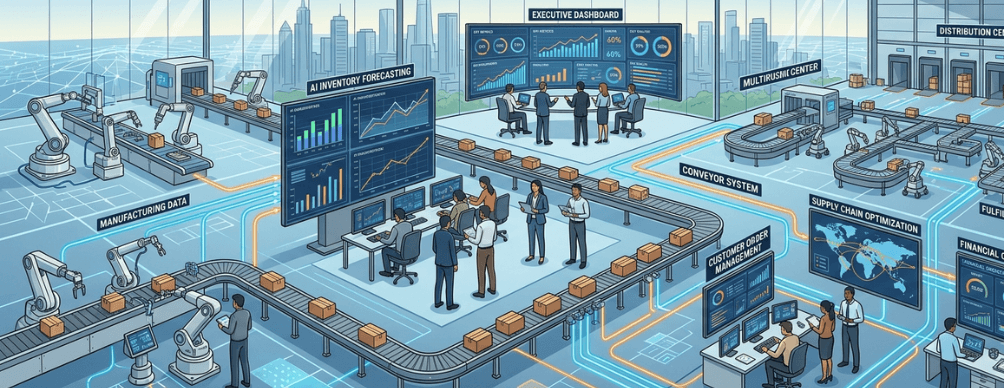
Every SMB owner running physical inventory has lived through both sides of the same problem: shelves full of stock that will not move before it goes stale, and empty shelves on the one item customers actually want that week. Traditional forecasting, built on last year’s sales averaged out with a bit of gut feeling, tends to get both of these wrong in predictable ways. AI powered demand forecasting does not eliminate uncertainty, but it narrows the gap enough to meaningfully reduce both overstock and stockouts for growing businesses.
Why Traditional Forecasting Falls Short
Manual forecasting usually relies on a simple average of past sales, sometimes adjusted for an obvious seasonal spike like a festival period. This approach misses subtler patterns: a slow build in demand ahead of a regional event, the effect of a competitor’s promotion, or a shift in buying behaviour that started only a few weeks ago and has not yet shown up clearly in a monthly sales report. By the time a manual forecast catches up to a real shift in demand, the business has usually already either overstocked or run out.
What AI Forecasting Actually Looks At
AI based demand forecasting tools analyse a wider range of signals than a simple historical average, including recent sales velocity, seasonality patterns specific to each product rather than the business as a whole, promotional history, and in more advanced setups, external factors like local events or weather patterns that correlate with demand shifts. The result is a forecast that adjusts continuously rather than one that gets recalculated once a month based on a static spreadsheet.
Reducing Overstock Without Starving Fast Movers
The instinct to avoid stockouts often pushes SMB owners toward over ordering across the board, which quietly ties up working capital in slow moving inventory. AI forecasting helps by scoring products individually rather than applying one blanket reorder rule across an entire catalogue, flagging genuinely fast moving items that need tighter reorder cycles separately from slower items that can be ordered less frequently and in smaller batches. This product level precision is where most of the real overstock reduction comes from.
Integrating Forecasting Output Into Daily Ordering Decisions
A forecast that lives in a separate dashboard nobody checks regularly delivers little practical value, regardless of its underlying accuracy. The tools that see the strongest adoption are the ones that surface reorder recommendations directly inside the existing ordering workflow, whether that means a flagged item in the purchase order screen or an automated alert sent to the person responsible for that product category, rather than requiring a separate check in dashboard as an extra daily task.
Book a Forecasting Demo
Catching Stockouts Before They Happen
On the other side of the same problem, AI forecasting tools typically flag products trending toward a stockout days or weeks in advance, based on current sales velocity against remaining stock and expected lead time from suppliers. This lead time buffer matters enormously for SMBs working with suppliers who take one to two weeks to fulfil a reorder, since a forecast that only flags a problem once stock is nearly gone leaves no realistic window to act.
The table below summarises where AI forecasting tends to add the most value over manual methods.
| Forecasting Challenge | Manual Approach | AI Forecasting Approach |
| Seasonal demand shifts | Adjusted only after the season starts | Anticipated from early sales velocity signals |
| Product level accuracy | One reorder rule across categories | Individual scoring per product |
| Stockout warning window | Often too late to reorder in time | Flagged days or weeks ahead, factoring lead time |
Seasonal Planning Deserves Special Attention
Festival periods and other seasonal sales windows are exactly where traditional forecasting breaks down most visibly, since a simple historical average smooths out the sharp, short lived demand spikes that define festive shopping behaviour. AI forecasting tools that specifically model seasonal patterns per product, rather than applying one blanket seasonal multiplier across the catalogue, tend to perform noticeably better during these high stakes windows, which is often where the cost of getting inventory wrong is highest for the whole year.
Getting Started Without a Full Data Science Team
SMB owners often assume AI forecasting requires a dedicated data team or a custom built model, but most modern ERP and inventory platforms now include forecasting features that work out of the box once connected to historical sales data. The practical starting point is making sure sales, inventory, and supplier lead time data are all captured consistently in one system, since fragmented data across spreadsheets and disconnected tools is the biggest blocker to accurate forecasting, regardless of how sophisticated the underlying model is.
Where AI Forecasting Still Needs Human Judgement
AI forecasting is genuinely strong at pattern recognition across historical and current data, but it cannot anticipate events with no prior pattern to learn from, such as a brand new product launch, a sudden supply chain disruption, or a one off marketing push that has no comparable history. For these situations, forecasts should be treated as a strong starting estimate that a human then adjusts based on context the model simply does not have access to, rather than a fully automated decision with no oversight.
Building Trust in the Forecast Before Relying on It
Teams new to AI forecasting often swing between two extremes: ignoring the forecast entirely because it feels like a black box, or trusting it blindly without spot checking its recommendations. A more sustainable approach is running the forecast alongside existing manual ordering decisions for a few cycles, comparing the two, and gradually shifting weight toward the AI recommendation as its accuracy proves out against actual sales. This building of trust matters more for adoption than the underlying model’s technical sophistication.
Measuring Whether Forecasting Is Actually Working
The clearest sign that improved forecasting is paying off is a narrowing gap between forecasted and actual demand over successive ordering cycles, tracked alongside falling rates of both stockouts and aged, slow moving inventory. Reviewing this at a category level every month, rather than only reacting when a specific stockout or overstock problem becomes visible, turns forecasting into a continuous improvement process rather than a one time tool setup.
Zyfoo’s pricing page outlines how demand forecasting fits into the broader ERP toolkit, and SMB owners weighing whether it fits their catalogue size can book a demo to see forecasting accuracy tested against their own historical sales data before committing.
For a broader industry view on adoption trends, McKinsey’s research on AI in supply chain management is a useful independent reference for benchmarking how forecasting accuracy improvements compare across company sizes.