Why Indian SMBs Are Ditching Excel for Cloud ERP in 2026


For years, the spreadsheet was the default operating system of the Indian small business. Rows for inventory. Columns for orders. A separate file for billing. Another for tracking vendors. And someone, somewhere in the office, always making sure the numbers matched across all of them.
That era is ending.
Across India, small and medium businesses are quietly replacing their Excel-heavy workflows with cloud ERP platforms. The shift is not happening because Excel is broken. It is happening because the businesses using it have outgrown what a spreadsheet can realistically handle. When you are processing fifty orders a day, a spreadsheet works fine. When that number reaches five hundred, a single formula error or an outdated file version can cost you real money.
This article digs into why cloud ERP for small business India has gone from a nice-to-have to a genuine operational necessity in 2026, what Indian SMB owners are actually gaining from the switch, and what you should look for if your business is still relying on manual tools.
The Excel Problem That Indian SMBs Know Too Well
Excel is not the enemy. It is one of the most versatile tools ever built. But it was designed for analysis, not for running business operations in real time. When Indian retailers and D2C founders use it as their core business software, they run into the same wall repeatedly.
The moment a second person needs to edit the same file, version control breaks down. The moment your product catalog crosses a few hundred SKUs, navigation becomes a manual slog. And the moment you need to connect your inventory numbers to your billing software and your order management system, you are doing that connection by hand, every single time.
Common pain points Indian SMBs describe before switching:
• Stock levels going out of sync across platforms, leading to overselling
• Billing done separately from inventory, creating reconciliation nightmares at month end
• No visibility into which products are actually profitable
• Sales data trapped in one file, purchase orders in another, vendor payments in a third
• Staff spending hours each week on data entry that adds no direct value
None of these are new problems. What changed in 2026 is that affordable, India-ready cloud ERP platforms have made the alternative genuinely accessible for businesses at every stage of growth.
Industry Insight:Small and medium enterprises now represent the fastest-growing segment for cloud ERP globally, with a 21.22% CAGR projected through 2030. The same momentum is visible in India, where digital transformation pressure and GST compliance requirements have accelerated adoption significantly.
What Cloud ERP Actually Means for a Small Business
The term ERP, which stands for Enterprise Resource Planning, carries baggage. It sounds like something only a large corporation with an IT department would use. That perception has shifted dramatically in the last three years.
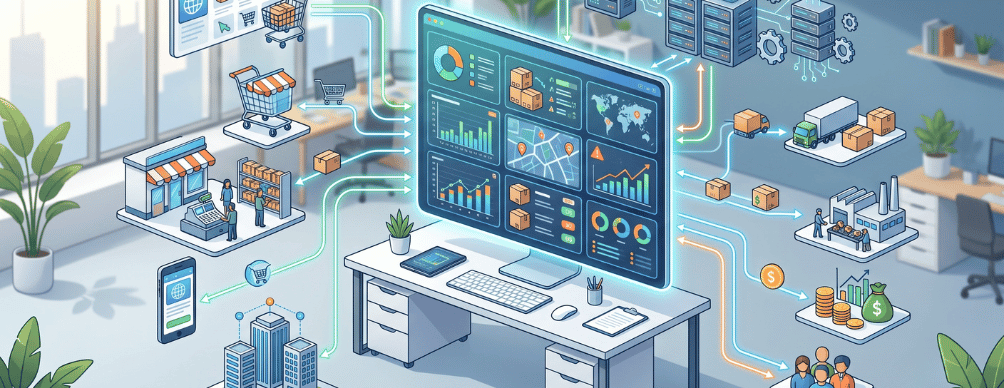
Modern cloud ERP platforms built for SMBs are subscription-based, require no on-site servers, and are designed so a non-technical business owner can manage them without outside help. The core idea is simple: instead of running your inventory in one tool, your billing in another, your CRM in a third, and your vendor management in a spreadsheet, everything lives in one connected system.
When an order comes in, it updates inventory automatically. When stock drops below a threshold, the system can alert you or trigger a purchase order. When a customer makes a repeat purchase, their history is already there. When you need a monthly revenue report, it is a click away, not a two-hour manual exercise.
| Old Way (Excel + Manual Tools) | Cloud ERP Approach |
|---|---|
| Update stock manually after each sale | Inventory syncs automatically with every order |
| Reconcile billing and sales at month end | Financials update in real time |
| Customer records spread across WhatsApp and notes | All customer data in a single CRM view |
| Vendor payments tracked in a separate sheet | Vendor and expense management built in |
| Reports built manually every week | Dashboards and reports generated on demand |
Ready to Replace Your Spreadsheets with a Platform Built for Indian Business? Start with Zyfoo
Why 2026 is the Year Indian SMBs Are Making the Move
Several forces have converged to make this the most active period of ERP adoption in India’s SMB sector.
GST Compliance Has Become Non-Negotiable
Indian businesses dealing with GST filings know the pressure of keeping purchase records, sales records, and reconciliation data consistent. A cloud ERP with GST-ready invoicing and reporting removes the manual layer from compliance. Errors that previously required hours to trace back can be flagged and resolved within minutes.
D2C Growth Is Pushing Operational Complexity
India’s direct-to-consumer market has grown rapidly, with more local brands now selling across multiple channels simultaneously, including their own website, marketplaces, and WhatsApp. Managing inventory and orders across these touchpoints without an integrated system creates constant friction. Cloud ERP resolves this by acting as the single source of truth regardless of where the sale happened.
Cloud Pricing Has Made It Accessible
The cost barrier that once kept ERP out of reach for small businesses has collapsed. SaaS-based cloud ERP platforms today charge on a subscription basis, often with no setup fees and no hardware investment required. For a business spending thousands each month on disconnected tools, consolidating into a single platform often reduces overall software costs while dramatically increasing capability.
Mobile-First Operations Are Now Standard
Indian business owners increasingly manage operations from their phones. Cloud ERP platforms with strong mobile apps let owners check stock, approve orders, track deliveries, and review sales figures from anywhere. This matches how modern Indian SMB owners actually work, not how enterprise software vendors assumed they would work a decade ago.
What Indian SMBs Gain When They Switch to Cloud ERP
The benefits of moving from spreadsheets to a cloud ERP platform are not abstract. Here is what businesses actually report changing in their day-to-day operations after making the switch.
Real-Time Inventory Visibility
Instead of checking a spreadsheet that was last updated yesterday morning, every team member sees the same live stock count. Overselling becomes rare. Stock-outs can be anticipated rather than discovered after a customer complaint.
Faster Order Processing
Orders from any channel flow into a single queue. The team processes them with a clear workflow rather than copying information between systems. Fulfillment times drop because the steps are cleaner.
Accurate Business Reporting
Revenue, margins, return rates, and vendor costs are available without manual aggregation. Business owners can look at last week’s numbers, compare them to the previous month, and make decisions based on data rather than gut feeling.
Reduced Dependence on One Person
When business operations are stored in a spreadsheet that only one person knows how to navigate, that person becomes a single point of failure. A cloud ERP with clear roles and access controls distributes that knowledge across the team and into the system itself.
Scalability Without System Changes
A business that grows from one hundred orders a month to a thousand does not need to rebuild its ERP. The platform scales with the business. Adding a new product line, a new warehouse, or a new sales channel does not require a new software purchase.
| Metric | Before Cloud ERP | After Cloud ERP |
|---|---|---|
| Inventory accuracy | Manual, often outdated | Real-time, automatic |
| Order processing speed | Slow, multiple handoffs | Streamlined, single system |
| Monthly reporting | Hours of manual work | Minutes, dashboard-driven |
| GST reconciliation | Manual, error-prone | Built-in and automated |
How Zyfoo Addresses the Specific Needs of Indian SMBs
Not every cloud ERP platform is built with the Indian market in mind. Many are designed for Western markets and adapted, which means they carry assumptions about business structures, payment methods, and compliance requirements that do not apply here.
Zyfoo Commerce Cloud is built for businesses operating in India’s market. The platform brings inventory management, order processing, CRM, vendor and expense management, sales reports, and ecommerce functionality into a single connected system. There are no separate apps to stitch together and no hidden costs for core features that should have been included from the start.
For retail businesses and D2C brands, Zyfoo’s Commerce Cloud allows you to manage your online store, track stock across locations, communicate with customers, and generate business reports from a single login. The platform integrates with WhatsApp, Zoho, Magento, and WooCommerce, so businesses that already use these tools do not have to start from scratch.
Businesses using Zyfoo have reported moving from daily manual reconciliation to automated workflows that free up hours each week. For a business owner who is also the operations manager, the customer service lead, and the head of procurement, those recovered hours matter.
Ready to Replace Your Spreadsheets with a Platform Built for Indian Business? Start with Zyfoo
Choosing the Right Cloud ERP for Your Indian SMB
The ERP market in India has grown substantially, and the options can feel overwhelming. Before evaluating specific platforms, it helps to get clear on what your business actually needs.
Questions to ask before choosing a cloud ERP:
• Does the platform handle GST invoicing and compliance natively, or through a third-party plugin?
• Can it manage inventory across multiple locations or warehouses if your business grows?
• Does it include a CRM, or do you need to pay extra for customer management features?
• What is the mobile experience like? Can your team actually use it on a phone without frustration?
• Is Indian payment gateway integration available out of the box?
• What does the onboarding process look like, and is there local support available?
A common mistake is choosing the platform with the most features rather than the platform that best fits the way your business actually operates. A D2C brand selling through its own website and WhatsApp has different needs than a wholesale distributor managing multiple vendor relationships and a large SKU catalog.
| Business Type | Priority Features to Check |
|---|---|
| D2C Brand | Ecommerce integration, CRM, WhatsApp connectivity |
| Retail Store (Online + Offline) | Multi-channel inventory, POS support, GST billing |
| Wholesale Distributor | Vendor management, bulk order processing, purchase tracking |
Common Concerns Indian SMB Owners Have Before Switching
Making the move from Excel to cloud ERP is not something most business owners do impulsively. The concerns are real and worth addressing directly.
Will My Team Be Able to Learn It?
Modern cloud ERP platforms aimed at SMBs are built for non-technical users. Most have guided onboarding, video tutorials, and customer support that goes beyond a knowledge base article. The learning curve is real but manageable, particularly if you roll out the platform department by department rather than switching everything overnight.
What Happens to My Existing Data?
Most platforms support data import from Excel and CSV files. Your existing product catalog, customer records, and historical order data can be migrated without starting from zero. The quality of migration support varies between vendors, so this is worth confirming before committing.
Is It Secure?
Cloud ERP platforms maintain security standards that most small businesses cannot replicate on their own. Data is encrypted, backed up automatically, and stored on servers with professional security monitoring. Compared to a critical business spreadsheet stored on a single laptop, the security profile of a reputable cloud ERP is significantly stronger.
What Does It Actually Cost?
Pricing varies widely. Some platforms charge per user, some per transaction volume, and others offer flat monthly plans. The key is to calculate the total cost honestly, including any add-ons required for features you need. A platform that appears cheaper on the surface but charges extra for GST compliance, CRM, or mobile access can end up costing more than a slightly higher flat rate that includes everything.
Research from NetSuite’s ERP Statistics analysis shows that organizations implementing cloud ERP report a 66% improvement in operational efficiency, driven by automated workflows and real-time data access. For Indian SMBs still managing operations manually, that kind of efficiency gain has a direct impact on margin and capacity to grow.
Signs Your Business Is Ready to Make the Move
Not every business needs a cloud ERP today. But certain signals suggest the spreadsheet era has run its course for your operation. If several of these apply to your business, the case for switching is strong.
• You spend more than two hours a week reconciling data between different files or systems
• You have experienced a stock discrepancy that cost you a customer or a sale
• Your team regularly asks each other whether a particular file is the latest version
• You cannot tell within five minutes how much revenue you made last month
• Adding a new sales channel means rebuilding your tracking system from scratch
• A key team member leaving would take critical operational knowledge with them
• You are growing but you feel like the back office is holding the front end back
Zyfoo’s platform is designed for exactly this stage of business growth. You can read more about how Zyfoo Commerce Cloud supports scaling Indian businesses and what the transition from disconnected tools to an integrated platform looks like in practice.
What the Transition Actually Looks Like
The fear around switching to a new business platform is often worse than the reality. Most businesses that plan the migration carefully find that the process is straightforward, particularly when they start with the highest-pain areas rather than trying to move everything at once.
A typical migration path for an Indian SMB:
1. Audit your current tools: List every spreadsheet, app, and manual process your business relies on.
2. Identify the biggest friction point: Usually inventory, billing, or order management.
3. Start your ERP with that module first: Get comfortable with one area before expanding.
4. Import your existing data: Product catalog, customer records, vendor list.
5. Train your team on the module you launched first: Keep it focused.
6. Expand to other modules once the core is running smoothly.
This phased approach reduces disruption, keeps the team from feeling overwhelmed, and gives you quick wins that build confidence in the new system.
Ready to Replace Your Spreadsheets with a Platform Built for Indian Business? Start with Zyfoo
The Spreadsheet Served Its Purpose
Excel helped millions of Indian businesses organize themselves at a stage when the alternatives were either too expensive or too complex. That is a genuine contribution, and there is no reason to dismiss it.
But a spreadsheet does not know when your last unit of a product sold. It cannot send an automated follow-up to a customer who has not ordered in sixty days. It cannot show you, in a single view, which products are dragging your margins down while you focus on the ones growing your revenue.
Cloud ERP for small business in India is no longer a luxury reserved for companies with IT budgets. Platforms like Zyfoo Commerce Cloud have brought genuine ERP functionality to the scale and price point where Indian SMBs actually operate. The question for most businesses today is not whether to make the move, but how soon the current setup will stop supporting the growth they are working toward.
For a deeper look at how cloud platforms are reshaping Indian retail and D2C operations, the Praxis Info Solutions analysis on cloud ERP benefits for Indian SMBs in 2026 offers useful context from an India-specific perspective.