Reducing Duplicate Customer Records: A Data Hygiene Guide for Growing Stores

Duplicate customer records creep into a growing store’s database quietly, one guest checkout here, one slightly different email spelling there, until marketing segments become unreliable and customer lifetime value calculations undercount repeat buyers who accidentally show up as multiple separate people. Fixing this properly requires both a cleanup of existing duplicates and a structural fix to stop new ones from forming.
How Duplicate Records Actually Form
Most duplicates trace back to a handful of predictable sources: guest checkout creating a new record instead of matching an existing customer, minor email variations, typos or different capitalization, that a system treats as entirely distinct, and customers using multiple email addresses across different orders without any account linking prompting them to consolidate. Understanding which of these is your primary source matters, since the fix differs depending on the root cause.
Common Sources of Duplication
| Source | How It Happens | Fix Approach |
| Guest checkout | New record created each time, no account match | Prompt account matching at checkout |
| Email variations or typos | System treats variants as different customers | Fuzzy matching during deduplication |
| Multiple emails per customer | Same person, different addresses across orders | Manual review, order pattern matching |
Running an Initial Cleanup
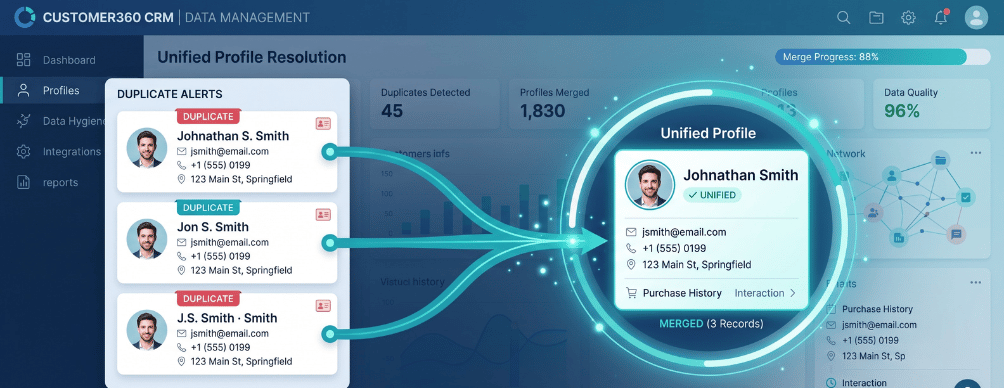
A one-time deduplication pass on existing data should start with exact-match duplicates, identical email addresses, which are the safest and most confident to merge automatically. Fuzzy matches, similar names with different emails, or the same shipping address under slightly different customer records, need human review before merging, since automated fuzzy matching carries real risk of incorrectly combining two genuinely different customers who happen to share similar details.
Preventing New Duplicates at the Source
Cleanup alone does not solve the problem long term if the same duplication sources keep generating new records. Prompting guest checkout customers to match against an existing account when their email matches a prior order, rather than silently creating a new guest record every time, closes the most common duplication source at checkout. This single change, implemented once, prevents a large share of future duplicates without requiring ongoing manual cleanup.
Merging Records Without Losing Order History
The technical risk in merging duplicate customer records is losing or orphaning order history in the process. A proper merge needs to consolidate order history, loyalty points, and any saved preferences under a single retained record, rather than simply deleting the duplicate and losing its associated data. Testing the merge process on a small batch before running it across the full customer database catches this kind of data loss risk before it affects real customer records at scale.
Clean up your customer data
A Practical Cleanup and Prevention Sequence
- Run an exact-match deduplication pass first, merging identical email address records automatically
- Review fuzzy matches manually before merging, rather than automating this riskier category
- Implement account matching at guest checkout to prevent the most common ongoing duplication source
- Schedule periodic light cleanup passes rather than treating deduplication as a one-time project
Zyfoo merchants can review duplicate customer flags directly through their commerce platform’s CRM dashboard rather than exporting customer data to a separate deduplication tool, which keeps the cleanup process tied directly to live order history throughout.