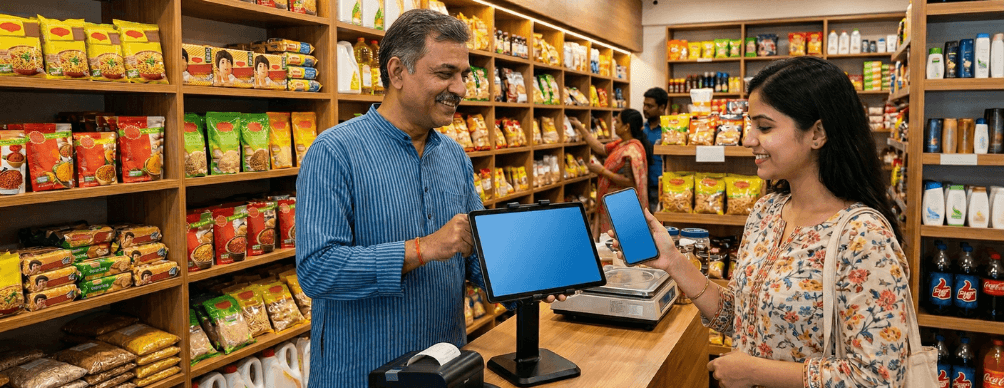
Walk into almost any neighbourhood in India and a kirana store is within 500 metres. That proximity has always been the most powerful competitive advantage in retail. For decades it was enough on its own. A familiar face, a name remembered, a product pulled from the top shelf before the customer even finished asking. These are things no corporate chain can replicate through training manuals alone. Today that proximity is necessary but no longer sufficient on its own. Quick commerce platforms now deliver in 10 minutes. Supermarket chains have expanded deep into Tier 2 cities with well-lit stores, standardised pricing, and loyalty programmes backed by data science teams. Large organised retailers have built systems that know a customer s purchase history with more precision than the kirana owner who has served their family across two generations. The technology gap that once seemed irrelevant to neighbourhood retail has quietly become a question of survival. The kirana stores that are genuinely thriving in 2026 are not the ones trying to out-stock a supermarket or undercut a quick commerce app on delivery time. They are the ones using cloud POS and connected retail technology to do what large chains genuinely cannot: serve the neighbourhood with speed, personal familiarity, and a level of contextual knowledge that no algorithm has matched yet. This article breaks down exactly how that shift is happening, what cloud POS actually does for a kirana store, and what the practical path to adoption looks like for retail SMB owners across India in 2026.
The Scale and the Pressure of the Kirana Economy in 2026
India has between 12 and 15 million kirana stores. Together they represent close to 88 percent of the country s total retail market, which is valued at roughly 900 billion dollars, according to data compiled by the Confederation of All India Traders and research from BCG and the Retailers Association of India. These are not marginal businesses tucked into a corner of the economy. They are the backbone of how India shops, stocks its kitchens, and manages its daily household needs. The challenge is structural and it is growing. Organised retail, including both physical supermarket chains and digital commerce platforms, is expanding at a pace that is reshaping buyer habits at the neighbourhood level. A survey by Kiko Live, a SaaS platform built for neighbourhood stores, found that 80 percent of kirana store owners believe they need to adopt online operations to remain competitive. The same survey found that approximately 84 percent of respondents had already begun incorporating some form of digital tool into their store operations. The direction of travel is clear. The question for a kirana owner in 2026 is not whether to digitise. It is which technology solves the right problem first, at a cost and complexity level the store can actually absorb. Cloud POS sits at the centre of that answer because it does not require the owner to overhaul how they work. It makes what they already do faster, more accurate, and more useful. The research published by Policy Circle on kirana digitisation captures this dynamic well, noting that a new tool succeeds in a kirana environment only when it visibly reduces queues, prevents stockouts, or frees up time for the owner. Utility drives adoption, not novelty. Cloud POS, when implemented correctly, delivers on all three of those outcomes from the first week of use.
What a Cloud POS Actually Does That a Traditional System Does Not
A traditional billing machine prints a receipt and records a transaction number. That is the beginning and the end of its usefulness to the business. A cloud POS does something structurally different: it converts every transaction into structured, accessible data that improves the next decision the store owner makes. When a kirana owner processes a sale through a cloud POS, several things happen simultaneously that previously required separate manual effort. The inventory count for each item sold updates automatically. The customer profile is tagged with the purchase if the customer is in the system. The transaction is recorded in a running daily report that is accessible from the owner s phone from anywhere. Payment method, time of sale, and category of product are all captured without anyone doing additional work. It is not a reporting tool the owner has to remember to use. It is an output of the billing process itself.
| What Gets Tracked | Traditional POS | Cloud POS |
|---|
| Inventory | Manual count only | Auto-updated per sale |
| Customer history | Memory or notebook | Stored and searchable |
| Daily sales data | Manual ledger entry | Real-time dashboard |
| Low-stock alerts | Discovered at stockout | Automatic threshold alert |
| Access location | In-store machine only | Any device, anywhere |
That shift from passive transaction recording to active data generation changes the competitive position of a kirana store in a way that few other single investments can. The owner stops operating on memory and instinct alone. They begin operating with the same category of information that a supermarket chain s operations manager uses every morning, without needing the operations manager.
Three Specific Ways Cloud POS Closes the Gap with Supermarkets
Large supermarkets have invested in technology for one reason: data-driven operations are faster, cheaper, and more consistent than manually managed ones. A supermarket chain knows exactly when to reorder detergent because its system tracks daily sales velocity per SKU and maps it against supplier lead time automatically. A kirana owner without digital tools finds out detergent is low when a customer asks for it and the shelf is empty. By then, the sale is already lost, and there may be two or three more days before the next supplier visit. Cloud POS closes that operational gap in three specific ways that matter most for the neighbourhood retail context.
- Inventory Accuracy Without Counting
Every sale through a cloud POS automatically reduces the stock count for each item sold. When a product crosses a configured low-stock threshold, the system sends an alert. This means the kirana owner is prompted to reorder before a stockout happens rather than after it. For fast-moving daily staples such as packaged milk, cooking oil, atta, and instant noodles, where demand is high and shelf turnover is daily, this single capability prevents a significant amount of revenue leakage that most kirana owners do not currently measure because they cannot see it. - Customer Memory at Scale
A kirana owner who serves 50 customers a day knows their regulars well. At 200 to 300 customers a day, that personal knowledge begins to degrade. At 400 or more, it is impossible to maintain accurately across the full customer base. A cloud POS builds a purchase record for every customer who provides their phone number at checkout. Over 30 days, that record shows which products each customer regularly buys, which customers have not visited in over a week, and which purchase combinations are most common. That data enables the kind of personalised outreach that supermarkets spend crores building, delivered through a WhatsApp message from a kirana owner who already has a personal relationship with the customer. - Daily Sales Clarity Without a Manual Ledger
The end-of-day reconciliation that used to take an hour of adding up receipts and notebook entries takes under five minutes when every transaction has already been recorded in the POS. Revenue by product category, cash versus UPI versus card split, average transaction value for the day, highest-selling items, the data is structured and ready. There is no arithmetic involved. The owner opens the dashboard, reads the summary, and goes home. That recovered hour, compounded across a year, is a meaningful return on its own.
The GST Compliance Advantage That Removes a Major Adoption Barrier
One of the most commonly cited reasons kirana owners have been hesitant about adopting digital billing systems is the concern around tax visibility. Many store owners worry that a digital system will surface transactions that were previously undocumented, or that managing GST invoicing through software will require accounting knowledge and time they do not have. This concern, while understandable, is based on an outdated picture of what modern cloud POS systems actually do. GST-compliant invoicing is now built into the billing process itself in well-designed platforms. When a product is added to the system with its HSN code and applicable tax rate, every transaction involving that product automatically generates a fully compliant invoice. The GSTR data that previously required a separate weekly or monthly accounting session can be exported directly from the POS dashboard with a few taps. For kirana stores that have been operating without formal billing documentation, moving to a cloud POS does not create a compliance burden. It creates compliance by default, with no additional effort required from the store owner. The invoice is generated as part of the sale. The record is kept automatically. The tax calculation is done by the software. This is, counterintuitively, a reason to move earlier rather than later, because the longer a store delays, the further it falls behind on building the formal transaction history that will become increasingly important for accessing credit, government schemes, and platform partnerships.
The Online Store Layer: Adding Digital Sales Without Replacing What Works
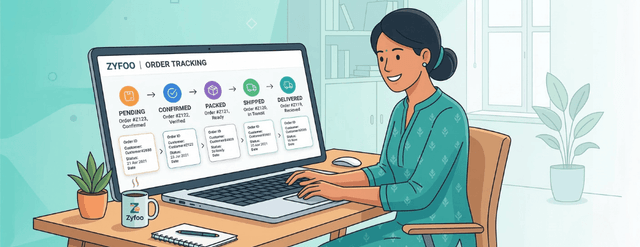
The kirana stores gaining the most competitive ground in 2026 are not stopping at in-store digitisation. They are using their cloud POS as the operational foundation and layering an online storefront on top of it, so customers who prefer to order ahead, browse from home, or place a WhatsApp order can do so without the kirana losing their business to a quick commerce app or a supermarket s delivery service. This is where the choice of platform becomes critical. If the POS system, the inventory tool, and the online storefront are three separate applications that do not talk to each other, the owner ends up with three logins, three data sets to reconcile, and three places where errors can creep in. An out-of-stock item on the physical shelf may still show as available online. An online order may not be visible to the person packing in the store. These are not hypothetical problems. They are the day-to-day operational reality of using disconnected tools, and they erode the customer experience in ways that are hard to recover from. Platforms like Zyfoo Commerce Cloud are built to solve this specifically. Rather than managing a POS, an inventory tool, and an online store through separate applications, Zyfoo connects these layers into a single platform where inventory that updates when an in-store sale happens also updates for the online store. An order placed through the online store is visible in the same operations dashboard as walk-in billing. The owner does not need to cross-check between systems or manually update stock counts across channels. It all moves together. That operational unity is what makes it feasible for a kirana owner to run both physical and online channels without needing a dedicated person to manage each one. The technology does the coordination that would otherwise require a full-time staff member.
What to Look for When Choosing a Cloud POS for a Kirana Store
Not every cloud POS is designed for the operational reality of an Indian kirana store. A system built for a restaurant or a fashion retail chain will have features that are irrelevant to grocery retail and will miss capabilities that matter enormously. The wrong platform choice causes frustration within the first week and often leads the store owner to abandon the experiment entirely, which sets back adoption by years. Here are the practical requirements that are specific to the kirana retail context and should be non-negotiable when evaluating any platform:
| Feature | Why It Matters for Kirana |
|---|
| Barcode and weighing scale integration | Most kirana items are either barcode-tagged or sold by weight |
| Multi-payment support (UPI, cash, card) | Indian customers use all three daily and expect all options at checkout |
| Low-stock alerts by SKU | Fast-moving staples run out quickly and a stockout means a lost loyal customer |
| WhatsApp invoice sharing | Customers expect a digital receipt immediately after payment |
| Offline billing mode | Internet connectivity in some areas is unreliable and billing cannot stop |
| Vernacular language interface | Many kirana owners and staff are more comfortable in their regional language |
Beyond features, the two most important qualities are ease of initial setup and the quality and accessibility of ongoing support. A kirana owner is not a technology professional and should not need to be. The system should be fully operational within a day of installation, and when a question or problem arises, help should be available in a format and language the owner can actually use, not through a ticketing system with a 48-hour SLA.
Real Shifts Already Happening Across Indian Retail
The transformation of kirana retail through technology is not a future possibility. It is already underway in cities and towns across India, and the pace is accelerating in response to competitive pressure from quick commerce and organised retail. An analysis published by Policy Circle on kirana digitisation documented that store owners who once managed sales through handwritten ledgers are now closing daily accounts using voice-enabled apps, and that WhatsApp has evolved from a personal messaging tool into a combined sourcing platform, credit management system, and customer communication channel for many stores. The research highlighted that the B2B platforms that have succeeded in this space, such as Udaan and ElasticRun, did so by building tools with local language interfaces and a utility-first approach rather than complex feature sets. Their success came from making procurement, pricing, and logistics genuinely easier, not from digitising for its own sake. Businesses that have already made the move confirm the pattern. Petkadai, which began as a neighbourhood aquarium shop and scaled into a nationally recognised online pet store, built its retention and operational systems before scaling acquisition. The discipline of fixing operations first, and then growing traffic, is exactly the sequence that works for neighbourhood retail businesses making the offline-to-online transition. For a kirana store in a busy residential colony, the most immediate and measurable impact of cloud POS is during peak billing hours. The morning rush, when 25 to 40 customers arrive in a 45-minute window before office hours, is the highest-value trading period of the day. A cloud POS with barcode scanning and UPI integration reduces the time per transaction from 90 seconds to under 30. That is not a marginal improvement. It changes the effective capacity of the store during its most revenue-critical window and directly reduces customer frustration and queue abandonment.
The Loyalty Advantage That Kiranas Already Hold and Technology Helps Deepen
Here is the competitive reality that large supermarkets and quick commerce platforms spend significant resources trying to replicate: the personal relationship between a kirana owner and their regular customers is an asset that took years to build and cannot be manufactured by any loyalty programme or delivery speed. A customer who has been buying from the same store for five years trusts the owner s product recommendations. They call ahead to check if a specific item is in stock. They extend credit on both sides. This level of relationship is the deepest competitive moat in neighbourhood retail. The opportunity for a kirana owner with cloud POS is to use technology to deepen and activate that relationship rather than to replace it. The system knows which customer always buys a particular brand of rice. When that brand comes in at a promotional price from the supplier, the owner can send a personalised WhatsApp message to the 40 customers who buy it regularly. That kind of contextual, personalised outreach is genuinely difficult for a supermarket chain to replicate at the individual customer level across thousands of stores. It requires the pre-existing relationship, and it requires the data to act on it at the right moment. The combination of personal trust and data-enabled personalisation is the competitive position that a digitised kirana can hold indefinitely. It is a position that neither a supermarket nor a quick commerce app can fully take away because it depends on something those formats are structurally unable to build: a decade of daily neighbourhood presence.
| Competitor | Their Strength | Kirana Advantage with Cloud POS |
|---|
| Supermarket | Wide range and branded trust | Personal relationship and faster local service |
| Quick commerce | 10-minute delivery speed | Credit relationships and personalised product memory |
| Online marketplaces | Pricing and variety | Trust, freshness, and community familiarity |
How to Start: The Practical Sequence for Kirana Digitisation
The most common mistake kirana owners make when considering cloud POS is framing it as a large, all-or-nothing transition that requires shutting the store for a day, training all staff, and overhauling every process simultaneously. It is not. The practical path to adoption is incremental, and the first milestone is modest enough to achieve in a single afternoon.
- Week One: Billing and Basic Inventory
Set up the cloud POS for billing only. Enter your top 50 fastest-moving SKUs with their prices, HSN codes, and opening stock counts. Process every sale through the system for one week. Do not change anything else about how the store operates. At the end of seven days, open the dashboard and look at what sold most, what is running low, and how your daily revenue varied across the week. That data alone, drawn from seven days of actual transactions, contains more actionable insight than a month of manual ledger analysis. - Week Two and Three: Full Catalogue and Customer Records
Add the rest of the product catalogue. Begin capturing customer phone numbers at checkout for regular buyers. The conversation is simple and most customers are accustomed to it from pharmacy and restaurant visits. Within three weeks, the system will begin to build a picture of who your high-value customers are, what they buy, and how frequently they visit. - Week Four Onward: Online Orders and Customer Communication
Once billing and inventory are running cleanly on the POS, add the online storefront. Set up WhatsApp integration so online orders flow directly into the operations dashboard. Configure low-stock alerts for your top 20 fastest-moving items. Begin sending periodic WhatsApp updates to customer segments about new stock arrivals, promotional pricing, or festival special bundles. The full transition from a traditional kirana to a cloud-connected retail business with both physical and online sales channels takes about 30 days when done in this sequence. There is no single disruptive moment. Each week adds a layer of capability on top of a foundation that is already working.
The Cost Reality: Why Cloud POS Is Now Within Reach for Small Retailers
Five years ago, the conversation about POS systems for kirana stores was often a conversation about affordability. Enterprise billing and inventory platforms were priced for organised retail chains, and the subscription models that existed for smaller businesses were often underpowered, requiring workarounds and manual processes that negated the benefit of having software at all. That landscape has changed considerably. Cloud-based platforms serving Indian SMBs now operate on subscription models that are within the monthly technology budget of a kirana store doing even moderate volume. The hardware requirement has also dropped significantly. Most modern cloud POS platforms run on a standard Android tablet or even a smartphone, which eliminates the need for dedicated, expensive POS hardware. A barcode scanner, a small thermal printer for receipts, and a tablet are all the physical infrastructure required. The total monthly cost for a well-configured cloud POS setup, including the software subscription, hardware amortisation, and a reliable internet connection, is now comparable to what a kirana store spends on packaging materials in a month. The return on that investment, measured in recovered revenue from prevented stockouts, time saved on daily reconciliation, and incremental online sales, makes the payback period short for most stores that implement consistently. For kirana owners evaluating platform options, it is worth understanding the difference between a standalone POS tool and an integrated commerce platform. A standalone POS handles billing well but requires separate tools for everything else. An integrated platform like Zyfoo Commerce Cloud brings billing, inventory, online store, CRM, and customer communication into a single system where data flows across all functions without manual intervention. The comparison between Zyfoo and Shopify covers the specific ways that an integrated platform built for Indian commerce differs from a general-purpose ecommerce tool, and it is worth reading before committing to any platform.
The Window That Is Open Right Now
The kirana stores that will still be growing and relevant in 2030 are, for the most part, already making their technology decisions in 2026. The stores that are waiting for the tools to become simpler, cheaper, or more proven may find that the customer habits formed during the quick commerce adoption wave and the supermarket expansion into their neighbourhoods are harder to reclaim than the technology transition they were trying to avoid. There is a specific window in any competitive landscape where the effort required to adopt new capability is lowest and the advantage of early adoption is highest. For kirana stores and neighbourhood retail SMBs across India, that window is right now. The technology is mature enough to be reliable. The cost is low enough to be accessible. The competitive pressure is real enough to make inaction costly. And the relationship capital that kiranas hold with their communities is still strong enough to be the foundation that digital tools amplify rather than replace. The kirana that adds a cloud POS this month is not becoming a different kind of business. It is becoming a better version of the business it already is: faster at billing, smarter about stock, more consistent with customers, and present on the channels where its neighbourhood increasingly shops.