How WhatsApp Commerce Is Changing the Way Indian SMBs Sell Online

Long before the term conversational commerce entered any business strategy document, Indian shopkeepers were practicing it. A regular customer walked into a store. The owner greeted them by name. They discussed what the customer needed. The owner suggested something new that just arrived. The customer bought it, and both left the interaction satisfied. The personal relationship was the product as much as the item exchanged.
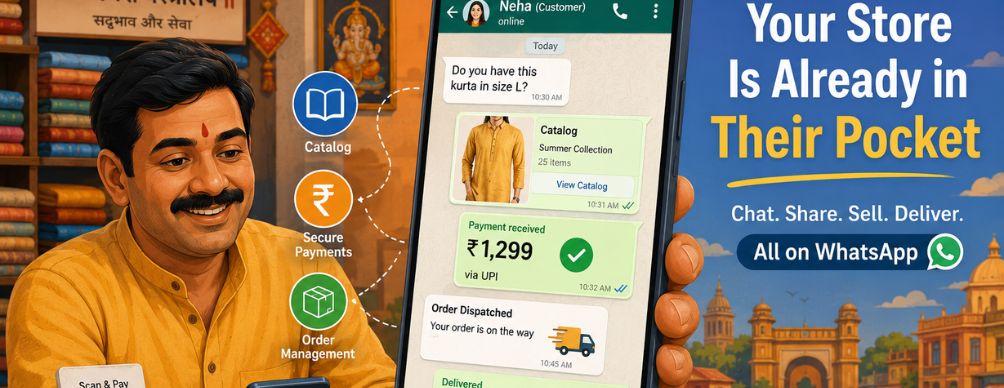
WhatsApp commerce is, in its simplest form, that relationship rebuilt for a world where the customer is no longer walking into your store. They are messaging you from their phone while sitting on their sofa, during a lunch break, or in the middle of browsing five other options. And the reason WhatsApp has become such a powerful sales channel for Indian SMBs is precisely because it replicates the intimacy of that original shopkeeper relationship at scale.
The numbers behind this shift are significant. The data is no longer speculative. WhatsApp commerce is not a trend that Indian SMBs are evaluating. It is a channel that hundreds of thousands of them are already using to receive orders, answer product questions, collect payments, and build the kind of buyer relationships that bring customers back repeatedly.
The Scale of WhatsApp in India: Why This Channel Cannot Be Ignored
| 535M+ | WhatsApp monthly active users in India in 2026, making India the world’s largest WhatsApp market by a significant margin. |
|---|
| 15M | Active WhatsApp Business accounts in India, leading all countries globally in business adoption of the platform. |
|---|
India’s position in the WhatsApp ecosystem is unlike any other market. According to data compiled from Meta and Statista, India accounts for over 535 million monthly active WhatsApp users, roughly 17 percent of the platform’s entire global base. The country leads global WhatsApp Business adoption with 15 million active business accounts, ahead of Brazil, Indonesia, and every other market.
What makes these numbers meaningful for Indian SMBs is not just the volume of users but the behavior patterns they represent. Indian WhatsApp users open the app 23 to 25 times per week on average. They are checking it multiple times every day, often before checking email, news, or any other app. Business messages sent through WhatsApp achieve open rates of 95 to 98 percent, compared to 20 to 25 percent for email. A message your customer receives on WhatsApp will almost certainly be seen. The same message sent by email may wait in an inbox for hours or be ignored entirely.
WhatsApp commerce GMV in India was projected to reach Rs. 2.5 lakh crore in 2025, according to WizMessage’s 2026 WhatsApp Business report. UPI adoption among WhatsApp users in India stands at 65 percent with a transaction success rate of 98.1 percent. The infrastructure for commerce through WhatsApp, catalog browsing, payment, confirmation, and order tracking, is not hypothetical. It is operational and being used by Indian buyers every day.
How WhatsApp Became a Full Commerce Channel for Indian SMBs
The evolution of WhatsApp from a messaging tool to a commerce channel for Indian SMBs happened organically, driven by buyer behavior rather than by platform design. It did not start with a business strategy. It started with a customer sending a message.
Phase 1: The Order Message Era
The first phase of WhatsApp commerce in India was entirely informal. A customer found a business through word of mouth or social media, saved the number, and sent a message: ‘Do you have this saree in green?’ or ‘I want to order 2 kg of almonds, can you deliver tomorrow?’ The shopkeeper responded, confirmed availability, shared their UPI ID, received payment, and dispatched the order. No website. No app. No formal system.
This pattern is still active across India’s small business ecosystem. Thousands of home bakers, cloth merchants, grocery stores, and artisans run their entire order flow through WhatsApp conversations. For many of them, it was their first experience of selling online, and it worked because it felt like a natural extension of how their customers already communicated with them.
Phase 2: The Catalog and Broadcast Era
As WhatsApp Business launched and matured, the channel gained structure. Sellers could now create product catalogs within the WhatsApp Business app, allowing buyers to browse products and share items directly within a conversation. Broadcast lists allowed sellers to message multiple customers simultaneously with new arrivals, festival offers, and back-in-stock announcements without creating a group where all buyers could see each other.
This phase brought a new level of professionalism to WhatsApp selling. A buyer could receive a catalog share, tap through to see available products with prices and descriptions, and initiate a purchase without the seller having to photograph and share each item individually in the chat. According to Meta’s business data, WhatsApp Business catalogs draw approximately 40 million views per month globally, with India representing a disproportionate share of that engagement.
Phase 3: The API and Automation Era
The current phase of WhatsApp commerce in India is defined by the WhatsApp Business API, which connects WhatsApp to ecommerce platforms, CRM systems, and order management tools. This is where the channel moves from a manually managed sales tool to an automated commerce infrastructure that scales with the business.
Through the API, order confirmations are sent automatically when a customer completes a purchase on your website. Shipping updates are pushed to the customer’s WhatsApp as their package moves through the courier network. Abandoned cart reminders, as covered in the Zyfoo abandoned cart recovery guide, reach buyers through WhatsApp with a personal message pointing them back to what they left behind. Payment confirmations, review requests, and re-engagement campaigns all flow through the same channel where the customer already communicates with friends and family.
Why WhatsApp Commerce Works Specifically for the Indian Market
WhatsApp commerce is growing in markets across Latin America, Southeast Asia, and the Middle East, but it works particularly well for Indian SMBs for reasons that are specific to the Indian commerce context.
India Is a Mobile-First, App-Familiar Market
Over 81 percent of Indian ecommerce happens on mobile devices. Indian buyers are comfortable using apps for everything from banking to grocery shopping. WhatsApp, which is already installed on virtually every Indian smartphone, offers a zero-friction entry point for commerce. The buyer does not need to download a new app, create an account on an unfamiliar platform, or learn a new interface. They are already in WhatsApp every day.
UPI Makes Instant Payment Through WhatsApp Natural
India’s Unified Payments Interface is one of the most advanced real-time payment systems in the world. Indian buyers are deeply familiar with sending money via UPI, and many prefer it over entering card details on an unfamiliar website. When a seller shares their UPI ID or a payment link within a WhatsApp conversation, the buyer can complete the payment in under 30 seconds without leaving the app. The payment confirmation then arrives back in the same chat, creating a complete transaction record within a single conversation thread.
Trust Is Built Through Conversation
A significant segment of Indian buyers, particularly in smaller cities and among older age groups, feel more confident making a purchase from a business they can message directly than from an anonymous website. According to consumer research cited by Gallabox, 67 percent of buyers report higher trust when they can reach a business through WhatsApp, and 65 percent say they are more likely to buy from a business they can message. The ability to ask a question and receive a prompt, personal response resolves the hesitation that might prevent a purchase on a website where there is no one to ask.
Group Commerce and Referrals Are Native to WhatsApp
Indian buyers share products with family members and friends in WhatsApp groups before making purchase decisions, particularly for larger purchases. A seller who shares a product catalog or a specific product link in a conversation is giving the buyer content they can easily forward to a spouse, a parent, or a friend for a second opinion. This word-of-mouth sharing within WhatsApp groups is a form of organic product distribution that is unique to the platform and genuinely valuable for Indian SMBs whose customers often buy in a community context.
Real-World Scenario: A Home Baker in Bengaluru
A home baker in Bengaluru runs her entire business through WhatsApp. She broadcasts a weekly menu to 400 contacts every Sunday evening. Customers reply with their order, she confirms availability, shares a payment link, and delivers the next day. Her repeat customer rate is above 70 percent. She has no website, no app, no delivery platform. Her average monthly revenue has grown threefold since she moved from Instagram DMs to a structured WhatsApp broadcast system. WhatsApp commerce, at its most direct, looks exactly like this.
Ready to Set Up WhatsApp Commerce for Your Store? Talk to Zyfoo
How Indian SMBs Are Using WhatsApp Commerce Across Categories
| Business Type | How They Use WhatsApp | Key Outcome |
|---|---|---|
| Home bakers and food businesses | Weekly menu broadcasts, order confirmation, UPI payment in chat | High repeat customer rate, zero platform commission |
| Fashion and ethnic wear sellers | Product catalog sharing, fabric and size queries, tailoring confirmations | Reduced return rate through pre-purchase consultation |
| Grocery and daily essentials | Standing orders, delivery slot booking, loyalty discounts via broadcast | Reduced phone call volume, faster order processing |
| Electronics and accessories | Product queries, warranty info, demo video sharing, order tracking | Higher pre-purchase confidence, fewer returns |
| Beauty and wellness brands | Routine recommendations, product launches, reorder reminders | Increased average order value through upsell in conversation |
| D2C brands | Post-purchase updates, review collection, abandoned cart recovery, loyalty campaigns | Improved NPS and repeat purchase rate |
| Retail stores with offline presence | Stock availability checks, home delivery booking, festival promotions | Extended reach beyond walk-in customers |
What the WhatsApp Business API Unlocks That the Free App Cannot
Most Indian SMBs start with the free WhatsApp Business app, which is a capable tool for managing conversations at low volume. As order volumes grow and the manual effort of managing individual conversations becomes a bottleneck, the WhatsApp Business API is what allows the channel to scale without requiring more staff hours.
| Capability | WhatsApp Business App vs API |
|---|---|
| Broadcast messages | App: limited to 256 contacts per list. API: unlimited, with opt-in compliance |
| Automation and chatbots | App: no automation. API: full automation of order confirmations, shipping updates, recovery messages |
| CRM integration | App: manual, no native CRM link. API: integrates with Zyfoo CRM for unified customer records |
| Multi-agent access | App: single user only. API: multiple team members can manage conversations simultaneously |
| Message templates | App: informal, no pre-approved templates. API: approved templates for transactional and promotional use |
| Order management link | App: manual order recording. API: orders link directly to ecommerce platform backend |
| Analytics | App: basic message stats. API: delivery, open, and response rate data per campaign |
The transition from the free WhatsApp Business app to the API is the inflection point where WhatsApp becomes a genuine commerce channel rather than a communication tool. For businesses processing more than 50 to 100 orders per month through WhatsApp, the manual management of individual conversations becomes a constraint that the API removes.
How Zyfoo Connects WhatsApp Commerce to Your Full Store Operations
The challenge with managing WhatsApp as a sales channel alongside a website store is that the two systems are usually disconnected. An order that comes through WhatsApp is logged separately from an order that comes through the website. Inventory does not update. The customer record in the CRM does not reflect the WhatsApp purchase. The GST invoice is not generated. These disconnections create manual work and data inconsistency that compound as order volumes grow.
Zyfoo Commerce Cloud connects your WhatsApp commerce channel to the same backend that handles your website store and mobile app. When a buyer completes an order through WhatsApp, that order appears in your Zyfoo order management dashboard alongside orders from every other channel. Inventory updates immediately. The customer profile in your Zyfoo CRM records the purchase. A GST-compliant invoice is generated automatically. The order status updates are sent back to the buyer through WhatsApp as the order progresses.
Product Catalog Sync Between Your Store and WhatsApp
With Zyfoo’s WhatsApp integration, your product catalog in your Zyfoo store is the same catalog that buyers see when you share it through WhatsApp. You update a product price or add a new item in your Zyfoo dashboard, and the change reflects immediately in your WhatsApp catalog. You are not maintaining two separate product lists.
Automated Order Updates via WhatsApp
Order confirmation, payment receipt, dispatch notification, and delivery confirmation are all sent automatically to the buyer’s WhatsApp as the order moves through your fulfilment workflow. Your team does not need to manually message each buyer at each stage. The notifications are triggered by the order status changes in your Zyfoo dashboard and delivered to WhatsApp without requiring separate action.
CRM Records Every WhatsApp Interaction
Every buyer who places an order through WhatsApp is added to your Zyfoo CRM with their purchase history, contact details, and order timeline recorded. This means you can run re-engagement campaigns, send personalised WhatsApp broadcasts to specific buyer segments, and identify your highest-value WhatsApp customers without piecing together data from separate systems.
Abandoned Cart Recovery Through WhatsApp
For buyers who add items to your website store or app and do not complete checkout, Zyfoo triggers an automated WhatsApp recovery message as part of the abandoned cart sequence. This is a different trigger from the product inquiry conversation that starts in WhatsApp directly, but both are managed within the same Zyfoo notification system. The recovery message reaches the buyer on the channel they are most likely to respond to, within the timeframe where the purchase intent is still active.
Ready to Set Up WhatsApp Commerce for Your Store? Talk to Zyfoo
The Performance Metrics That Make WhatsApp Commerce Worth Investing In
For Indian SMB owners evaluating whether to invest time in setting up a structured WhatsApp commerce channel, the performance data from businesses that have done it is the most relevant input.
| WhatsApp Commerce Metric | What the Data Shows |
|---|---|
| Message open rate | 95 to 98% vs 20 to 25% for email. Nearly every WhatsApp message your customer receives will be read. |
| Click-through rate | 45 to 60% on promotional messages vs 2 to 6% for email. Buyers are far more likely to act on a WhatsApp message. |
| Average response time from buyers | Users respond to WhatsApp messages within 45 to 90 seconds on average. Email responses average 6+ hours. |
| Conversion rate vs email | WhatsApp achieves 18 to 25% conversion rates, nearly three times higher than email campaigns at 6 to 7%. |
| Revenue uplift for D2C brands | D2C brands using WhatsApp broadcast, cart recovery, and upsell flows report 15 to 30% revenue uplift within 60 days. |
| Buyer trust increase | 67% of Indian buyers report higher trust in businesses they can reach via WhatsApp. |
| Repeat purchase rate | Businesses using structured WhatsApp CRM see measurable improvement in repeat purchase frequency. |
These metrics, sourced from Meta Business Reports and IAMAI’s Digital India data, are not outcomes achievable only by large D2C brands with dedicated marketing teams. They reflect what happens when any business, including a two-person operation running from a home studio or a small shop, sets up a consistent and responsive presence on WhatsApp and uses it to communicate with buyers the way those buyers actually want to communicate.
What Separates Effective WhatsApp Commerce from Spam
The biggest risk Indian SMBs face when moving to WhatsApp commerce is crossing the line from helpful to intrusive. WhatsApp is a personal channel. Buyers share it with family and close friends. A business that floods buyers with daily promotional broadcasts quickly gets blocked, and a blocked business number is a customer relationship that cannot be recovered.
Lead With Value, Not Promotion
The most effective WhatsApp communications from Indian SMBs are ones that the buyer genuinely finds useful. A new arrival that matches what they have bought before. A back-in-stock alert for a product they previously enquired about. A reminder that a festival discount they opted into is ending soon. These messages have context and relevance. A generic ‘Check out our sale!’ broadcast sent to everyone on the list has neither.
Keep Opt-In and Opt-Out Simple
Under WhatsApp Business API guidelines, businesses must collect opt-in consent before sending marketing messages. This is not a limitation. It is a filter that ensures your WhatsApp broadcast list consists only of buyers who actually want to hear from you, which makes every metric on that list better. Make opt-in easy (a simple tick during checkout or a message response), and make opt-out equally easy so buyers never feel trapped.
Use Conversational Language, Not Marketing Copy
A WhatsApp message that reads like an email newsletter will feel out of place on a channel where buyers are used to talking to people, not brands. Keep messages short. Use the buyer’s name. Reference something specific to them where you can. A message that says ‘Hi Priya, the cotton kurtas in your size are back in stock’ will outperform ‘Dear Customer, New Stock Available!’ every single time.
Respond Promptly to Inbound Messages
WhatsApp commerce does not only flow in one direction. Buyers who message your business expect a response that feels timely. For businesses handling more than 20 to 30 inbound WhatsApp messages per day, an automated chatbot that handles the initial response and routes queries to the right team member is what makes the channel sustainable. This is one of the primary reasons businesses migrate from the free WhatsApp Business app to the API as their volumes grow.
The Direction WhatsApp Commerce Is Heading in India
WhatsApp’s product roadmap for India is explicitly commerce-focused. Meta has invested in UPI integration directly within WhatsApp, allowing buyers to complete payments without leaving the conversation. In-chat payments through WhatsApp Pay are already live for a growing number of Indian users and are being expanded steadily. The platform is also rolling out AI-powered features that allow businesses to build conversational flows that guide buyers from product discovery to payment completion without any human involvement on the seller side.
For Indian SMBs, the direction of this platform investment is clear: WhatsApp is being built into a complete commerce layer, not just a communication tool. Sellers who build their commerce operations around WhatsApp today, with the right platform connecting WhatsApp to their inventory, orders, CRM, and payments, are building on infrastructure that will only become more capable and more widely adopted by Indian buyers over the coming years.
Brands like Ulamart have built their online commerce presence using Zyfoo’s integrated approach, where WhatsApp is one connected channel within a platform that also handles the website store, mobile app, inventory, and customer records. That integration, rather than managing WhatsApp as a separate channel alongside disconnected tools, is what makes WhatsApp commerce operationally sustainable as a business scales.
For a closer look at how WhatsApp commerce fits into the broader Zyfoo platform alongside the storefront comparison and inventory management, the Zyfoo vs Shopify article and the Zyfoo vs Unicommerce comparison both cover how native WhatsApp integration changes the economics of Indian ecommerce for SMBs.