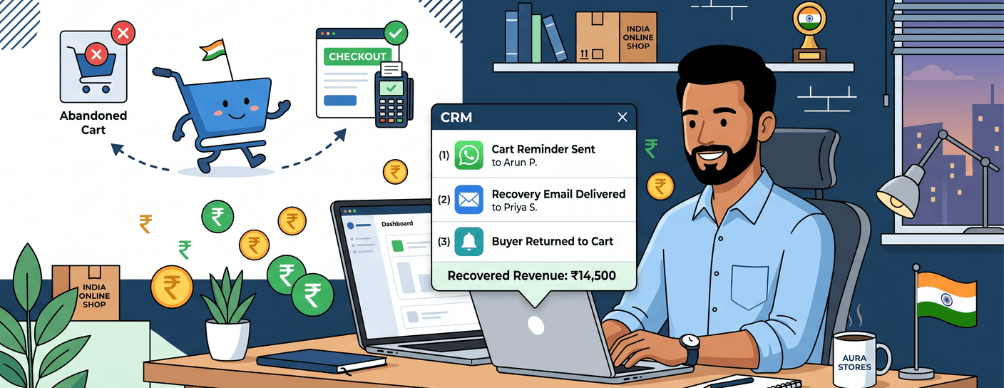
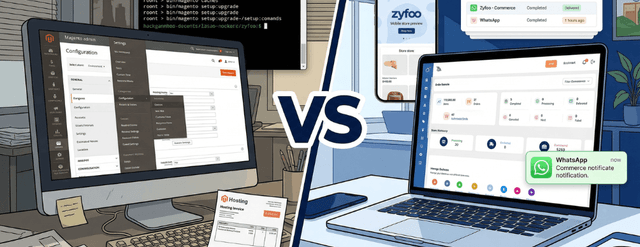
You spent time building your store, sourcing your products, and driving traffic to your listings. A buyer found what they were looking for, added it to the cart, and then left. The sale did not happen. This is cart abandonment, and if you run an online store in India, it is happening to you right now, likely at a rate higher than you expect. Cart abandonment is one of the most directly addressable revenue losses in ecommerce. Unlike low traffic or poor product-market fit, it does not require rebuilding your marketing strategy or changing your catalog. It requires a recovery system that re-engages buyers who were already interested enough to add your product to their cart. The infrastructure to do this is not complicated, and setting it up correctly can meaningfully increase your monthly revenue without increasing your ad spend. This guide covers why Indian online buyers abandon carts at the rates they do, what an effective recovery sequence looks like across WhatsApp, email, and push notifications, and how to set this up within Zyfoo s CRM and notification system so that recovery happens automatically for every abandoned cart, not just the ones you happen to notice.
The Scale of the Problem: What Indian Sellers Are Losing Every Month
The global average cart abandonment rate sits at around 70 percent, as documented by the Baymard Institute s ongoing research across 50 studies. In India, the number is compounded by the mobile-first nature of Indian ecommerce. Mobile cart abandonment rates run higher than desktop across every market, and with over 81 percent of Indian ecommerce happening on mobile devices, Indian stores face higher baseline abandonment than most markets. For a store doing Rs. 3 lakh in monthly sales, a 70 percent abandonment rate means roughly Rs. 7 lakh in revenue is being left on the table every month by buyers who got as far as the cart. Even recovering 15 to 20 percent of those abandoned carts through a recovery sequence adds Rs. 1 to Rs. 1.4 lakh per month in revenue without a single additional visitor to your store. The recovery opportunity is real. Research compiled across multiple recovery studies shows that cart abandonment recovery emails have an average open rate of 40 to 45 percent, which is significantly higher than standard promotional emails. Of those who open, around 50 percent go on to complete their purchase. SMS and WhatsApp recovery sequences, which are more relevant to the Indian context, perform even better on open rates given that Indian consumers check WhatsApp messages far more consistently than email.
Why Indian Online Buyers Abandon Their Carts
Understanding why abandonment happens is the first step to recovering it. The reasons are predictable and most of them are addressable through your recovery messaging and checkout experience.
| Reason for Cart Abandonment | How Common It Is |
| Unexpected extra costs at checkout (shipping, taxes) | The leading reason globally, cited in nearly 39% of abandonments |
| Browsing or comparing prices, not ready to buy yet | A significant portion of Indian mobile browsers add to cart as a bookmark |
| Required to create an account before checkout | Causes 24-26% of abandonments; Indian buyers prefer guest checkout |
| Payment method not available or preferred option missing | 13% abandon when their preferred method (UPI, wallet) is not shown |
| Slow page load or checkout errors on mobile | Indian 4G users on budget phones are highly sensitive to load speed |
| Distracted or interrupted during checkout | Mobile browsing on shared devices creates natural session breaks |
| Price felt too high, waiting for a discount | Price-sensitive segments deliberately abandon to wait for an offer |
For Indian sellers specifically, the WhatsApp browsing behavior creates a category of abandonment that is distinct from Western markets. Many Indian buyers discover products through WhatsApp groups, Instagram, or YouTube, tap through to a store on their phone, add the item to cart while still in another conversation, and never return to complete the purchase. They were genuinely interested. They just got interrupted. A well-timed WhatsApp recovery message reaches them where they already are.
The Three Recovery Channels Every Indian Store Should Use
Effective abandoned cart recovery in India is not a single message. It is a coordinated sequence across three channels, each playing a different role in re-engaging the buyer at the right moment.
1. WhatsApp Recovery Messages
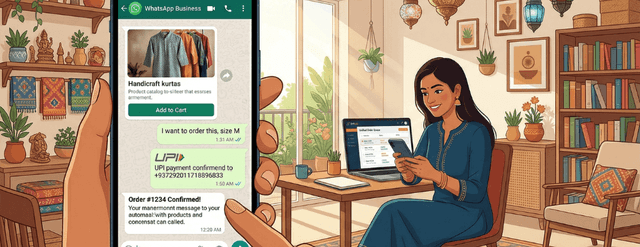
WhatsApp is the highest-engagement recovery channel for Indian ecommerce. Indian consumers open WhatsApp messages at a rate that far exceeds email, and the conversational format of WhatsApp makes a recovery message feel personal rather than promotional. A well-crafted WhatsApp recovery message sent within 30 to 60 minutes of abandonment catches the buyer while the product is still fresh in their mind. The key principles for WhatsApp cart recovery in India are brevity, personal tone, and a clear link back to the cart. Avoid lengthy promotional copy. The buyer already knows what they wanted. Your job is to remind them it is waiting and, if appropriate, give them a small reason to return.
2. Email Recovery Sequences
Email recovery works best when it is structured as a sequence rather than a single message. A three-email sequence consistently recovers more carts than a single reminder, and the timing and content of each email serve different purposes in the buyer s decision journey.
| Email | Timing | Purpose and Content |
| Email 1 | 1 hour after abandonment | Simple reminder. Show the product image, name, and price.
Direct link back to cart. No discount yet. Tone: helpful, not pushy. |
| Email 2 | 24 hours after abandonment | Add social proof. Include a product review or rating. Mention if stock is limited.
Still no mandatory discount but can add free shipping offer if margins allow. |
| Email 3 | 48 to 72 hours after abandonment | Final recovery attempt. Offer a time-limited discount or added value.
Create urgency. Clear CTA button to return to cart. |
3. Push Notifications
Push notifications through your branded mobile app reach buyers even when they are not actively browsing your store or checking WhatsApp. For Indian stores using Zyfoo s integrated mobile app, push notifications are a direct line to buyers who have installed your app. The open rate for push notifications averages around 50 percent, making them the highest open-rate channel in the recovery toolkit. Push notifications work best as the first touchpoint in the recovery sequence because they are instant and require no action from the buyer other than unlocking their phone. Keep them short: the product name, a simple message, and a tap-to-return action. The Zyfoo mobile app platform enables push notifications as part of the same CRM dashboard where you manage your recovery workflows.
How to Set Up Abandoned Cart Recovery on Your Zyfoo Store
Zyfoo s CRM and notification system handles abandoned cart recovery as an automated workflow. Once configured, the sequence runs without manual intervention for every cart abandonment your store records. The setup is a one-time process with the following steps.
| 1 | Define What Counts as an Abandoned Cart in Your Settings |
In your Zyfoo CRM dashboard, navigate to the Abandoned Cart settings and define the time window after which an incomplete checkout is treated as an abandoned cart. For most Indian stores, 30 to 45 minutes is the recommended threshold. Carts where the buyer has already checked out, even if payment is pending, should be excluded from abandonment triggers to avoid sending recovery messages to buyers who are completing their purchase.
| 2 | Connect Your WhatsApp Business Account |
In the Notifications section of your Zyfoo dashboard, connect your WhatsApp Business API account. This enables automated WhatsApp messages to be sent from your business number rather than a generic platform number. Buyers receiving a WhatsApp from your own business name are more likely to open and respond than messages from an unknown sender. Once connected, you can set the message templates for each recovery touchpoint in the sequence.
| 3 | Set Up Your Email Recovery Templates |
In the Email Campaigns section, create your three-email recovery sequence using Zyfoo s template editor. For each email, set the product image block to pull automatically from the abandoned cart data, so the buyer sees exactly what they left behind without you having to manually design each email. Set the send timing for Email 1 at one hour, Email 2 at 24 hours, and Email 3 at 48 to 72 hours. Each email should have a single, clear call-to-action button that takes the buyer directly back to their cart with the items still saved.
| 4 | Configure Push Notification Triggers for Your App |
In your Zyfoo mobile app settings, enable the abandoned cart push notification trigger. Set it to fire within 15 to 30 minutes of abandonment, making it the first touchpoint in the sequence. Keep the push notification text short: the product name, a simple prompt to return, and a tap action that opens the cart directly. Buyers who tap a push notification are already on their phone and are one tap away from completing the purchase.
| 5 | Set Discount Rules and Eligibility |
Decide whether you want to offer a discount as part of your recovery sequence, and if so, at which point in the sequence. A common structure for Indian stores is: no discount in the first two touchpoints, offer a 5 to 10 percent discount or free shipping in the third touchpoint. In Zyfoo s CRM, you can create a unique discount code that is automatically generated for each abandoned cart session, making the offer feel personal and preventing the buyer from sharing the code widely. You can also set rules to exclude buyers who abandoned carts with products already on sale.
| 6 | Enable Sequence Suppression Rules |
Suppression rules stop the recovery sequence the moment the buyer completes their purchase. Without suppression rules, a buyer who returns and checks out after the first WhatsApp message will still receive the second and third recovery messages, which creates a poor experience. In Zyfoo s CRM automation settings, enable the purchase-completion trigger to immediately halt all pending recovery messages for that cart session. Similarly, if a buyer explicitly replies to a WhatsApp message saying they are not interested, the sequence should stop.
| 7 | Test the Full Sequence Before Going Live |
Use a test account to simulate an abandoned cart and verify that all three channels fire in the correct order, at the correct intervals, with the right product details pulled into each message. Check that the cart link in the WhatsApp message and email goes to the correct cart with the items still saved. Verify that the purchase-completion suppression works by completing the purchase after the first message and confirming that the subsequent messages do not send. A 20-minute test prevents the most common issues that affect buyer experience after launch.
Messaging Best Practices for Indian Cart Recovery
Keep WhatsApp Messages Conversational, Not Transactional
The biggest mistake Indian sellers make with WhatsApp recovery is sending a message that reads like a marketing email. WhatsApp is a personal channel. A message that feels like it came from a real person at your business converts better than one that reads like a template. Use the buyer s name, mention the specific product they left behind, and keep the tone warm and helpful rather than urgent or salesy. Save urgency and discount offers for the later touchpoints when the buyer has already ignored the first reminder.
Use Product Images in Email Recovery
Recovery emails that include the product image get significantly higher click-through rates than text-only emails. When a buyer sees the exact item they were considering, the memory of wanting it is activated immediately. Zyfoo s email templates pull the product image automatically from the cart data, so every recovery email shows the buyer exactly what they left behind without requiring you to manually edit each message.
Match the Incentive to Your Margin
Not every abandoned cart recovery needs a discount. Offering a discount too early in the sequence trains buyers to abandon carts deliberately to wait for an offer. Start with a reminder and social proof. Only introduce a discount at the final recovery touchpoint, and make sure the discount is sized so the recovered sale is still profitable. A 5 to 10 percent discount on a product with a 40 percent gross margin is recoverable. A 15 percent discount on a product with a 20 percent margin is not.
Indian online buyers are most active in the evenings between 7 pm and 11 pm, and on weekends. If a cart is abandoned at 2 pm on a weekday, the most effective recovery window is the evening of the same day or the following morning. Zyfoo s scheduling settings allow you to configure smart send-time rules so recovery messages do not fire in the middle of the night and instead reach buyers during their active browsing hours.
Stop the Sequence the Moment They Buy
A buyer who returns and completes their purchase after your first recovery message should not receive the second and third messages in the sequence. Receiving a discount offer after you have already paid full price is one of the fastest ways to damage buyer trust. Suppression rules that halt the sequence on purchase completion are non-negotiable, not an optional configuration.
Setting up the sequence is the start. Measuring its performance is how you improve it over time. The metrics that matter for abandoned cart recovery are specific and should be reviewed monthly.
| Metric | What It Measures | Target Benchmark |
| Cart abandonment rate | Percentage of carts not completed | Track change over time; aim to reduce gradually |
| Recovery rate | Percentage of abandoned carts that result in a completed purchase | 10-20% is a strong outcome for Indian stores |
| WhatsApp open rate | Percentage of recovery messages opened | Above 60% is healthy for WhatsApp in India |
| Email open rate | Percentage of recovery emails opened | 40-45% for abandonment emails is the benchmark |
| Revenue recovered per month | Total value of orders recovered through the sequence | Track monthly; aim for upward trend |
| Discount usage rate | How often buyers use the discount code in Email 3 | High usage suggests buyers are reaching that stage before buying |
Your Zyfoo CRM dashboard tracks all of these metrics within the same interface where you manage your recovery workflows. You can see how many carts were abandoned in a given period, how many recovery sequences were triggered, how many resulted in a purchase, and what the total recovered revenue looks like for the month. This data helps you decide whether to adjust your timing, your messaging, or your discount strategy.
Beyond Recovery: Using Abandoned Cart Data to Improve Your Store
Cart abandonment data tells you more than just who did not complete a purchase. It tells you where your checkout experience is creating friction, which products have the highest abandonment rates (suggesting price sensitivity or unclear value), and how your Indian buyers behave across different devices and times of day.
- If a specific product has an abandonment rate significantly above your store average, review the product page for missing information, unclear sizing or specifications, or a price that is out of alignment with similar products buyers can find elsewhere.
- If abandonment spikes at the payment stage, check whether your preferred Indian payment methods are all available and prominently displayed. UPI should be the first option, not buried behind credit card fields.
- If mobile abandonment is significantly higher than desktop abandonment, audit your mobile checkout flow for load speed, form field count, and the ease of entering delivery details on a small screen.
- If your third recovery email gets a high discount usage rate, it means many buyers are reaching that stage before converting. Consider whether a smaller discount offered earlier in the sequence would recover more carts at a lower cost to your margin.
The Zyfoo CRM and analytics module surfaces these patterns in your dashboard so you can act on them without manually pulling data from separate tools. As your recovery sequence runs, the data it generates becomes one of the most useful inputs for improving both your checkout experience and your product presentation. For sellers looking at a broader view of how Zyfoo s CRM fits into a full ecommerce operation, the Zyfoo vs Shopify comparison covers how native CRM compares to the third-party apps that most Shopify sellers rely on for the same functions. And for more on how Ulamart uses Zyfoo s platform for their day-to-day operations, including customer re-engagement, visit Ulamart.