When Indian online sellers start selling across more than one channel, inventory management becomes the single biggest operational challenge. Your products are listed on your own website, a mobile app, perhaps Amazon or Flipkart, and your physical store counter. Each channel needs to reflect the correct available stock at every moment. When a sale happens on one channel, every other channel must know about it instantly. If it does not, you oversell, fulfil with stock you do not have, and start a chain of customer complaints that is expensive to unwind. Two platforms that Indian sellers commonly evaluate for multi-channel inventory are Unicommerce and Zyfoo. They are built with different assumptions about who their user is and what problem they are primarily trying to solve, and those differences matter significantly when you are making a choice for your business. Unicommerce is a well-established, enterprise-grade ecommerce enablement platform that has powered large Indian D2C brands and marketplace sellers for over a decade. Zyfoo is a full-stack cloud commerce platform built for Indian SMBs that need their storefront, inventory, CRM, and operations to work as one integrated system from day one. This comparison looks at both platforms honestly and specifically through the lens of multi-channel inventory management, so you can make a decision based on what your business actually needs rather than what either platform s marketing page emphasizes.
Unicommerce: Inventory and Order Management at Scale
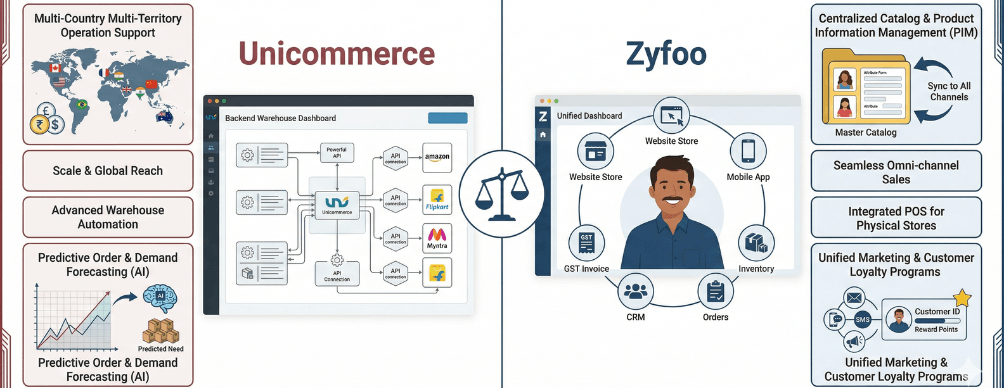
Unicommerce, trading as Uniware, is India s leading ecommerce enablement SaaS platform built primarily for order management, warehouse management, and multi-channel inventory operations. Founded in 2012 and listed on NSE and BSE, the platform powers over 7,500 clients including large Indian brands such as Mamaearth, boAt, FabIndia, Lenskart, and Myntra. It processes over one billion annual transactions across more than 10,300 warehouses. Unicommerce s strength is the depth of its inventory and warehouse operations toolset. It connects with 285 plus integrations across marketplaces, logistics providers, and ERP systems. Its core product is the Uniware order processing platform, which handles post-purchase operations: inventory sync, order routing, warehouse management, and returns. The platform is designed to be dropped into an existing ecommerce operation as the backend operations layer, not as a storefront builder.
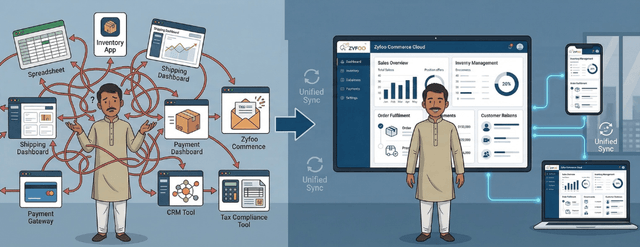
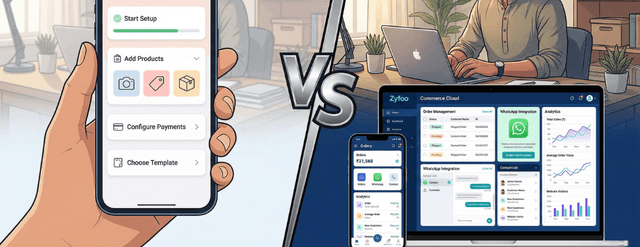
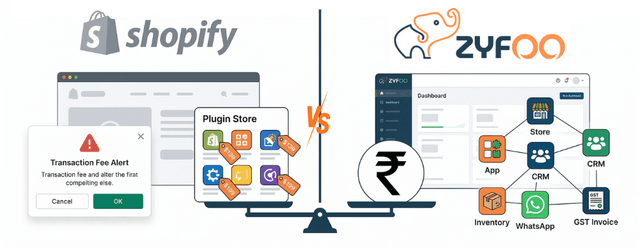
Zyfoo is a cloud-based, all-in-one commerce platform that combines the customer-facing storefront (website store and mobile app) with backend operations including inventory management, order processing, CRM, vendor management, GST invoicing, expense tracking, and sales reporting. It is designed for Indian SMBs that want to launch and manage their entire online business from one platform rather than assembling a stack of separate tools. Where Unicommerce assumes you already have a storefront on Shopify, Magento, or another platform and need a backend operations layer on top, Zyfoo Commerce Cloud is both the storefront and the backend in a single system. The inventory, orders, CRM, and reporting are native to the platform rather than integrations.
At a Glance: Zyfoo vs Unicommerce
| Factor | Unicommerce | Zyfoo |
| Platform type | Backend OMS and WMS layer | Full-stack commerce platform |
| Storefront included | No, integrates with existing stores | ✔ Zyfoo: Website store and mobile app included |
| Primary target user | D2C brands, enterprise sellers | Indian SMBs, D2C founders, retail brands |
| Multi-channel inventory sync | ✔ Uni: Yes, 285+ integrations | Yes, across web store, app, and channels |
| Marketplace integrations | ✔ Uni: Amazon, Flipkart, Myntra, 100+ | Key Indian marketplaces supported |
| GST invoicing built in | Via integrations | ✔ Zyfoo: Native, auto-generated per order |
| CRM built in | Not a core module | ✔ Zyfoo: Full CRM included |
| Mobile app for customers | Not provided | ✔ Zyfoo: Included in platform |
| WhatsApp commerce | Via Convertway add-on | ✔ Zyfoo: Native integration |
| Pricing model | Custom, quotation-based | Bundled, India-focused pricing |
| Setup complexity | Moderate to high (technical setup) | Low (guided, no-code setup) |
Multi-Channel Inventory Management: A Deep Comparison
How Unicommerce Handles Multi-Channel Inventory
Unicommerce s multi-channel inventory management is one of the most comprehensive in the Indian market. The platform syncs inventory in real time across all connected sales channels, whether those are marketplaces like Amazon, Flipkart, Meesho, and Myntra, or website platforms like Shopify and WooCommerce. According to Unicommerce s own documentation, the system prevents overselling by updating stock counts across all channels the moment a sale is recorded on any one of them. Key inventory capabilities on Unicommerce include real-time stock sync across 285 plus integrations, multi-warehouse management across more than 10,300 warehouses in India, FIFO and FEFO inventory controls for perishable or batch goods, demand forecasting tools, barcode scanning support, and inventory aging reports. The platform also supports drop-shipment, vendor-managed inventory, and complex order routing logic that assigns fulfilment to the most optimal warehouse or store location based on delivery speed and stock availability. For large brands operating across 10 or more channels simultaneously with complex warehouse networks, Unicommerce s depth in this area is hard to match. The platform was built specifically to solve this class of problem at enterprise scale.
How Zyfoo Handles Multi-Channel Inventory
Zyfoo s inventory management is built around the principle that for an Indian SMB, inventory should be a natural part of running the store, not a separate system you maintain in parallel. Every product in your Zyfoo catalog is tracked across your website store and mobile app with real-time sync as the default behavior. When a customer buys on your website, your mobile app inventory reflects the updated stock instantly. When you receive a supplier delivery and update your stock count, the change flows to every customer-facing channel immediately. Low-stock alerts are configurable per product so you are notified before an item runs out rather than discovering the issue when a customer tries to order something unavailable. Zyfoo also supports multi-location inventory management for businesses operating from more than one warehouse or store. Orders are processed through a single dashboard regardless of which channel they came from, and the inventory impact of each order is captured centrally. The key difference from Unicommerce is not the absence of inventory capability but the scope of channel integrations. Unicommerce connects to over 100 marketplaces. Zyfoo s integrations cover the key Indian channels and are sufficient for most SMBs that primarily sell through their own website, app, and WhatsApp rather than across a portfolio of major marketplaces simultaneously.
| Inventory Capability | Unicommerce | Zyfoo |
| Real-time stock sync | ✔ Uni: Yes, enterprise-grade | ✔ Zyfoo: Yes, across own channels |
| Marketplace integrations | ✔ Uni: 100+ marketplaces (Amazon, Flipkart, Myntra, Meesho etc.) | Key Indian channels |
| Multi-warehouse management | ✔ Uni: 10,300+ warehouses supported | Multi-location supported |
| Barcode scanning | ✔ Uni: Yes | ✔ Zyfoo: Yes |
| Low-stock alerts | Yes | ✔ Zyfoo: Yes, configurable per product |
| Demand forecasting | ✔ Uni: Yes (advanced) | Reporting-based visibility |
| FIFO / FEFO controls | ✔ Uni: Yes | Standard FIFO supported |
| Drop-shipment support | ✔ Uni: Yes | Vendor management module |
| Order routing logic | ✔ Uni: Advanced, multi-node | Single-dashboard fulfilment |
| Setup complexity | Moderate to high | ✔ Zyfoo: Low, guided setup |
The Storefront Question: Where the Fundamental Difference Lies
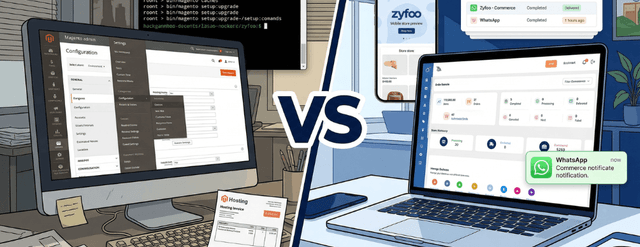
This is where the comparison takes a significant turn for Indian SMB operators. Unicommerce does not include a storefront. It is a backend operations platform. To use Unicommerce, you first need a functioning online store on a platform like Shopify, WooCommerce, Magento, or a custom-built website. Unicommerce then sits behind that storefront and manages the inventory, orders, and warehouse operations. This makes it a powerful addition for businesses that already have a tech stack, but it adds a layer of cost, complexity, and integration management for businesses that are starting out or want to simplify. Zyfoo includes the storefront. Your website store and mobile app are part of the same platform as your inventory, orders, CRM, and reports. There is no integration to maintain between your shop and your backend because they are the same system. For a business just starting online or for one that wants to consolidate from multiple tools into one, this is a meaningful structural advantage.
| Storefront Factor | Unicommerce | Zyfoo |
| Website store included | No | ✔ Zyfoo: Yes, responsive store builder |
| Mobile app for buyers | No | ✔ Zyfoo: Yes, included in platform |
| WhatsApp selling | Via Convertway (add-on product) | ✔ Zyfoo: Native integration |
| Storefront-inventory link | Integration required with 3rd party store | ✔ Zyfoo: Same system, no integration needed |
| Number of tools required | 2+ (storefront + Unicommerce) | ✔ Zyfoo: 1 (everything in one platform) |
| Monthly cost structure | Subscription for OMS on top of storefront cost | Bundled platform cost |
CRM, GST Invoicing, and WhatsApp Commerce: Built In vs Bolted On
CRM
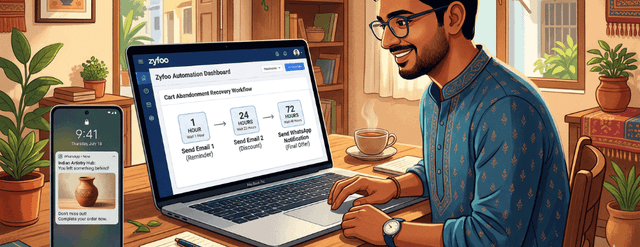
Unicommerce s core product is order and warehouse management. Customer relationship management is not a native module in the Unicommerce OMS. Sellers using Unicommerce for backend operations typically manage customer data either within the storefront platform they are using or via a separate CRM tool. Zyfoo includes a full CRM module that tracks every buyer s purchase history, contact details, and communication timeline within the same platform as the store and inventory. This means you can run customer retention campaigns, identify repeat buyers, and trigger personalized follow-ups without switching to a separate tool. For Indian SMBs where the founder or a small team is managing both operations and customer relationships, having CRM in the same dashboard as orders and inventory is a practical advantage.
GST Invoicing
Unicommerce handles GST reporting and return data but invoice generation relies on integration with an accounting or billing system. Sellers on Unicommerce typically use a separate billing tool for compliant GST invoice generation, which adds to the tool count and introduces a data sync requirement. Zyfoo generates GST-compliant invoices automatically on every order confirmation, with the correct IGST or CGST plus SGST split applied based on the buyer s state, the right HSN code pulled from the product configuration, and a sequential invoice number assigned automatically. As covered in detail in the Zyfoo GST invoicing guide, this removes the need for a separate billing tool entirely.
WhatsApp Commerce
Unicommerce offers WhatsApp commerce capabilities through Convertway, which is a separate marketing automation product within the Unicommerce group. Convertway handles WhatsApp and SMS campaigns, chatbot support, and customer engagement. This is a capable product but it is a separate subscription and setup from the Unicommerce OMS. Zyfoo s WhatsApp integration is native to the commerce platform, enabling product catalog sharing, order inquiry handling, and purchase completion through WhatsApp without requiring the buyer to navigate to a website. For Indian sellers where a significant portion of initial customer contact happens through WhatsApp, this native integration supports the way Indian commerce actually works.
| Feature | Unicommerce | Zyfoo |
| CRM | Not a core module | ✔ Zyfoo: Full CRM, native |
| GST invoicing | Via billing integration | ✔ Zyfoo: Auto-generated, native |
| WhatsApp commerce | Via Convertway (separate product) | ✔ Zyfoo: Native integration |
| Expense tracking | Not included | ✔ Zyfoo: Built in |
| Sales reports | Advanced, marketplace-level detail | ✔ Zyfoo: Live dashboard, all operations |
Pricing and Total Cost of Ownership
Unicommerce uses a custom, quotation-based pricing model. The starting price cited by independent review platforms is around Rs. 8,000 to Rs. 10,000 per month for smaller implementations, but the actual cost depends on order volume, number of channels, warehouses, and specific features required. Large enterprise implementations are priced on a custom contract basis. Unicommerce s pricing is not publicly listed, which means you need to engage their sales team to understand your total cost. For an SMB adding Unicommerce to an existing Shopify or WooCommerce setup, the total monthly spend includes the storefront platform cost, the Unicommerce subscription, any billing tool for GST invoicing, and if needed, the Convertway subscription for WhatsApp marketing. These costs accumulate quickly. Zyfoo s pricing bundles the storefront, mobile app, inventory, order management, CRM, GST invoicing, vendor management, and reporting into a single platform fee. Indian businesses pay one subscription that covers the full operational scope. You can see Zyfoo s current plans directly on the platform s pricing page, and for most SMB use cases the total cost is lower than assembling an equivalent stack with Unicommerce plus a storefront tool plus a billing tool.
| Cost Component | Unicommerce Setup (Typical SMB) |
| Storefront platform (Shopify Basic) | Rs. 1,499 to Rs. 5,599 per month |
| Unicommerce OMS subscription | Rs. 8,000+ per month (custom, varies) |
| GST billing tool | Rs. 500 to Rs. 2,000 per month |
| WhatsApp commerce (Convertway) | Additional subscription |
| CRM tool | Additional subscription or manual |
| Total estimated monthly cost | Rs. 12,000 to Rs. 20,000+ per month |
For a business whose primary sales channel is their own website and app rather than a portfolio of major marketplaces, the cost and complexity of the Unicommerce stack may not be justified by the operational gains it provides over a simpler integrated platform.
Who Should Choose Unicommerce and Who Should Choose Zyfoo
Unicommerce is the right choice if you:
- Are already selling on 5 or more major Indian marketplaces simultaneously (Amazon, Flipkart, Myntra, Meesho, Nykaa) and need real-time inventory sync across all of them
- Operate multiple warehouses or fulfilment centres and need advanced warehouse management including order routing, FIFO controls, and pick-pack-ship workflow automation
- Already have a functioning storefront on Shopify or another platform and are looking specifically for a backend operations layer on top
- Are a D2C brand at a growth stage where marketplace compliance SLAs, demand forecasting, and inventory aging analysis are operationally critical
- Have a dedicated operations or tech team that can manage the integration setup and ongoing maintenance of a multi-tool stack
Zyfoo is the right choice if you:
- Are an Indian SMB or D2C brand that needs a storefront, inventory management, order processing, CRM, and GST invoicing in one platform without maintaining multiple subscriptions
- Want to launch an online store and be operationally functional within a day, without requiring a developer or a technical team
- Primarily sell through your own website and mobile app, with WhatsApp as an additional sales channel
- Want to avoid the hidden cost of stacking multiple tools for functions that Zyfoo includes natively
- Are moving from spreadsheets or a disconnected set of tools and want a clean, consolidated starting point for your digital operations
- Are a retail business with an offline store that wants to add online channels without managing a complex integration project
Making the Right Call for Your Business Stage
The Unicommerce vs Zyfoo decision is ultimately a question of business stage and operational complexity. Unicommerce solves a specific and important problem extremely well: managing inventory and orders across a high-volume, multi-marketplace operation. For brands at that scale, its integration breadth, warehouse management depth, and enterprise reliability justify the investment and the operational overhead of maintaining it alongside a storefront. For the vast majority of Indian SMBs and growing D2C brands that are either just starting their online journey or looking to consolidate fragmented operations, the more relevant question is: how quickly can you get to a fully functional, compliant, and scalable online operation without a large technology budget or a dedicated tech team? That is the problem Zyfoo is designed to solve. You can also explore other platform comparisons that cover different dimensions of the Indian commerce tool landscape, including Zyfoo vs Shopify for storefront decisions.