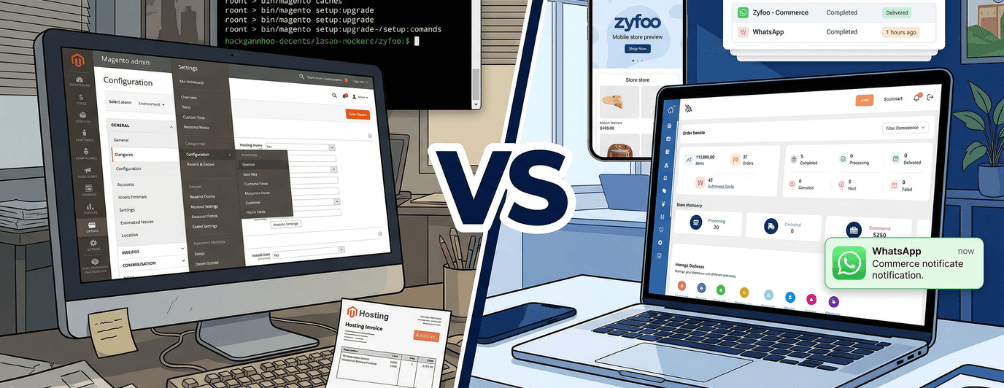
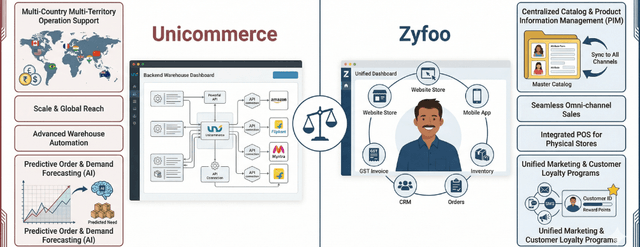
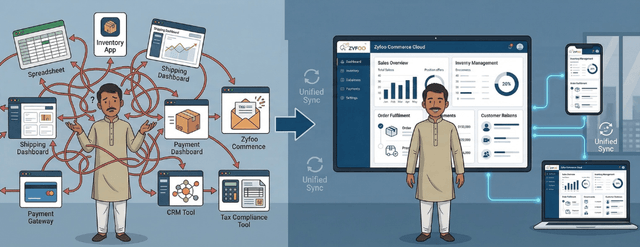
There is a specific moment in the growth of an Indian eCommerce business when the platform decision becomes genuinely difficult. You have outgrown the simplest storefront tools. Your order volume, product catalogue complexity, and multi-channel requirements have moved beyond what entry-level platforms handle well. But you are not yet at a scale where a full enterprise implementation with dedicated developers, six-month timelines, and multi-lakh licensing fees is justified or accessible. This is the moment when many mid-market Indian merchants look at Magento. The platform s reputation for enterprise-grade capability, its open-source availability, and the large developer ecosystem around it make it an appealing option on paper. Some businesses commit to a Magento implementation and build a powerful store. Many more discover that the gap between Magento s capability on paper and the practical reality of implementing and maintaining it without an enterprise IT budget is wider than anticipated. Zyfoo is built for the merchant who wants enterprise-level capabilities, specifically deep inventory control, multi-channel commerce, order management automation, vendor management, CRM, and detailed reporting, without the infrastructure overhead that Magento requires to deliver those capabilities. This comparison examines both platforms honestly across the dimensions that matter most for Indian mid-market merchants considering their options in 2026. For the full picture of what Zyfoo includes, zyfoo.tech covers the complete platform.
Magento: An Open-Source Enterprise Commerce Framework
Magento, now operating as Adobe Commerce in its commercial form with Magento Open Source as the free alternative, is one of the most feature-complete eCommerce platforms ever built. It was designed for large catalogues, complex B2B and B2C configurations, multi-store architectures, and the kind of custom business logic that major retailers and manufacturers require. The platform is genuinely capable of handling almost any eCommerce scenario you can describe. That capability comes with a corresponding complexity. Magento is not a product you deploy and configure through a browser interface. It is a PHP-based framework that requires server provisioning, command-line installation, theme development, extension management, and ongoing technical maintenance. The standard recommendation from Magento s own ecosystem is that a certified Magento developer is needed both for initial setup and for ongoing platform management. Without that expertise, a Magento store degrades over time as updates are skipped, extensions conflict, and performance issues accumulate.
Zyfoo is a cloud-hosted SaaS platform that covers the full commerce lifecycle for Indian businesses: storefront, mobile app, WhatsApp commerce, order management, inventory, vendor management, accounts with GST, CRM, and analytics. The platform was built specifically for Indian market conditions, which means UPI, Razorpay, and COD are native, Indian courier integrations are built in, GST invoicing is automatic, and vernacular language support is part of the architecture. Zyfoo s Commerce Cloud is managed infrastructure, meaning hosting, security, updates, and performance are the platform s responsibility, not the merchant s. The comparison between Zyfoo and Magento is not a comparison between a simple tool and a complex one. It is a comparison between two different architectural philosophies: open-source framework requiring assembly and maintenance versus managed SaaS requiring configuration and usage. Both can deliver enterprise-grade outcomes. The question is which path is appropriate for your business s technical capacity, budget, and timeline.
Side-by-Side Comparison
| Capability | Zyfoo | Magento Open Source |
| Setup and go-live time | 3 to 7 days | 8 to 24 weeks with developer |
| Hosting requirement | Included and managed | Separate, self-managed server |
| Technical expertise required | None, fully no-code | PHP developer mandatory |
| Indian payment gateways (UPI, COD, Razorpay) | Native, no extension needed | Extension required, manual config |
| WhatsApp commerce | Native integration | Third-party extension or custom dev |
| Branded mobile app | Included | Separate PWA or app development |
| Indian courier integrations | Native (Delhivery, Shiprocket, etc.) | Extension or custom API |
| GST invoicing automation | Built in | Extension required |
| Multi-channel order management | Unified dashboard | Requires configuration and extensions |
| Vendor and purchase management | Built in | Extension or custom module |
| CRM module | Built in | Extension or third-party CRM |
| Platform updates and security | Automatic, managed by Zyfoo | Manual, owner s responsibility |
| Monthly total cost of ownership | Predictable flat subscription | Hosting + extensions + developer fees |
| Support model | Dedicated platform support | Community forums, paid developer |
The Total Cost of Ownership: Where Magento s Price Tag Actually Sits
The phrase Magento Open Source is technically accurate: the core software can be downloaded at no cost. The practical cost of running a production-ready Magento store for an Indian mid-market merchant is a different figure entirely, and it is one that surprises many businesses who begin a Magento implementation without a full picture of the cost stack.
The Magento Cost Components
A Magento store suitable for a mid-market Indian eCommerce business with a catalogue of 500 or more SKUs, multi-channel requirements, and a target of 1,000 or more orders per month requires the following investments beyond the zero-cost core software.
- Managed cloud hosting: A server configuration capable of handling Magento s resource requirements without performance degradation under traffic loads. Magento is memory and CPU-intensive by architecture. A suitable managed hosting plan on platforms like AWS, DigitalOcean, or Cloudways starts at Rs 8,000 to Rs 25,000 per month depending on the resource configuration, scaling further during peak periods.
- Magento developer for implementation: Initial store setup, theme development, extension configuration, and payment gateway integration require a certified Magento developer. An experienced Magento developer in India charges Rs 600 to Rs 1,500 per hour. A complete implementation for a mid-market store typically requires 200 to 400 developer hours, placing the initial setup cost between Rs 1.2 lakhs and Rs 6 lakhs.
- Ongoing developer retainer: Magento stores require ongoing developer involvement for extension updates, compatibility fixes after core updates, performance optimisation, and any new feature development. A monthly retainer of Rs 15,000 to Rs 50,000 is typical for a production Magento store.
- Paid extensions: Core Magento functionality gaps for the Indian market, including UPI payment gateways, Indian courier integrations, GST invoicing, WhatsApp notifications, and advanced analytics, are addressed through extensions that carry individual licensing fees. A typical Indian mid-market Magento store requires 8 to 15 paid extensions, with annual costs ranging from Rs 500 to Rs 8,000 per extension.
- Security and compliance: SSL certificates, PCI DSS compliance measures, malware scanning tools, and regular security audits add Rs 15,000 to Rs 40,000 annually to the cost structure.
Aggregating these components, a mid-market Indian Magento store carries an annual total cost of ownership between Rs 4.5 lakhs and Rs 15 lakhs, exclusive of the initial setup investment. That range is wide because the actual cost depends heavily on the complexity of the implementation and the extent of developer involvement required. At the lower end, it assumes a lean, largely self-managed store with minimal customisation. At the upper end, it reflects a store with active development, regular feature additions, and a reliable developer relationship. Zyfoo s subscription model covers all of the above capabilities in a single flat fee. For current plan pricing, visit zyfoo.tech. The total cost comparison over a 24-month period consistently favours Zyfoo for Indian mid-market merchants who do not have an in-house Magento development team.
India-Specific Capabilities: The Gap That Extensions Cannot Fully Close
Magento s global architecture was designed for Western eCommerce markets. Its default payment options, logistics architecture, tax calculation model, and communication channels reflect that origin. Adapting Magento to the Indian commerce context requires a series of extension installations and configurations that each carry their own setup complexity and ongoing maintenance requirements.
Payment Gateway Integration
Indian eCommerce runs on UPI, COD, Razorpay, PayU, and BNPL options that are not native to Magento s payment framework. Integrating these requires installing the respective payment gateway s Magento extension, configuring API credentials, setting up webhooks for payment confirmation, and testing the checkout flow end-to-end. Each gateway extension is maintained by a third party, meaning updates, compatibility issues, and configuration changes are managed separately by the merchant or developer. Zyfoo integrates UPI, Razorpay, PayU, COD, and BNPL natively with zero extension configuration. A change in Razorpay s API is handled by Zyfoo at the platform level, not by the merchant or their developer.
GST Invoicing and Compliance
Magento s tax calculation engine is flexible but not pre-configured for Indian GST. Implementing GST-compliant invoicing on Magento requires either a paid GST extension or custom development covering HSN code assignment per product, GSTIN-based invoice formatting, credit note generation for returns, and the specific invoice numbering sequences required under Indian tax law. Maintaining GST compliance through Magento as tax regulations change requires developer involvement each time a rule change affects the invoice format or filing requirement. Zyfoo generates GST-compliant invoices automatically on every order with no extension or custom development. HSN codes are assigned at the product level and flow through to invoices and filing reports without any additional configuration.
WhatsApp Commerce and Indian Courier Network
WhatsApp as a structured commerce channel and India s multi-courier logistics network are two capabilities that Magento cannot provide out of the box. A WhatsApp commerce integration on Magento requires selecting a WhatsApp Business Solution Provider, building or purchasing a catalog sync integration, connecting the ordering flow to Magento s API, and maintaining the integration as both Magento and the WhatsApp API evolve. Indian courier integrations follow a similar pattern: each courier requires a separate extension or API integration, and the fragmented nature of the courier market means this is an ongoing maintenance task rather than a one-time setup. Zyfoo s platform provides both capabilities natively without any of this integration overhead.
Magento is a technically capable platform for high-scale operations. Adobe Commerce, the commercial version, powers some of the world s largest retail sites. That raw scalability is genuine. The relevant question for a mid-market Indian merchant is not whether Magento can scale, but whether the infrastructure investment required to make Magento perform well is proportionate to the business s current and near-term scale.
Magento s performance on shared or underpowered hosting is poor. The platform generates significant server-side load for catalogue browsing, checkout processing, and admin operations. A Magento store that performs adequately during normal traffic can degrade significantly during a promotional event or a social media-driven traffic spike if the underlying hosting infrastructure is not sized appropriately. Right-sizing the hosting requires both technical expertise and a willingness to pay for reserved capacity that may be underutilised most of the time. Additionally, Magento s default page generation is not optimised for mobile performance out of the box. Full-page caching, Varnish configuration, image optimisation, and JavaScript bundling are all performance improvements that require developer configuration. A Magento store without these optimisations will consistently score poorly on Google s Core Web Vitals for mobile, which directly affects search ranking for a business whose primary traffic source is mobile Indian shoppers.
Zyfoo s Infrastructure Model
Zyfoo s cloud infrastructure scales automatically with demand. There is no hosting tier to upgrade before a sale event and no performance degradation risk during traffic spikes. The platform is built for mobile-first performance from the architecture level, meaning Core Web Vitals benchmarks are addressed at the platform layer rather than requiring merchant-level configuration. For an Indian mid-market business whose customers are primarily mobile shoppers, this is a meaningful operational difference that affects both conversion rate and organic search visibility.
Enterprise Feature Depth: What Zyfoo Delivers Without the Development Cost
The argument for Magento among mid-market Indian businesses typically centres on feature depth and customisation flexibility. These are genuine strengths. The counterargument is that for the majority of mid-market Indian eCommerce requirements, the feature depth available in Zyfoo s Commerce Cloud, built specifically for Indian commerce conditions, is sufficient and often exceeds what a Magento implementation delivers in practice for a business without a large development budget.
Order Management and Fulfilment
Zyfoo s order management handles multi-channel order ingestion, automated courier assignment based on pin code and weight, AWB generation, customer notification at every status change, and return management with reverse logistics. All of this operates from a unified dashboard without extensions. A Magento implementation delivering the same capability requires the Order Management System extension or Adobe Commerce s OMS module, courier-specific extensions, and custom notification logic.
Inventory Management
Zyfoo s inventory module provides real-time multi-channel inventory sync, multi-location stock tracking, batch and lot management, automated reorder alerts, and vendor purchase order integration. Magento s native inventory management, introduced in version 2.3 as Multi-Source Inventory, provides strong catalogue and multi-warehouse support but requires additional configuration and extension support for the purchase order and vendor management workflows that Zyfoo includes natively.
Analytics and Reporting
Zyfoo s reporting dashboard provides channel-level sales performance, product profitability net of fulfilment cost, vendor performance metrics, customer lifetime value by cohort, and expense tracking in one unified view. Magento s native reporting covers basic order and sales summaries. Advanced reporting equivalent to Zyfoo s built-in dashboard requires either the Adobe Commerce Business Intelligence module, which carries a significant additional licensing cost, or a third-party analytics integration. For Indian mid-market merchants who want the reporting depth to make informed decisions without a BI team, Zyfoo s analytics capability is directly accessible from the standard subscription.
Making the Right Choice for Your Business
Magento Is the Right Choice If
- You have an in-house development team with Magento expertise or a dedicated agency relationship with a certified Magento partner.
- Your business logic is genuinely complex in ways that require custom module development: configurable products with thousands of variant combinations, complex B2B pricing rules, multi-brand multi-store architecture from a single admin.
- You are already on Magento with substantial customisation investment and established SEO rankings that make migration cost-prohibitive.
- Your organisation has an IT budget that supports the ongoing development, hosting, and maintenance requirements of a production Magento environment.
Zyfoo Is the Right Choice If
- You want enterprise-level inventory, order management, vendor management, CRM, and analytics without a developer dependency or a lengthy implementation project.
- Your business needs Indian-native capabilities: UPI, COD, Razorpay, WhatsApp commerce, Indian courier integrations, and GST invoicing that work out of the box.
- You are processing 500 to 10,000 orders per month and want a platform that scales with you without infrastructure projects at each growth milestone.
- You want a branded mobile app, WhatsApp commerce, and multi-channel order management included in one subscription without separate development investments.
- Your team does not include a Magento developer and you do not want to build a dependency on one for the ongoing operation of your store.
- You want predictable platform costs rather than a variable bill from hosting, extensions, and developer hours.
Two-Year Cost Comparison for an Indian Mid-Market Store
| Cost Component | Magento Open Source | Zyfoo Commerce Cloud |
| Initial setup and developer fees | Rs 1.2L to Rs 6L (one-time) | Included in subscription |
| Monthly hosting | Rs 8,000 to Rs 25,000 | Included in subscription |
| Monthly developer retainer | Rs 15,000 to Rs 50,000 | Not required |
| Paid extensions (annual) | Rs 20,000 to Rs 80,000 | Not required |
| Security and compliance (annual) | Rs 15,000 to Rs 40,000 | Included in subscription |
| Year 1 total (excl. setup) | Rs 6.96L to Rs 18L | Flat subscription rate |
| Year 2 total | Rs 6.96L to Rs 18L | Flat subscription rate |
Migrating from Magento to Zyfoo: What the Process Looks Like
For merchants who are currently on Magento and evaluating a move to Zyfoo, the migration concern is understandable. A live Magento store with an established product catalogue, customer base, and search engine presence carries real migration risk if the process is not managed carefully. The risk is manageable with a structured approach.
What Migrates Directly
- Product catalogue including all SKUs, descriptions, images, variant configurations, pricing, and stock quantities.
- Customer accounts and order history imported for records, analytics baseline, and CRM data.
- Product categories and navigation structure recreated in Zyfoo s storefront configuration.
- Static content pages including About, Contact, Policy, and any supporting content pages.
What Requires Careful Planning
- URL structure and SEO: Magento and Zyfoo use different URL patterns for product and category pages. A comprehensive 301 redirect map from old Magento URLs to new Zyfoo URLs must be implemented before the old site is taken down to preserve search rankings.
- Custom functionality: Any custom Magento modules built for specific business logic need to be evaluated against Zyfoo s native capabilities. In most cases, Zyfoo s built-in features cover the requirement without custom code.
- Extension-dependent workflows: Workflows that depend on specific Magento extensions, such as subscription billing, complex configurable product pricing, or custom checkout steps, need a Zyfoo-native equivalent identified before migration.
Zyfoo s onboarding team provides a structured migration assessment and supports the data transfer process for merchants moving from Magento. The typical migration timeline for a catalogue of up to 2,000 SKUs is 7 to 14 business days with a parallel-run period to validate the new store before the old site is decommissioned. Speak to the Zyfoo team to start a migration assessment.
Verdict by Category
| Category | Verdict |
| Ease of setup and go-live | Zyfoo: live in days, not months |
| Total cost of ownership for Indian SMBs | Zyfoo: predictable subscription vs variable Magento stack |
| India-native payment and logistics | Zyfoo: built in vs extension-dependent on Magento |
| WhatsApp commerce | Zyfoo: native vs custom development on Magento |
| GST invoicing automation | Zyfoo: automatic vs extension-required on Magento |
| Deep custom business logic | Magento: unmatched flexibility for complex custom requirements |
| Large catalogue B2B multi-store | Magento: purpose-built for enterprise complexity |
| Technical maintenance burden | Zyfoo: zero vs significant on Magento |
| Branded mobile app included | Zyfoo: included vs separate project on Magento |
| Reporting and analytics depth | Zyfoo: built-in vs paid module or third-party on Magento |
The Enterprise Features You Need Are Already Available
The distinction that matters for Indian mid-market merchants in 2026 is not whether Magento is technically capable of delivering enterprise-grade eCommerce. It clearly is. The distinction is whether the path to those capabilities through Magento is proportionate to your budget, your technical resources, and your timeline relative to an alternative that delivers the same functional outcomes without the assembly and maintenance overhead. For the majority of Indian businesses processing 500 to 10,000 orders per month, the enterprise features they actually need are real-time inventory across channels, automated order management and fulfilment, native Indian payment and logistics integrations, WhatsApp commerce, structured vendor management, GST-compliant accounting, and analytics depth that informs daily decisions. None of these require a custom Magento implementation. All of them are available in Zyfoo s Commerce Cloud as part of a standard subscription. The Magento path makes sense for a narrow set of businesses: those with genuine custom complexity, established development teams, and a use case that genuinely pushes beyond what a managed SaaS platform can configure. For everyone else, the more honest question is why you would take on the overhead of an enterprise framework when the enterprise capabilities you need are available without it. Explore the full Zyfoo platform at zyfoo.tech and see what mid-market Indian commerce looks like when the infrastructure takes care of itself. For independent analysis of the Indian eCommerce platform landscape, Inc42 s annual Indian SaaS and eCommerce reports provide market context and platform positioning data that supports an informed platform decision.