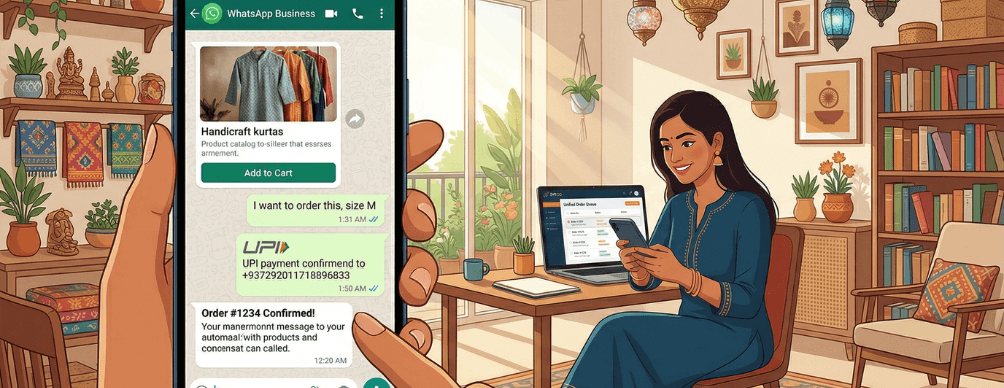
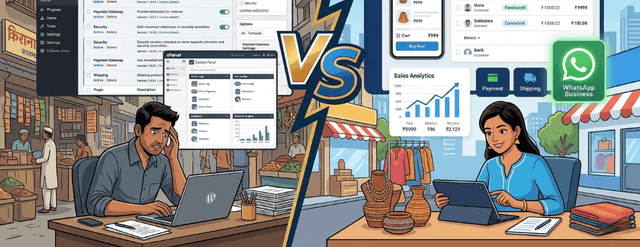
Walk into any Indian D2C founder s phone and you will almost certainly find a WhatsApp conversation thread where a customer asked about a product, got a response, placed an informal order, and paid via UPI. This happens millions of times every day across Indian eCommerce, in fashion, food, beauty, home goods, jewellery, and nearly every other consumer category. WhatsApp commerce is not a new idea in India. It is already happening, informally and at scale. The problem with informal WhatsApp selling is not the channel itself. WhatsApp is genuinely one of the highest-performing sales surfaces available to any Indian brand. The problem is the absence of structure. Orders confirmed in chat threads with no formal record. Inventory not updated after a WhatsApp sale. Customers waiting hours for a status update because nobody checked the thread. Returns handled through repeated back-and-forth messages with no defined process. Payments received in a personal UPI account rather than a business payment system. This informal version of WhatsApp commerce leaks revenue, erodes customer trust, and creates operational chaos at scale. This guide is about building the structured version: a WhatsApp commerce setup where customers can browse a catalogue, place a confirmed order, pay through a verified link, and receive automated status updates without a single manual message from your team. Every order flows into Zyfoo s unified order management dashboard alongside website and app orders, with inventory updated, courier assigned, and customer notified automatically. This is WhatsApp commerce done right, and in 2026 it is one of the highest-ROI sales channels available to any Indian brand at any scale.
Why WhatsApp Is the Most Underutilised Commerce Channel in India
India has over 500 million active WhatsApp users. It is the primary digital communication interface for a significant share of Indian consumers across every demographic, income level, and geographic tier. Unlike a website or a marketplace, WhatsApp is not a platform where the customer goes to shop. It is a platform where the customer already spends hours every day, which means the distribution problem that every eCommerce brand faces, getting the customer to show up at your store, is already solved. The behavioural data on WhatsApp commerce in India is consistent across studies: WhatsApp messages from opted-in brands achieve open rates of 80 to 90 percent compared to 20 to 25 percent for email. Orders placed through WhatsApp commerce flows have conversion rates of 8 to 15 percent compared to 2 to 4 percent for website visitors. Repeat purchase rates from WhatsApp-acquired customers are 40 to 60 percent higher than from anonymous web traffic, because the relationship is personal and the communication channel is direct. These numbers reflect the fundamental difference between WhatsApp commerce and all other eCommerce channels. WhatsApp is a relationship channel. Every customer who has opted in to receive messages from your brand has actively chosen that relationship. They are warm to your brand before your message arrives. The commercial outcomes that flow from that warmth, higher open rates, higher conversion, higher repeat purchase, are not coincidental. They are the direct result of the channel s relational nature.
The WhatsApp Commerce Opportunity by Segment
WhatsApp commerce is not uniformly relevant across all customer segments. Understanding where it performs best helps brands prioritise where to invest in building the capability.
- Tier-2 and tier-3 city buyers who are more comfortable with a familiar conversational interface than a formal eCommerce checkout flow.
- Buyers in the 35 to 55 age group who use WhatsApp as their primary digital platform and have lower comfort with navigating unfamiliar mobile apps.
- Customers of high-touch product categories like jewellery, customised products, premium fashion, and health supplements where questions before purchase are the norm.
- Repeat buyers across all categories who have established a purchase pattern and prefer the convenience of reordering through a familiar thread.
- B2B buyers who use WhatsApp for business communication and find it more convenient to place reorders there than to navigate a separate B2B portal.
WhatsApp Business vs WhatsApp Business API: What Indian Sellers Need to Know
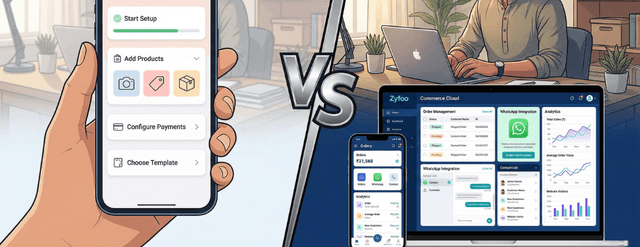
Most Indian sellers who are already using WhatsApp for business communication are using WhatsApp Business, the free app available on Android and iOS. WhatsApp Business provides a business profile, a product catalogue, quick reply shortcuts, and the ability to set automated away messages. For a business with under 50 customers and a low weekly order volume, WhatsApp Business is a functional starting point. The limitation of WhatsApp Business becomes visible as soon as order volume grows. WhatsApp Business is tied to a single device and a single phone number. It cannot send automated messages triggered by external events like a purchase, a shipment update, or a cart abandonment. It cannot integrate with an eCommerce platform to sync product availability or receive orders directly into a management system. It does not support the multiple-agent model where several team members handle customer conversations simultaneously under a single business number. And it cannot send broadcast messages to more than 256 contacts at a time. The WhatsApp Business API removes all of these constraints. It is the infrastructure layer that enables true WhatsApp commerce: automated order confirmations, catalogue browsing within WhatsApp, in-chat payment links, multi-agent support, and integration with eCommerce platforms. The API is accessed through WhatsApp-approved Business Solution Providers, and the complexity of setting it up directly has historically been a barrier for Indian SMBs.
| Capability | WhatsApp Business App | WhatsApp Business API |
| Device and number | Single device, single number | Cloud-based, multiple agents |
| Automated messages on triggers | No | Yes, fully automated |
| eCommerce platform integration | No | Yes, via API connection |
| In-chat product catalogue order flow | Basic catalogue only | Full order placement flow |
| Broadcast to large lists | 256 contacts maximum | Unlimited opted-in contacts |
| Payment link integration | Manual sharing only | Automated payment link on order |
| Cart abandonment recovery | Not possible | Automated sequence support |
| Multi-agent customer support | No | Yes, team inbox supported |
Zyfoo s WhatsApp commerce integration is built on the WhatsApp Business API, with the BSP relationship and API configuration managed by the platform. Indian SMB sellers on Zyfoo access the full API capability through the platform s dashboard without navigating the BSP selection process or the API setup independently. The full feature set is described on Zyfoo s features page.
What a Complete WhatsApp Commerce Flow Looks Like
Understanding the end-to-end customer experience in a properly configured WhatsApp commerce setup helps brands see both what they are building toward and where the value is generated at each stage.
Stage 1: Discovery and Opt-In
A customer discovers the brand through Instagram, a WhatsApp broadcast from a friend, a Google search, or a physical product they purchased previously. They see a Click-to-WhatsApp link or QR code on an ad, a product page, or the physical packaging. They tap it, and a pre-populated WhatsApp message opens with the brand s business number. The customer sends the message and has now opted in to receive WhatsApp communication from the brand. This opt-in is the required compliance step for using the WhatsApp Business API for outbound messaging.
Stage 2: Catalogue Browsing Within WhatsApp
Once the conversation is open, an automated welcome message is sent immediately. The message includes a greeting, a brief brand introduction, and a prompt to browse the catalogue. The customer taps Browse Catalogue and sees the brand s product catalogue natively within WhatsApp, with product images, names, prices, and a brief description for each item. No browser tab opens. No app download is required. The entire product discovery experience happens within the WhatsApp interface the customer is already in.
Stage 3: Product Selection and Order Placement
The customer adds items to a cart within WhatsApp, selects variants if applicable, confirms their delivery address, and receives an order summary. The order summary shows the items selected, quantities, total price, applicable GST, and delivery charge. The customer reviews and confirms the order with a single tap, generating a formal order record that flows directly into the brand s Zyfoo order management dashboard alongside all other channel orders.
Stage 4: Payment
Immediately after order confirmation, an automated message is sent containing a secure payment link generated through Razorpay, PayU, or the brand s configured payment gateway. The customer taps the link, selects UPI, saved card, or any other available payment method, completes payment, and receives an automatic payment confirmation within the WhatsApp thread. For COD orders, the confirmation is sent without a payment link and the order is routed to the fulfilment queue immediately.
Stage 5: Automated Order Updates
From this point, every status change in the order lifecycle generates an automatic WhatsApp message to the customer. Order confirmed, order packed, order dispatched with AWB and tracking link, out for delivery, delivered. Each message is sent from the brand s business number without any manual action from the seller s team. The customer has full visibility of their order status within the same WhatsApp thread where they placed the order, creating a seamless and professional experience.
Stage 6: Return and Reorder
If the customer wants to return the item, they reply in the thread and a return initiation flow is triggered. If they want to reorder, a single message to the brand s WhatsApp number reopens the catalogue and their previous order history is visible as a reference. Repeat purchases through WhatsApp are significantly faster than a first purchase because the customer s address, payment preference, and product history are already on record.
Setting Up WhatsApp Commerce: The Step-by-Step Process
For Indian brands using Zyfoo, setting up a structured WhatsApp commerce channel involves the following steps. Brands not on Zyfoo will need to work through a BSP selection and API configuration process that requires additional technical setup before reaching these steps.
Step 1: Verify Your Business on WhatsApp
The WhatsApp Business API requires a verified business account. This involves submitting your business name, registered address, business category, and a Facebook Business Manager account for verification. WhatsApp s verification process typically takes 3 to 5 business days. Businesses with a registered company name and active online presence complete verification more reliably than unregistered sole proprietors, which is an additional reason to ensure your business is formally registered before investing in WhatsApp commerce infrastructure.
Step 2: Build Your WhatsApp Product Catalogue
Your product catalogue for WhatsApp must be configured in the WhatsApp Business Catalogue Manager, linked to your Facebook Business Manager account. Each product requires a title, description, price, and product image. On Zyfoo, the product catalogue is synced directly from the Zyfoo product master, meaning products added or updated in your Zyfoo store are automatically reflected in the WhatsApp catalogue without separate manual entry. Catalogue images for WhatsApp require a square format with a minimum 500 by 500 pixel resolution. Product descriptions should be written to answer the questions a customer would ask before buying, in plain language and at a reading level appropriate for your target audience. For brands selling to tier-2 or tier-3 markets, vernacular language product descriptions in the WhatsApp catalogue consistently improve engagement and conversion.
Every outbound message sent through the WhatsApp Business API to a customer who has not messaged your brand in the last 24 hours must use a pre-approved message template. Templates for order confirmation, payment request, shipping notification, delivery confirmation, and cart abandonment recovery all require submission to WhatsApp for approval before they can be sent. Approval typically takes 24 to 72 hours per template. On Zyfoo, standard commerce message templates for all key order lifecycle events are pre-built and submitted for approval as part of the WhatsApp commerce setup process. Sellers can customise the brand name, product reference style, and tone within the approved template framework without starting from scratch. The template management interface is accessible from the Zyfoo dashboard. Full setup documentation is available on Zyfoo s features page.
The WhatsApp Business API requires explicit customer opt-in before any outbound marketing or transactional message can be sent. Opt-in must be collected through a channel other than WhatsApp itself, meaning a website form, an Instagram ad, a checkout page checkbox, or a physical QR code. The opt-in record must clearly state what the customer is consenting to receive and must include the brand s name and the option to opt out. Effective opt-in collection points for Indian eCommerce brands include a WhatsApp opt-in checkbox on the checkout page, a Click-to-WhatsApp button on product pages and social media profiles, a QR code on product packaging that opens a pre-populated WhatsApp message, and a post-purchase message asking customers to opt in for order updates and exclusive offers.
Step 5: Connect Order Management and Inventory
For WhatsApp commerce to function as a genuine sales channel rather than a manual conversation layer, every order placed through WhatsApp must flow into the same order management system as website and app orders. This is the step that separates proper WhatsApp commerce from informal WhatsApp selling. On Zyfoo, this connection is native: WhatsApp orders appear in the unified order queue, inventory is decremented in real time, the courier assignment and AWB generation workflow is triggered, and the automated notification sequence begins without any manual steps from the seller.
Using WhatsApp Broadcasts to Drive Sales Without Paid Advertising
One of the most significant commercial advantages of a well-built WhatsApp contact list is the ability to reach your entire opted-in customer base with a relevant message at zero incremental cost per message beyond the WhatsApp API per-conversation fee. For Indian D2C brands spending Rs 30 to Rs 80 per click on Meta or Google ads, the economics of WhatsApp broadcast marketing are dramatically more favourable when the list is large and well-segmented.
What WhatsApp Broadcasts Are Effective For
- New product launches: A broadcast to your existing customer base announcing a new product generates immediate awareness among the highest-intent audience available to your brand, people who have already bought from you.
- Flash sales and limited-time offers: WhatsApp broadcasts for time-limited offers with a direct payment link achieve conversion rates significantly above what email broadcasts deliver for the same offer.
- Restock alerts: Customers who enquired about an out-of-stock item and opted in for restock notification represent extremely high purchase intent. A WhatsApp message the moment the item is back in stock converts at a very high rate.
- Seasonal and festive campaign launches: Diwali, New Year, Eid, Pongal, and regional festival sale launches sent to a well-segmented WhatsApp list generate a purchase velocity spike that is difficult to replicate through paid channels at comparable cost.
- Loyalty rewards and exclusive offers: Sending an exclusive offer to your WhatsApp list before it goes to the general public reinforces the value of the opt-in relationship and increases list retention and engagement rates over time.
How to Segment Your WhatsApp List for Better Results
A WhatsApp broadcast sent to your entire list without segmentation will always underperform a broadcast sent to a relevant segment. Segmentation by purchase history, product category preference, geography, and purchase recency allows you to send messages that are directly relevant to each recipient s relationship with your brand. A customer who bought a specific skincare product 60 days ago is a high-probability target for a repurchase broadcast with the same or a complementary product. A customer in Mumbai who has bought from your home decor range is a better target for a Mumbai-specific flash sale than a customer in Rajasthan who bought a different category. The investment in list segmentation pays through higher open rates, higher conversion, and lower opt-out rates on every broadcast.
WhatsApp Cart Abandonment Recovery: The Highest-ROI Automation
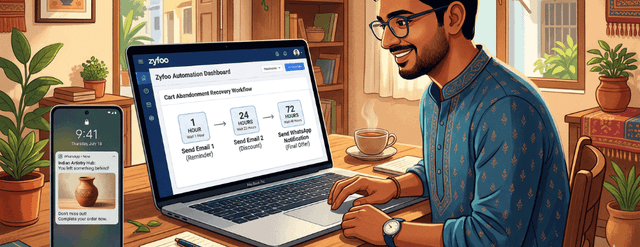
Cart abandonment recovery through WhatsApp is the single highest-return automation available to Indian eCommerce brands who have WhatsApp commerce set up. The mechanics of why it works so well are not complicated: a warm customer who added a product to their cart and left has demonstrated purchase intent that is significantly higher than an anonymous website visitor. Reaching that customer on WhatsApp, where they are almost certain to see the message, within an hour of abandonment, while the product is still fresh in their attention, is a structurally advantaged recovery scenario. The three-touch recovery sequence, covered in detail in Zyfoo s cart abandonment automation guide published on March 24, applies directly to WhatsApp as the primary recovery channel. The first touch at one hour is a friendly reminder with the product image and a direct return-to-cart link. The second touch at 24 hours adds social proof. The third touch at 72 hours carries a time-limited offer. All three are delivered as WhatsApp messages to opted-in customers without any manual action from the seller s team. The WhatsApp recovery advantage over email in the Indian context is significant. WhatsApp messages are read at 80 to 90 percent open rates compared to 30 to 40 percent for email. The in-thread context of the conversation, including the product image and the direct checkout link, reduces the number of steps between reading the message and completing the purchase. For Indian mobile shoppers who complete purchases in short sessions between other activities, this frictionless path to checkout converts at measurably higher rates.
| Metric | WhatsApp Commerce | Website (Mobile) | Email Marketing |
| Message or page open rate | 80 to 90 percent | Session-dependent | 20 to 30 percent |
| Checkout conversion rate | 8 to 15 percent | 2 to 4 percent | 1 to 3 percent |
| Cart recovery conversion | 12 to 25 percent | Not applicable | 5 to 10 percent |
| Repeat purchase rate | 45 to 60 percent | 25 to 35 percent | 20 to 30 percent |
| Cost per converted order | API fee only, no ad spend | Includes acquisition cost | Low but lower conversion |
WhatsApp Commerce Compliance: What Indian Brands Must Get Right
WhatsApp s Business Messaging Policy is enforced actively and violations can result in the suspension of a brand s WhatsApp Business API access. For a brand that has built WhatsApp as a primary commerce channel, an API suspension is a serious operational disruption. Staying compliant is not optional and it is not complicated if the right practices are built in from the start.
The Non-Negotiable Compliance Requirements
- Explicit opt-in: Every contact in your WhatsApp list must have provided explicit consent to receive messages from your brand. Importing phone numbers without opt-in consent and sending broadcast messages is a policy violation that will result in account suspension.
- Opt-out respect: Every customer who replies STOP or asks to be removed from your list must be removed immediately and not messaged again. Continuing to message opted-out customers is one of the fastest routes to account suspension.
- Template-only outbound messages after 24 hours: Outside a 24-hour window from the customer s last inbound message, all outbound messages must use approved templates. Sending free-form messages outside this window is a policy violation.
- No prohibited content: WhatsApp s commerce policy prohibits certain product categories from being sold or promoted through the platform, including tobacco, alcohol, prescription medications, and financial products not compliant with local regulations. Verify that your product category is permitted before investing in WhatsApp commerce infrastructure.
- Message frequency: High-frequency broadcasting to the same contacts without relevant personalisation generates opt-outs and spam reports. Both reduce the quality score of your WhatsApp Business account and can trigger access restrictions.
Building a Healthy WhatsApp List
A WhatsApp contact list built through genuine opt-in, where customers actively chose to receive messages because they expected value from the communication, will consistently outperform a larger list built through aggressive or borderline consent practices. Opt-out rates on a genuine opt-in list are typically under 2 percent per broadcast. Opt-out rates on a list with unclear consent can reach 10 to 20 percent, which both depletes the list rapidly and risks triggering WhatsApp s automated quality enforcement. For detailed guidance on India s digital marketing consent requirements, the Digital Personal Data Protection Act 2023 guidelines from MeitY outline the consent standards that apply to WhatsApp-based marketing communication for Indian businesses.
A WhatsApp commerce channel that is not measured is an investment whose return cannot be understood or optimised. The following metrics should be reviewed weekly once WhatsApp commerce is live and generating consistent order volume.
Channel-Level Metrics
- WhatsApp order volume and GMV as a percentage of total store revenue: tracks the channel s contribution and growth trajectory relative to website and app.
- WhatsApp conversion rate: the percentage of catalogue views within WhatsApp that result in a completed order. Benchmark against 8 to 12 percent for a well-configured catalogue.
- Broadcast open rate and click-through rate per campaign: tracks which message types, product categories, and offer structures generate the highest engagement from your list.
- Cart recovery conversion rate from WhatsApp sequences: the percentage of WhatsApp recovery messages that result in a completed purchase.
- WhatsApp customer repeat purchase rate: measures whether WhatsApp-acquired customers return for second and third purchases at higher rates than website-acquired customers.
List Health Metrics
- Opt-out rate per broadcast: should remain below 2 percent for a healthy, well-segmented list.
- List growth rate: new opt-ins per month from all collection points.
- List engagement rate: the percentage of your total list that has opened or responded to a message in the last 30 days. A declining engagement rate signals list fatigue or relevance issues with your broadcast content.
| WhatsApp Metric | Healthy Benchmark | Action if Below |
| Broadcast open rate | 75 percent or above | Review message timing and relevance; increase personalisation |
| Catalogue-to-order conversion | 8 to 12 percent | Improve product images and descriptions; add social proof |
| Cart recovery conversion | 12 to 20 percent | Review message timing and offer structure |
| Opt-out rate per broadcast | Under 2 percent | Reduce frequency; improve segmentation and relevance |
| Repeat purchase rate | 40 percent or above | Strengthen post-purchase follow-up sequence |
Integrating WhatsApp Commerce With Your Broader Sales Operation
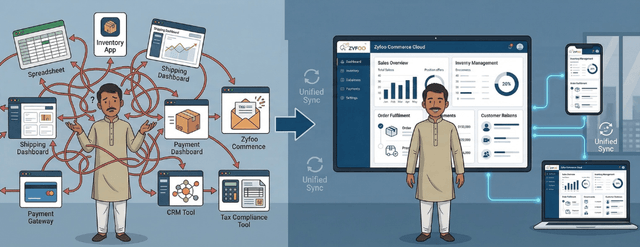
WhatsApp commerce delivers its full value when it operates as a connected channel within a unified commerce platform rather than as a standalone communication tool managed separately from the rest of the business. A WhatsApp order that flows automatically into the same order management queue as website and app orders, drawing from the same real-time inventory pool and triggering the same fulfilment automation, is worth significantly more than a WhatsApp order handled in a parallel manual workflow. The integration points that matter most are inventory synchronisation, order routing, customer record unification, and analytics attribution. When a customer who first bought through WhatsApp later visits the website and completes a second purchase, both transactions should be visible in a single customer record that reflects the full relationship. When a product sells out through WhatsApp orders during a flash sale, the availability should update immediately on the website and app to prevent overselling. When a return is initiated through WhatsApp, the reverse logistics workflow should trigger the same way a website return does. Zyfoo s unified commerce architecture handles all of these integration points natively because WhatsApp commerce is a built-in channel of the platform rather than an external integration. The full WhatsApp commerce and order management integration is available to all Zyfoo merchants as part of the standard platform subscription, without additional BSP fees or API configuration overhead.
The Channel That Compounds Over Time
Every other paid marketing channel you use for your eCommerce business, Meta ads, Google Shopping, marketplace promotions, delivers value when you are spending and stops when you stop. WhatsApp commerce is structurally different because it is a list you own and a channel that costs a fraction of paid acquisition per message delivered to your opted-in audience. A brand that spends 12 months building a WhatsApp list of 10,000 opted-in customers and maintaining genuine relevance through well-segmented, valuable communication has built a distribution asset that compounds in value over time. The cost of reaching those 10,000 customers with a product launch message is the WhatsApp API conversation fee, measured in paise per message, rather than the Rs 30 to Rs 80 per click required to reach the same number of people through paid social advertising. The investment required to build that asset is not large. It is a structured opt-in collection programme, a configured WhatsApp commerce integration, a set of approved message templates, and the discipline to maintain list quality by keeping communication relevant and respecting opt-out requests immediately. For Indian brands building direct customer relationships in 2026, WhatsApp commerce is not a supplementary channel to consider eventually. It is a core channel to build now, before the list building opportunity and the competitive window are both smaller than they are today.