The rules of online delivery in India are being rewritten. A few years ago, promising a three-day delivery window was considered fast. Today, customers in Tier 1 and Tier 2 cities increasingly expect their orders to arrive the same day, sometimes within hours. If your store relies entirely on national courier networks for every shipment, you are already behind on the speed curve that local and hyperlocal commerce is setting. Building a hyperlocal delivery network does not require a fleet of vehicles, a warehouse on every street corner, or a technology budget the size of Blinkit. What it requires is a clear operational structure, the right delivery partners, and a store management system that ties everything together in real time. This guide walks you through the practical steps of setting up hyperlocal delivery for your Indian online store, whether you are a neighbourhood retailer going digital, a D2C brand looking to add same-day delivery for metro customers, or a growing SMB trying to compete on fulfillment speed.
What Hyperlocal Delivery Actually Means for an Online Store
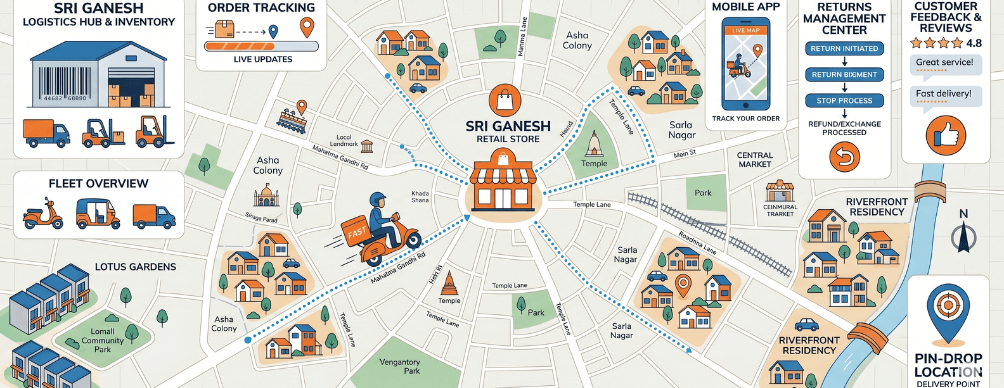
Hyperlocal delivery refers to fulfilling orders from a location close to the customer, typically within a 2 to 10 km radius, and completing the delivery within a few hours rather than days. The inventory sits either at your own store, a small dark store you operate, or a partner location in the delivery zone. This is different from standard ecommerce logistics, where a national courier picks up your shipment, routes it through a hub network, and delivers it one to three days later. In the hyperlocal model, the delivery loop is short and fast. A local delivery partner picks up from your store or warehouse and drops it directly at the customer s address, often the same day. The market data reflects just how quickly this model is gaining ground. Research on India s hyperlocal delivery growth shows the sector grew at a CAGR of over 50 percent between FY2021 and FY2025, and Tier 2 and Tier 3 cities are now driving a significant share of that expansion. For store owners in these markets, the window to establish a local delivery advantage before competitors do is still open, but it is narrowing.
Step One: Define Your Delivery Zones Before Anything Else
The most common mistake SMB owners make when starting hyperlocal delivery is trying to cover too much ground from day one. Hyperlocal only works when you keep the delivery radius tight enough to guarantee speed. Start with what you can actually fulfil reliably. Map your current order distribution. Look at where the majority of your existing customers are located. If 60 percent of your orders come from within 5 km of your store, that is your first delivery zone. Once you can consistently deliver within 2 to 3 hours in that zone, you expand to the next ring. For stores with a single location, begin with a 5 to 7 km radius. For stores with multiple stocking points or warehouses, you can define zones around each location and route orders to the nearest fulfilment point automatically. This is where your order management system earns its keep.
Step Two: Choose the Right Hyperlocal Delivery Partners
You do not need to build your own delivery fleet unless your order volumes are high enough to justify the fixed cost. For most SMBs, partnering with established hyperlocal logistics providers is the smarter and faster path. Several platforms operate hyperlocal delivery networks across Indian cities today. Porter covers intra-city delivery for everything from small parcels to bulk shipments, with transparent pricing and real-time tracking. Borzo, previously WeFast, operates across multiple Indian cities and is particularly strong for same-day and on-demand deliveries with a cash-on-delivery option. Shiprocket Quick offers same-hour delivery in select cities and integrates directly with store platforms for automated dispatch. The key is not picking one and committing exclusively. Smart operators use multiple hyperlocal partners and route each order based on which provider has the best coverage, speed, and current availability for that specific pin code. This multi-partner approach protects you from single-provider downtime during peak periods and gives you negotiating leverage on rates.
| Partner Type | Best For | Typical Range |
| On-demand bike partners (Porter, Borzo) | Small parcels, same-day delivery | 2 to 20 km |
| Shiprocket Quick | Same-hour delivery in metros | City-level |
| In-house riders (own or contractual) | High-volume, controlled SLA zones | 1 to 5 km |
Step Three: Organise Your Inventory for Fast Dispatch
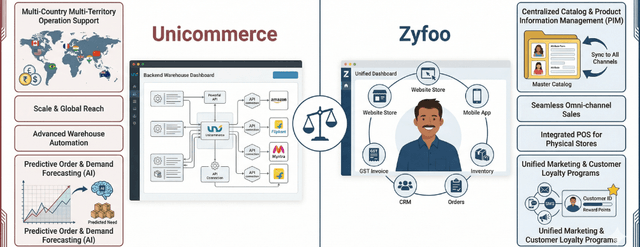
Speed at the dispatch end determines whether your same-day promise is actually achievable. An order placed at 11 AM that sits unprocessed for two hours before a rider even picks it up cannot be delivered by 3 PM, regardless of how fast your delivery partner is. Fast dispatch requires your inventory to be organised for speed. Your most frequently ordered SKUs should be at a pick-friendly location in your storage area, not buried behind slow-moving stock. Your packing station needs to be stocked with boxes, tape, and labelling materials so your team is never hunting for supplies mid-order. And your order management system should trigger the packing task the moment an order is confirmed, not when your team next checks the queue. If you are managing inventory across multiple locations or want to assign hyperlocal orders to the nearest stocking point automatically, Zyfoo s order and logistics management tools allow you to configure fulfilment rules by zone, delivery type, and stock availability. Orders destined for a local zone get routed to your fastest dispatch point without manual intervention.
Step Four: Set Up Real-Time Tracking and Customer Communication
The biggest driver of customer satisfaction in hyperlocal delivery is not speed alone. It is knowing that the delivery is on its way. A customer who placed an order an hour ago and has heard nothing is already anxious, even if the rider is five minutes out. Set up automated order confirmation, dispatch notification, and delivery tracking messages at each stage of the fulfillment journey. WhatsApp is the most effective channel for this in India, given open rates and the fact that most customers have it as their primary messaging app. A message confirming dispatch with a tracking link, followed by a notification when the rider is nearby, dramatically reduces enquiry calls to your team and builds post-purchase trust. Most hyperlocal delivery partners provide API-based tracking that you can plug into your store backend or order management system. If you are on a platform that supports logistics integrations, this data can flow into your customer-facing tracking page automatically rather than requiring your team to manually update order statuses.
Step Five: Structure Your Pricing So Hyperlocal Delivery Pays
Fast delivery has a cost, and it needs to be covered without silently eroding your margin on every local order. The way you structure delivery pricing for hyperlocal orders directly affects both conversion and profitability. Three models work for Indian SMBs in this space. The first is a flat local delivery fee, typically in the range of Rs 30 to Rs 60, that applies to all orders within your hyperlocal zone and is shown clearly at checkout. Customers in urban areas are accustomed to paying for fast delivery and generally accept this if the value proposition is same-day or next-few-hours delivery. The second model is free local delivery above a minimum order value. This incentivises customers to add to their cart to qualify, which increases average order value while covering your delivery cost through the higher basket size. The third model, less common but effective for loyal customer bases, is a delivery subscription. A monthly fee that covers unlimited local deliveries encourages repeat purchases and makes your store the default option for customers who have already paid in.
| Delivery Pricing Model | When It Works Best |
| Flat local delivery fee (Rs 30-60) | New stores building order volume |
| Free delivery above minimum order | Stores with Rs 300 to Rs 500+ average order value |
| Monthly delivery subscription | Stores with a strong repeat customer base |
Handling Same-Day Delivery Without Disrupting Your Regular Operations
One of the operational risks of adding hyperlocal delivery is that it can create a two-tier fulfilment workload that strains your team if not properly structured. Local orders that need to go out in two hours compete for the same packing and dispatch resources as next-day orders that do not have the same urgency. The fix is to segment your fulfilment flow by delivery type. Hyperlocal orders get batched and dispatched in defined windows, typically morning and afternoon, so your team knows exactly when the local rush happens and can plan staffing accordingly. Orders outside your hyperlocal zone follow the standard national courier workflow without competing for the same urgency slots. As your local order volume grows, this segmentation becomes even more important. The brands that scale hyperlocal delivery successfully treat it as a dedicated operational channel with its own queue, its own SLAs, and its own performance metrics, rather than bolting it onto an existing fulfilment process that was never designed for it.
Measuring Whether Your Hyperlocal Network Is Working
Like any operational investment, hyperlocal delivery needs to be tracked against clear metrics to know whether it is generating enough value to justify the cost and complexity.
- Percentage of local orders delivered within the promised time window
- Average dispatch time from order confirmation to rider pickup
- Customer satisfaction scores for hyperlocal orders versus standard shipping
- Repeat purchase rate from customers in your hyperlocal zone
- Hyperlocal delivery cost as a percentage of order value
If your on-time delivery rate is consistently above 90 percent and your repeat purchase rate from local customers is higher than your overall average, your hyperlocal network is working. If dispatch time is creeping above 30 minutes or customer satisfaction scores are lower than expected, the problem usually sits in inventory organisation or order routing, not in your delivery partner. India s hyperlocal delivery market is expected to cross USD 10 billion by 2026, and the gap between stores that offer fast local delivery and those that do not will only widen as consumer expectations continue to shift. The investment in building this capability now, even at small scale, positions your store ahead of the curve rather than scrambling to catch up when same-day delivery becomes the baseline expectation rather than the differentiator. Getting your store s logistics infrastructure right from the ground up, with zone-based routing, multi-partner integrations, and automated customer communication, is the kind of operational foundation that compound over time. Every order delivered fast and on-time is a customer more likely to come back.