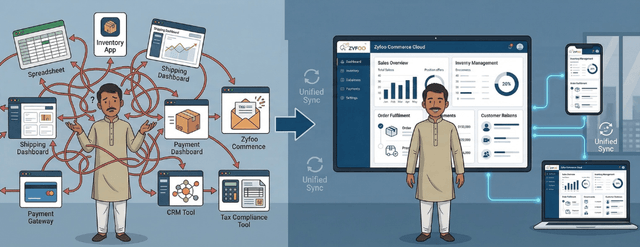
There is a function inside almost every Indian SMB eCommerce operation that has never been formally managed. It does not have a dashboard. It does not send alerts when something is overdue. It does not keep a record of what was agreed, what was delivered, and what was paid. That function is vendor and expense management, and for most growing Indian online businesses it runs on a combination of WhatsApp messages, a shared spreadsheet, informal conversations, and the founder s memory. This works at the beginning. When you have two vendors, 30 orders a month, and a clear mental picture of what you owe and when, informal management is adequate. The moment you cross three or four active suppliers, begin processing more than 100 orders a month, have staff handling procurement on your behalf, or start looking at your financials for a loan or an investor conversation, the informal model breaks down visibly. Vendor disputes over quantity discrepancies become unresolvable because there is no formal record of what was ordered. Payments are delayed because due dates exist only in someone s head. Reorders are missed because nobody noticed the stock running low until customers started receiving cancellation messages. Expenses are not tracked against budget because there is no budget, only a bank account that is checked when a payment is needed. This guide covers how Indian SMB eCommerce operators can build a structured, scalable vendor and expense management system, step by step, using Zyfoo s vendor and expense module. The goal is not to add administrative complexity. It is to replace informal workarounds with a systematic process that scales with your order volume without requiring additional headcount to manage it.
Why Vendor Management Is a Growth-Critical Function
Vendor management is often framed as a procurement or supply chain topic, relevant primarily to manufacturers and large distributors. For Indian eCommerce businesses that source finished products from suppliers, the relevance is equally direct. Your product quality, your stock availability, your unit economics, and your ability to scale during peak demand are all downstream consequences of how well you manage your vendor relationships.
The Supplier Side of Your Unit Economics
The gross margin on every product you sell is determined in large part by the price you pay your supplier. A vendor who quotes Rs 320 per unit versus one who quotes Rs 290 per unit for the same product represents a 9.4 percent difference in cost of goods that flows directly to gross margin on every single order. Vendors who know they are your only source of a product have little incentive to offer competitive pricing. Vendors who know you track their performance, pay on time, and maintain a formal relationship have both the incentive and the data to offer better terms. Formal vendor management creates negotiating leverage by demonstrating that you are a serious, organised buyer. It also gives you the data to back any renegotiation with specific evidence on volumes ordered, payment history, and any quality or delivery issues that justify a pricing conversation.
Stock Availability Is a Vendor Management Outcome
Every stockout your store experiences is a direct revenue loss. The customer who visits your product page, sees the out-of-stock label, and leaves has a 40 to 60 percent lower probability of returning than a customer who completes a purchase. For high-repeat-purchase categories like fashion consumables, health supplements, and food products, a single stockout experience can permanently redirect a loyal buyer to a competing brand. Stockouts are almost always predictable in advance if the right data is visible. When you know your average daily sales velocity for a product, your vendor s lead time, and your current stock level, the reorder date is calculable. The reason most Indian SMB businesses experience avoidable stockouts is not that the data does not exist. It is that the data is spread across a spreadsheet, a courier platform, and a manual stock count, making the calculation inconvenient enough to skip.
Expense Visibility Is a Profitability Prerequisite
You cannot manage what you cannot see. For an eCommerce business, operating expenses beyond the cost of goods include packaging materials, courier charges, platform fees, advertising spend, staff salaries, warehouse rent, and returns processing costs. When these expenses are not tracked systematically by category and by time period, the business operates without knowing its true cost structure. Decisions about pricing, promotions, and scaling are made against an incomplete financial picture, which consistently results in under-priced products, over-committed inventory, and growth that destroys margin rather than building it.
Step 1: Build Your Vendor Master Record
The starting point for structured vendor management is a vendor master record: a single, complete profile for each supplier that contains every piece of information your business needs to manage that relationship effectively. This replaces the scattered combination of a WhatsApp contact, a few saved PDFs, and a mental note about payment terms.
What a Complete Vendor Master Record Contains
- Business name, trading name, and registered office address
- Primary contact name, mobile number, WhatsApp number, and business email
- GSTIN and PAN for tax compliance and invoice verification
- Bank account details for payment processing
- Payment terms: credit period in days, whether COD or credit, penalty clause for late delivery if applicable
- Standard lead time from order placement to delivery at your warehouse
- Minimum order quantity per SKU or per order
- Product catalogue supplied by this vendor with current agreed pricing per unit and per quantity tier
- Quality standards agreed: acceptable defect rate, packaging specifications, labelling requirements
- Return and replacement policy: what the vendor accepts back and within what timeframe
For most Indian SMB eCommerce businesses, building the vendor master for the first time means collecting this information through a structured conversation with each supplier. It is a one-time investment that pays forward through every subsequent transaction. A vendor who has provided their GSTIN and bank details formally is also a vendor who takes the relationship more seriously than one who sends invoices as WhatsApp photos.
Setting Up Vendor Records in Zyfoo
In Zyfoo s vendor module, each vendor record is created with fields for all of the above information. The vendor s product catalogue is linked directly to the Zyfoo product master so that when a purchase order is raised for a specific SKU, the system automatically populates the vendor s agreed price, minimum order quantity, and standard lead time. Changes to agreed pricing are updated in the vendor record and automatically reflected in future purchase orders without manual correction.
A purchase order is not bureaucracy. It is a binding written record of what you asked a vendor to supply, at what price, in what quantity, and by what date. In the event of a dispute over quantity received, price charged, or delivery timeline, the purchase order is the reference document that resolves the disagreement. Without it, every dispute becomes a he-said-she-said conversation where the outcome depends on who keeps better records. For Indian eCommerce businesses that have been sending reorder requests via WhatsApp, moving to a formal purchase order workflow requires a change in habit but not a significant increase in effort when the right tools are in place.
The Standard Purchase Order Lifecycle
- Reorder trigger: Stock for a SKU drops below the defined reorder point, generating an alert in the inventory module.
- Draft PO creation: A purchase order is drafted referencing the vendor master for price, MOQ, and lead time. The order quantity is calculated based on the reorder quantity formula or entered manually.
- Internal approval: For orders above a defined value threshold, the PO is routed to the business owner or designated approver before being sent to the vendor.
- PO sent to vendor: The approved PO is sent to the vendor via email or WhatsApp directly from the platform, with a PDF copy retained in the system.
- Vendor acknowledgement: The vendor confirms the PO, noting any changes to quantity, price, or delivery date. Any changes are recorded against the original PO.
- Goods receipt: When the goods arrive at your warehouse, a goods received note is raised against the PO. Quantities received are checked against quantities ordered. Discrepancies are flagged immediately.
- Invoice matching: The vendor s invoice is matched against the PO and the goods received note. Payment is released only when the three-way match is confirmed.
- Payment processing: Payment is made according to the agreed credit terms and recorded in the accounts module, updating the vendor s outstanding balance.
Setting the Reorder Point Correctly
The reorder point for a SKU is the stock level at which a new purchase order must be placed in order for the replenishment stock to arrive before the current stock runs out. Calculating it correctly requires three inputs: average daily sales velocity, vendor lead time in days, and a safety stock buffer for demand variability and supply delays.
| Reorder Point Component | How to Calculate | Example |
| Average daily sales velocity | Total units sold in last 30 days divided by 30 | 120 units in 30 days = 4 units per day |
| Vendor lead time | Average days from PO to goods receipt, last 6 orders | 8 days average lead time |
| Safety stock buffer | 2 to 3 days of sales velocity as buffer | 4 units x 2.5 days = 10 units |
| Reorder point formula | (Daily velocity x Lead time) + Safety stock | (4 x 8) + 10 = 42 units |
| Reorder quantity | Based on MOQ and storage capacity | 100 units (MOQ) or higher |
Zyfoo s inventory module calculates and tracks reorder points per SKU automatically once the daily velocity, lead time, and safety stock parameters are set. When stock drops to or below the reorder point, an alert is triggered in the vendor module and a draft purchase order can be generated with a single action. This removes the manual monitoring task that most Indian SMBs rely on and that fails most reliably during high-volume periods when the monitoring need is greatest.
The moment vendor goods arrive at your location is one of the highest-value checkpoints in the procurement cycle and one of the most frequently skipped by Indian SMBs who are processing deliveries informally. A delivery that is accepted without a formal receipt count and quality check creates liability that is impossible to resolve after the fact.
Why the Goods Receipt Step Matters
Suppose a vendor ships 95 units against a purchase order for 100 units. If the shortfall is not recorded at the point of receipt, the 5-unit discrepancy will surface as a stock mismatch in your inventory at some future point, and by then the vendor delivery record has been closed and there is no basis for a claim. The vendor has no obligation to make good on a shortage that was not reported at the time of delivery. Similarly, if 12 units in a shipment of 100 arrive damaged and are accepted without a formal rejection note, you have accepted liability for the damage. A formal goods receipt process that records quantities received and separates accepted stock from rejected stock at the point of delivery creates a contemporaneous record that supports both the inventory update and any vendor claim.
The Three-Part Goods Receipt Check
- Quantity check: Count every unit received and compare against the purchase order quantity. Record any shortfall or excess.
- Quality check: Inspect a representative sample for defects, damage, incorrect variants, or non-compliant packaging. Record the rejection rate and the specific defects found.
- Documentation check: Confirm that the vendor s delivery challan and GST invoice match the PO in terms of product, quantity, price, and GSTIN. Flag any discrepancies before accepting the delivery.
Recording Goods Receipt in Zyfoo
In Zyfoo s vendor module, a goods received note is raised directly against the originating purchase order. The system pre-populates the expected quantities from the PO, and the warehouse team records the actual quantities received. Any quantity shortfall is automatically flagged as a vendor discrepancy and linked to the original PO for follow-up. Rejected stock is recorded separately and does not update the available inventory until a replacement or credit note is received from the vendor. The Zyfoo inventory and vendor module documentation covers the goods receipt workflow in detail.
Step 4: Manage Vendor Payments on Defined Terms
Vendor payment management is where the financial discipline of procurement becomes visible. For Indian eCommerce businesses that buy on credit terms, managing payment due dates, early payment discounts, and overdue penalties is a cash flow management function that directly affects working capital availability.
Understanding Your Payment Terms
Most Indian eCommerce SMBs work with vendors on one of three payment models. The first is advance or proforma, where 50 to 100 percent of the order value is paid before dispatch. The second is COD (Cash on Delivery at the business level, meaning payment to the vendor when goods arrive at your warehouse). The third is net credit terms, typically net 15, net 30, or net 45, where the full invoice amount is due within a defined number of days from the invoice date or goods receipt date. For a growing eCommerce business, net credit terms are the most valuable payment structure because they provide a float between the purchase of inventory and its conversion to revenue through customer sales. A vendor who gives net 30 terms effectively provides 30 days of interest-free working capital on every order. Managing these terms carefully, paying on time to preserve the relationship and avoid penalty charges, and negotiating extended terms as your order volume grows with a vendor, is a meaningful contributor to healthy cash flow.
The Payment Due Date Problem
The most common vendor payment problem in Indian SMB eCommerce is not intentional non-payment. It is missed due dates caused by the absence of a systematic payment calendar. When vendor payment due dates live in a mental note, a WhatsApp message, or a single row in a spreadsheet that is not reviewed regularly, payments slip past their due dates. Most Indian vendors in the SMB-to-SMB segment will tolerate a few days of delay without formal consequence, but recurring late payment erodes the vendor relationship, reduces your negotiating position at price review, and in some cases triggers penalty charges that were buried in the original terms.
| Payment Term Type | Cash Flow Impact | Risk if Missed |
| Advance payment (100%) | Highest cash outflow upfront | Delivery delay risk if vendor defaults |
| 50% advance, 50% on delivery | Moderate upfront, remainder on receipt | Quality risk reduced by delivery-linked balance |
| Net 15 credit | 15 days float on order value | Relationship damage and late fee if missed |
| Net 30 credit | 30 days float on order value | Vendor may switch to advance terms for future orders |
| Net 45 or longer | Maximum float, negotiated at volume | Requires strong vendor relationship and payment history |
Setting Up Payment Tracking in Zyfoo
Zyfoo s vendor module records payment terms per vendor and calculates payment due dates automatically from the invoice date or goods receipt date, whichever is the agreed trigger. A payment due calendar in the dashboard shows all upcoming vendor payments grouped by due date so that cash flow requirements for the coming 7, 14, and 30 days are visible at a glance. Payment reminders are triggered in the system before the due date so that no payment is missed because of oversight. When payment is processed, the vendor account balance is updated and the payment is recorded in the accounts module for GST and reconciliation purposes.
The value of formal vendor management extends beyond managing individual transactions. Over time, the data generated by a structured procurement process produces a vendor performance picture that fundamentally changes the quality of your supplier decisions.
- On-time delivery rate: The percentage of purchase orders for which goods were received on or before the committed delivery date. A vendor with a consistent 75 percent on-time rate is a reliability risk that needs to be addressed or diversified against.
- Quality rejection rate: The percentage of units received that were rejected during the goods receipt quality check. A vendor with a rejection rate above 3 to 4 percent is either shipping inconsistent quality or packing carelessly, both of which add cost and disruption to your operations.
- Price variance: The difference between the price on the purchase order and the price on the vendor s invoice. Unauthorised price increases, even small ones per unit, accumulate into meaningful margin erosion over a year of transactions with a high-volume vendor.
- Minimum order quantity flexibility: How willing the vendor is to accommodate orders below their stated MOQ during low-demand periods. Vendors who are inflexible on MOQ force you to hold more inventory than you need, tying up working capital.
| Performance Metric | Healthy Benchmark | Action if Below Benchmark |
| On-time delivery rate | 90 percent or above | Issue formal warning; identify backup vendor |
| Quality rejection rate | Under 3 percent | Raise quality issue formally; inspect next delivery 100% |
| Price variance from PO | Zero unauthorised variance | Query immediately; withhold payment until resolved |
| Lead time consistency | Within plus or minus 1 day of stated lead time | Update reorder point calculation; increase safety stock |
Vendor performance data transforms supplier negotiations from subjective conversations to evidence-based discussions. When you can show a vendor a 12-month record of on-time delivery at 74 percent, a rejection rate of 4.2 percent, and two invoice price variances over the period, you have a specific, documented basis for requesting improvement, a trial period with performance targets, or a pricing concession as compensation for the operational disruption their inconsistency has caused. Equally, when a vendor has a 96 percent on-time delivery record and a sub-2-percent rejection rate, you have the basis for a preferential vendor relationship with extended payment terms, priority allocation during supply-constrained periods, and collaborative product development conversations. Zyfoo s vendor performance dashboard compiles all four metrics automatically from purchase order, goods receipt, and invoice data without requiring any manual report assembly.
Step 6: Build a Structured Expense Tracking System
Vendor payments represent one category of business expenditure. The full cost structure of an eCommerce operation includes a broader set of operating expenses that need to be tracked, categorised, and reviewed regularly if the business is to understand its actual profitability and make informed decisions about where to invest and where to cut.
The Expense Categories Every Indian eCommerce Business Needs
- Cost of Goods Sold (COGS): The direct purchase cost of all inventory sold in a period, including inbound freight from vendor to warehouse.
- Fulfilment costs: Packaging materials, outbound courier charges, warehouse rent or storage fees, and returns processing cost.
- Platform and technology fees: eCommerce platform subscription, payment gateway transaction fees, WhatsApp Business API costs, and any SaaS tools used in operations.
- Marketing and advertising spend: Meta and Google ad spend, influencer fees, content production, and promotional discount cost.
- Staff costs: Salaries, contractor payments, and any freelance fees paid for operations, customer support, or content.
- Returns and write-offs: The cost of returned goods that cannot be resold, damaged stock written off, and any customer refunds not recovered from couriers.
- Compliance and professional fees: GST filing, accountant fees, legal costs, and any regulatory certification renewals.
Why Expense Categories Matter More Than Expense Totals
Tracking total expenses as a single number tells you how much you spent. Tracking expenses by category tells you where the money is going and which category has grown disproportionately relative to revenue growth. A business that sees its fulfilment costs growing at 40 percent while revenue grows at 20 percent has a unit economics problem that will only become visible if fulfilment is tracked as a separate category. A business that sees advertising spend growing without a corresponding improvement in customer acquisition metrics needs that data category-level to identify and address the issue. The goal of expense tracking is not compliance or accounting. It is decision support. The expense categories you track define the questions you can answer about your business. Categories that are not tracked are blind spots where costs accumulate invisibly until they become a crisis.
Step 7: Implement Expense Tracking That Actually Gets Used
The most sophisticated expense tracking system is worthless if it is not maintained consistently. The reason most Indian SMB expense tracking efforts fail is not a lack of intent. It is that the tracking process is too inconvenient relative to the alternative of not tracking. Expenses get entered in batches at month-end, which means details are forgotten, receipts are lost, and the quality of the data is poor. The practical solution is to lower the friction of expense recording to the point where it takes less than 60 seconds per expense and can be done from a mobile device at the moment the expense occurs.
Building a Low-Friction Expense Recording Habit
- Set a fixed expense category list at the start of each financial year and do not add new categories during the year without a deliberate decision. Category proliferation makes reports hard to read.
- Record every business expense within 24 hours of occurrence, not at month-end. The details are accurate only when the memory is fresh.
- Photograph every vendor invoice and receipt and attach it to the expense record immediately. A receipt attached at the time of recording is always better than one searched for at audit time.
- Assign every expense to both a category and a project or channel where applicable. An advertising spend assigned to both the Advertising category and the Instagram channel allows both budget-level and channel-level analysis.
- Review the expense dashboard weekly, not monthly. A weekly review catches trends and anomalies while there is still time to respond in the current month.
Expense Approval Workflows for Growing Teams
As soon as a business has more than one person with the authority to spend money on behalf of the company, an expense approval workflow becomes necessary. Without it, expenditure happens without oversight and the monthly expense total surprises the business owner when the bank balance is checked. Zyfoo s expense module supports configurable approval thresholds. Expenses below a defined amount are auto-approved. Expenses above the threshold are routed to the business owner or designated approver before the payment is processed. This does not slow down small routine expenses but creates a control point for significant expenditure. The approval record in the system also provides an audit trail that is valuable both internally and in any external audit or investor review. Zyfoo s full expense tracking features include receipt attachment, category assignment, approval workflows, and budget variance reporting.
Step 8: Set and Monitor Monthly Expense Budgets
Expense tracking without budgets tells you what happened. Expense budgets tell you what you planned to happen and give you a framework for identifying when reality is diverging from the plan early enough to respond.
How to Set Your First Monthly Expense Budget
For a business that has been tracking expenses without a formal budget, the starting point is a 3-month average of actual spending per category from the expense records. This gives a realistic baseline that reflects actual business behaviour rather than aspirational targets. The initial budget is the average plus a defined growth allowance per category based on expected order volume growth. Not every expense category scales linearly with order volume. COGS and fulfilment costs scale closely with order volume. Platform subscription fees are largely fixed. Advertising spend is a managed variable that should be adjusted based on target customer acquisition volume and cost per acquisition benchmarks. Staff costs scale with operational complexity rather than pure order volume. Setting the growth allowance per category requires understanding which costs are variable, semi-variable, and fixed relative to your growth trajectory.
| Expense Category | Cost Behaviour | Budget Setting Approach |
| Cost of goods sold | Fully variable with order volume | Target gross margin percentage times revenue forecast |
| Fulfilment and courier | Variable with order volume | Cost per order benchmark times order forecast |
| Platform and SaaS fees | Largely fixed | Prior period actuals plus planned tool additions |
| Marketing and advertising | Managed variable | Target CPA times customer acquisition goal |
| Staff costs | Semi-variable, step-change with headcount | Current salaries plus planned hires |
| Returns and write-offs | Variable, category-dependent | Return rate percentage times revenue forecast |
Variance Monitoring: The Weekly Check
A budget is only useful if actual spending is compared against it regularly enough to take corrective action. A monthly variance review conducted on the last day of the month is informational but rarely actionable. A weekly variance review conducted every Monday morning, comparing actual-to-date spending against the weekly budget pro-rata, gives the business owner time to adjust course within the month if a category is running over budget. Zyfoo s expense dashboard displays budget versus actual by category in real time, updated as each expense is recorded. The variance is shown both in absolute rupee terms and as a percentage of budget, with categories that are more than 10 percent over budget highlighted for attention. This removes the need for a monthly spreadsheet reconciliation and turns budget management from a retrospective exercise into a live operational tool.
Connecting Vendor Management and Expense Tracking for Full Cost Visibility
The most valuable insight from a properly configured vendor and expense management system is the complete cost picture for every product you sell. This is what transforms a revenue dashboard into a profitability dashboard.
From Revenue to Net Margin: The Full Stack
The path from a customer s payment to your actual net margin runs through multiple cost layers that must each be tracked to understand the true economics of any product or order. When vendor management and expense tracking are connected in the same platform as order management, this full stack calculation happens automatically.
| Cost Layer | Source in Zyfoo | Example per Rs 1,000 Order |
| Customer revenue | Order management | Rs 1,000 |
| Less: Cost of goods (vendor PO) | Vendor module | Rs 420 |
| Less: Outbound courier charge | Logistics module | Rs 65 |
| Less: Packaging cost | Expense module | Rs 18 |
| Less: Payment gateway fee | Expense module | Rs 20 (2%) |
| Less: Platform subscription pro-rata | Expense module | Rs 12 |
| Less: Returns provision | Returns module | Rs 25 (2.5% rate) |
| Net margin per order | Calculated automatically | Rs 440 (44%) |
When this calculation is visible per order and per product category, pricing decisions become data-driven rather than intuition-based. The product you thought was your best seller may have a lower net margin than the product with half the sales volume. The channel you are investing most in advertising may be generating orders with a 15 percent lower net margin than your organic channel. These are the insights that change how a business allocates its next Rs 50,000 of working capital.
Building a Multi-Vendor Strategy to Reduce Supply Chain Risk
Single-vendor dependency is one of the most underappreciated risks in Indian eCommerce. When a business sources a high-revenue product from a single supplier, that vendor has disproportionate power over the business s continuity. A vendor who faces a production issue, a cash flow problem, or simply a better customer who offers higher volume will cause a stockout that the eCommerce business cannot prevent or predict until it is too late.
The Dual-Source Principle
The practical risk mitigation for single-vendor dependency is dual-sourcing: maintaining an active relationship with a primary vendor who handles 70 to 80 percent of your volume and a secondary vendor who is tested, qualified, and available to scale up if the primary vendor has a supply disruption. The secondary vendor receives small regular orders, enough to maintain an active commercial relationship and a current assessment of their quality and lead time, but not enough to shift your volume-based pricing position with the primary. Managing a dual-source strategy without a formal vendor management system is significantly harder than it sounds. The secondary vendor orders are easy to deprioritise when the primary vendor is performing well, and the relationship atrophies to the point where the secondary vendor is not actually available when needed. Zyfoo s vendor module supports multi-vendor sourcing per SKU with the ability to set primary and secondary vendor assignments and track the order volume split across vendors over time.
Vendor Qualification for New Suppliers
Before adding a new vendor to your active supplier base, a structured qualification process reduces the risk of quality problems, delivery delays, and compliance issues. A standard vendor qualification for an Indian eCommerce SMB covers the following steps.
- Request for Quotation: Send a formal RFQ specifying product requirements, quantity, quality standards, packaging specifications, and delivery expectations.
- Sample order: Place a small sample order at the quoted price before committing to a full purchase order. Assess quality, packaging, and lead time accuracy.
- Reference check: Where possible, speak to at least one other buyer who sources from the same vendor about their experience with quality consistency, communication, and dispute resolution.
- Document collection: Collect GSTIN, PAN, bank details, and quality certifications relevant to your product category before the first commercial order.
- Trial order: Place a trial order at a volume representing 10 to 15 percent of your typical order size and evaluate the complete delivery and invoice experience against the vendor master standards.
Vendor and Expense Management as a Competitive Advantage
The Indian eCommerce businesses that build durable competitive advantages in 2026 and beyond will not do so solely through marketing spend or product innovation. They will do so through operational excellence that makes every rupee of working capital work harder. Vendor relationships that are managed formally deliver better pricing, higher reliability, and more favourable payment terms than relationships managed informally. Expenses that are tracked by category and measured against budget reveal the margin leaks that are invisible in a total-spend view. Neither of these capabilities requires a large team or a complex technology implementation. They require consistent process, the right tools, and the discipline to review the data regularly enough to act on what it reveals. For Indian SMBs at the stage where vendor and expense management is shifting from informal to formal, the investment in building structured systems today pays compounding returns through every subsequent scaling milestone. The practical starting point is setting up your vendor master records and expense categories before the next purchase order is raised. Zyfoo s vendor and expense module provides the structure, the workflows, and the performance tracking needed to run both functions from a single platform without additional software subscriptions or manual reconciliation overhead.