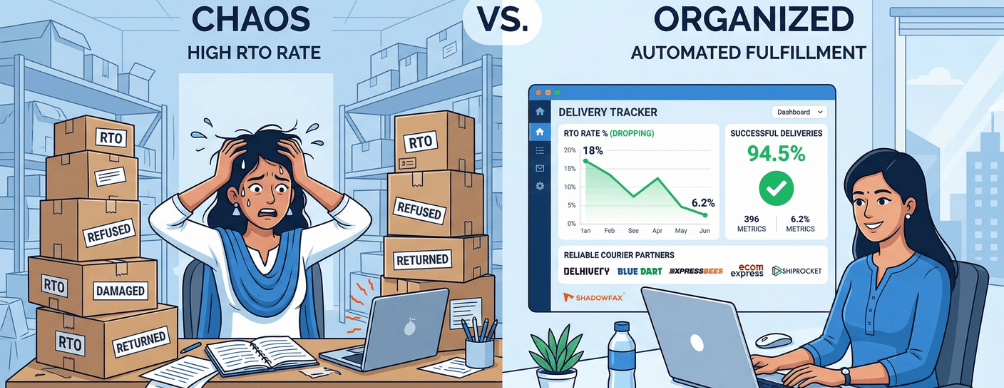
Every time a courier van pulls back into the warehouse with your package still on it, your margin takes a hit. Twice. Once for the forward shipping charge and once more for the reverse haul back to your shelf. In India, this scenario is not rare. It is a daily reality for thousands of online sellers running D2C brands, marketplace stores, or even small-town ecommerce ventures. RTO, which stands for Return to Origin, occurs when an order shipped out to a customer never reaches them and gets routed back to the seller. The reasons range from wrong addresses and unavailable customers to outright refusals at the doorstep. Whatever the cause, the financial damage is real, and for brands operating on thin margins in Tier 2 and Tier 3 markets, it can quietly erode profitability month after month. This guide breaks down what smart Indian brands are doing differently to bring RTO rates under control, protect their revenue, and build delivery operations that actually scale.
Why RTO Is a Bigger Problem in India Than Most Brands Admit
The scale of the challenge is hard to ignore. Cash on delivery still dominates Indian ecommerce, particularly in non-metro geographies. When a customer has not committed financially to a purchase upfront, the barrier to rejecting a parcel at the door is almost zero. The numbers reflect this reality. Industry research consistently puts average RTO rates in India between 20 and 30 percent across all order types, with COD-heavy categories like fashion, footwear, and consumer electronics routinely touching 35 to 40 percent in certain pin codes. For a brand processing 1,000 orders a month, that can translate to 250 to 400 orders coming back before a single rupee of revenue is realized. Beyond the direct logistics cost, high RTO creates downstream problems that are harder to see on a P&L but just as damaging. Inventory gets tied up in transit limbo. Products come back damaged or repackaged, lowering their resale value. Operational teams spend hours managing exception workflows instead of focusing on growth. And perhaps most critically, repeat RTO from the same customer signals a trust gap that no amount of discount codes can fix.
The Real Cost Breakdown of One RTO Order
Most sellers calculate RTO losses loosely as double shipping charges. The actual cost picture is more complex and typically worse.
| Cost Component | Approximate Impact |
| Forward shipping charge | Paid even on non-delivered order |
| Reverse logistics fee | Often equal to or higher than forward cost |
| Repackaging and QC | Labour and material cost on return |
| Inventory hold period | Cash locked in unsellable transit stock |
| Customer acquisition cost | Wasted if buyer churns after failed delivery |
When you map these components across an entire month of RTOs, the total loss often far exceeds what shows up in a basic logistics report. Brands that track RTO cost holistically, including the opportunity cost of blocked inventory, tend to treat it with far greater urgency than those who only watch the courier invoice.
Where RTO Actually Begins: The 5 Root Causes
Reducing RTO effectively requires understanding where it originates. Most failed deliveries are not random. They cluster around a predictable set of causes.
1. Incorrect or Incomplete Address Data
Address errors at the time of order placement are one of the top reasons delivery attempts fail. Customers typing quickly on mobile devices, autocomplete errors, and missing PIN codes all contribute to shipments reaching the wrong locality or getting stuck at the last mile.
2. Customer Unavailability
Many buyers place orders without coordinating their schedule with expected delivery windows. The courier arrives, nobody is home, and after two or three failed attempts the parcel is marked for return.
3. COD Order Impulsiveness
COD creates a psychology of low commitment. Customers sometimes order on a whim and refuse delivery when the product arrives, particularly if they have found a cheaper alternative or simply changed their mind.
4. Product Expectation Mismatch
When the delivered product looks or feels different from what the customer saw online, doorstep refusal becomes a common outcome. Poor product photography, vague size guides, and missing specification details all increase this risk.
5. Poor NDR Follow-Up
NDR, or Non-Delivery Report, is the notification triggered when a first delivery attempt fails. Brands that do not have an active NDR response workflow lose the narrow window to recover the delivery before it becomes a full RTO. Studies indicate that with timely intervention, a significant share of failed delivery attempts can be successfully converted to deliveries on reattempt.
What Smart Indian Brands Are Doing Differently
The brands that consistently maintain RTO rates below 10 percent are not lucky. They have built deliberate workflows, invested in the right tools, and created feedback loops that turn delivery data into actionable decisions.
Address Verification Before Dispatch
Running address data through automated verification tools at checkout or before shipment dispatch catches a large portion of errors before they cause delivery failures. Brands that implement this step see measurable reductions in RTO attributed to address issues within the first few weeks of deployment.
Proactive Order Confirmation
Sending an order confirmation message via WhatsApp or SMS within minutes of order placement, with a gentle confirmation prompt, achieves two things. It validates that the customer intended the purchase, and it gives them an easy way to flag address corrections early. This works particularly well for COD orders where the buyer has not made a payment commitment.
COD to Prepaid Nudge Campaigns
Brands that incentivize customers to switch from COD to prepaid at the point of confirmation, through small discount offers or cashback rewards, reduce their overall RTO exposure significantly. Prepaid orders in Indian ecommerce tend to have RTO rates in the 4 to 8 percent range compared to 20 to 30 percent for COD. Even a 15 to 20 percent shift in the prepaid mix can meaningfully change the RTO profile of a business.
Active NDR Management Workflows
When a delivery attempt fails, the most effective brands treat it as an alert requiring immediate action rather than an inevitable step toward return. Automated NDR workflows contact the customer within hours of a failed attempt via WhatsApp, SMS, or IVR, asking them to reschedule or update their delivery address. Industry data shows that timely NDR intervention can prevent a large share of NDR cases from escalating into full RTOs.
Not all logistics partners perform equally across all geographies. Brands that track courier success rates by pin code and route order volumes toward the better-performing partner in each zone see consistent improvements in first-attempt delivery rates. This kind of data-driven carrier selection is now accessible even to small and mid-size sellers through integrated order management platforms.
Building a Return-Proof Delivery Stack for Your Brand
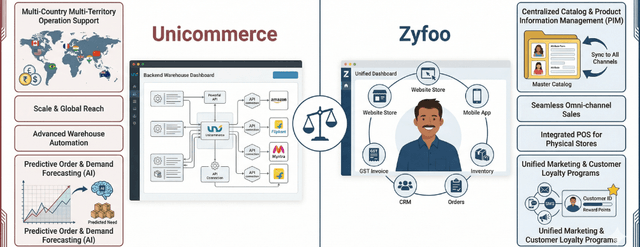
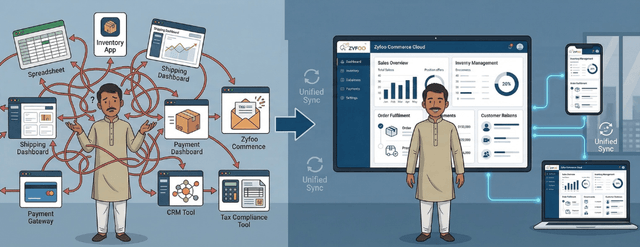
Keeping all of these workflows running manually is not sustainable beyond a certain order volume. The brands scaling past a few hundred orders a month need their order management system, logistics stack, and customer communication tools to work together in real time. This is where a platform like Zyfoo becomes operationally valuable. Zyfoo s order management layer handles the entire post-purchase journey, including shipment dispatch, delivery tracking, NDR alerts, and return processing, from within a single dashboard. Instead of toggling between your store admin, courier panel, and WhatsApp business account, your operations team works from one interface that surfaces exceptions the moment they arise. The platform also allows sellers to configure rules that automatically flag high-risk orders before they leave the warehouse. Orders from pin codes with historically high RTO rates, customers with prior non-delivery history, and COD orders above a certain value threshold can all be routed through additional verification steps before dispatch. This kind of pre-shipment intelligence is one of the most effective tools available for cutting RTO rates without adding manual overhead.
| Strategy | Effort Level | RTO Impact |
| Address verification at checkout | Low | High |
| COD to prepaid conversion nudge | Medium | High |
| Automated NDR follow-up workflow | Medium | Very High |
| Courier selection by pin code data | Medium | Medium-High |
| Pre-shipment order risk flagging | Low (with platform support) | High |
How Returns That Do Come In Can Still Protect Your Margin
Even with the best prevention systems in place, some returns will happen. The question is whether your returns process extracts maximum value from each one or simply adds another layer of cost. Smart brands build a structured return-to-resale pipeline. Products that come back in original, sellable condition are fast-tracked through quality check and relisted within 24 to 48 hours. Items that come back with minor wear or repackaging damage are moved to a discounted outlet channel or bundled into promotions rather than sitting as dead stock. This discipline around returned inventory significantly reduces the net cost impact of each RTO order. Customer-initiated returns are a separate category and require their own workflow. A self-serve return portal that captures return reasons, applies automated approval logic, and triggers refunds or replacements without requiring your team to handle each case manually reduces operational load while improving buyer satisfaction. When buyers feel that returns are easy and fair, they are more likely to repurchase, which makes a generous return policy a retention tool rather than just a cost center.
A Note on Tracking and Reporting
You cannot reduce what you cannot measure. Brands that take RTO seriously establish a simple but consistent reporting rhythm around a handful of key metrics.
- Overall RTO rate as a percentage of total orders shipped
- RTO rate by courier partner and pin code cluster
- RTO rate by payment method (COD vs prepaid)
- NDR resolution rate and average time to reattempt
- Percentage of returns resold within 48 hours
Reviewing these numbers weekly rather than monthly gives you a much faster feedback loop. You catch a spike in RTO from a specific courier in a specific region within days rather than discovering it at the end-of-month review when hundreds of orders have already been lost. For a deeper read on how broader ecommerce logistics strategy can support your growth, platforms like Shiprocket s blog on RTO protection offer useful benchmarks and industry-level data on how Indian brands are approaching this challenge in 2025 and beyond.
Getting Your Team Aligned on RTO Reduction
One pattern consistent across brands that have brought RTO under control is that it stopped being treated as a logistics problem and started being treated as a business problem. When only the operations manager tracks RTO, the responses tend to be reactive. When the founder, the marketing team, and the customer experience team all have visibility into RTO numbers, the solutions become systemic. Marketing teams start thinking about how product pages can set better expectations. Customer experience teams design proactive communication journeys that reduce doorstep refusals. Finance gets involved in modeling the true cost of COD exposure versus the revenue risk of limiting it. The result is a cross-functional approach that produces durable reduction rather than temporary fixes. If your brand is processing more than 500 orders a month and RTO is consistently above 15 percent, the opportunity cost of not addressing it systematically is substantial. The tools, workflows, and platform integrations needed to bring that number down are accessible to brands of any size today. Starting with even two or three of the strategies outlined here, implemented consistently and tracked closely, can produce visible improvement within the first month. Managing returns well is not just about cutting losses. It is about building a delivery operation that earns customer trust, keeps your inventory moving, and keeps your margins where they belong.