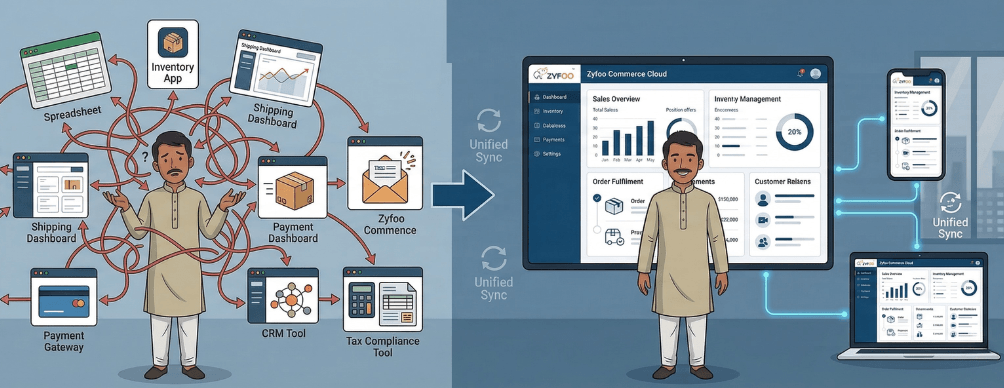
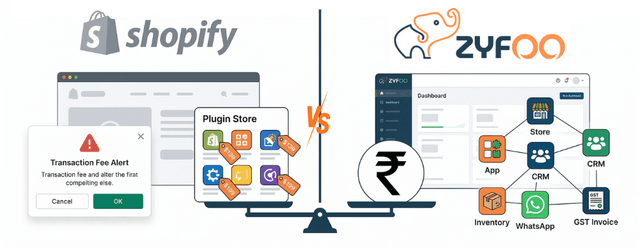
Ask most Indian SMB eCommerce owners how many software tools they use to run their business and the number is usually higher than they expect once they list them out. There is the eCommerce storefront. A separate inventory management app. A courier aggregator for shipping. A standalone accounting package for GST and invoicing. A WhatsApp Business account managed outside the store. A spreadsheet for vendor payments. And often a CRM tool or a manual record of customer contacts in someone s phone. Each of these tools was chosen because it solved a specific problem at a specific moment in the business s growth. The inventory app was added when stock mismatches became frequent. The courier aggregator came in when the single courier was not reaching all pin codes. The accounting tool arrived at the first GST filing. Individually, each decision was rational. Collectively, they created a technology stack that looks more like a patchwork than a platform. The cost of that patchwork is real and it compounds over time. It shows up as data entry that happens twice because the tools do not talk to each other. It shows up as reconciliation errors at the end of every month when inventory numbers in the store do not match the numbers in the accounting tool. It shows up as delayed decisions because the information needed to make them is spread across four different dashboards. And it shows up in the salary of the person whose primary job is to keep the tools manually synchronised. This article examines what ERP-integrated eCommerce actually means for Indian SMBs, why the fragmented tool model costs more than it saves at scale, and how Zyfoo s Commerce Cloud brings the capabilities that Indian SMBs need into a single unified platform that eliminates the synchronisation problem at its source.
What ERP-Integrated eCommerce Actually Means
The term ERP, which stands for Enterprise Resource Planning, has historically been associated with large corporations running complex multi-department software systems that cost crores of rupees to implement. SAP, Oracle, and Microsoft Dynamics are the names most often invoked. For Indian SMB owners, the word ERP can feel irrelevant or out of reach. That association is outdated. In 2026, ERP-integrated eCommerce for Indian SMBs does not mean a six-month implementation project managed by an IT consultancy. It means having the core business functions, specifically inventory, orders, accounts, vendor management, customer records, and sales reporting, connected to your storefront in a single platform where data flows automatically between functions without manual transfer.
The Five Functions That Need to Be Connected
When any of these five functions operate on a separate tool that does not share data in real time with the others, the SMB carries a synchronisation cost that grows proportionally with order volume.
- Inventory management: Stock levels must reflect every sale, return, purchase order receipt, and stock adjustment in real time across every sales channel.
- Order management: Orders from every channel must route into a single queue with status updates triggering downstream actions in inventory, accounts, and logistics automatically.
- Accounts and GST: Every invoice, payment receipt, vendor bill, and expense must be recorded and categorised without manual re-entry from the order management system.
- Vendor and purchase management: Purchase orders raised to restock inventory should reference the same product catalogue and trigger inventory updates when goods are received.
- Customer and CRM data: Every order, return, and interaction should build a unified customer record that informs future marketing, loyalty, and support decisions.
What Integration Eliminates
When these five functions are unified in a single platform, a specific class of operational problem disappears entirely. Stock count discrepancies between the store and the inventory tool cease to exist because there is only one inventory record. Month-end reconciliation between the order system and the accounting tool is no longer a manual exercise because every order automatically generates an accounting entry. The vendor payment spreadsheet becomes redundant because purchase orders are raised and tracked within the same system that manages the inventory they replenish. None of these improvements require process discipline from the business owner. They are structural. The integration removes the opportunity for synchronisation errors to occur rather than relying on consistent human behaviour to prevent them.
The financial case for ERP-integrated eCommerce is most clearly made by calculating the actual cost of the fragmented tool model. Most Indian SMB owners are aware of the subscription costs of their individual tools but have not aggregated the total spend or quantified the hidden costs that show up as staff time, errors, and delayed decisions.
Direct Subscription Costs
A typical Indian SMB eCommerce operation running on separate tools carries subscription fees across multiple platforms simultaneously. The aggregate annual cost for a mid-stage operation processing 100 to 500 orders per month is often higher than the cost of an all-in-one platform that includes all the same capabilities.
| Tool Category | Common India Options | Typical Annual Cost (INR) |
| eCommerce storefront | WooCommerce hosting + plugins, Shopify India | Rs 18,000 to Rs 60,000 |
| Inventory management | Zoho Inventory, Unicommerce, manual spreadsheet | Rs 12,000 to Rs 36,000 |
| Accounting and GST | Tally, Zoho Books, QuickBooks India | Rs 9,000 to Rs 27,000 |
| Courier aggregator | Shiprocket, Pickrr, NimbusPost | Rs 0 plus per-order charges |
| CRM tool | Zoho CRM free tier to paid, HubSpot starter | Rs 0 to Rs 24,000 |
| WhatsApp Business tool | Interakt, AiSensy, Wati | Rs 12,000 to Rs 36,000 |
| Total direct subscriptions | Excluding per-order charges | Rs 51,000 to Rs 1,83,000+ |
The Hidden Cost: Staff Time Spent on Synchronisation
The subscription fees are the visible part of the cost. The invisible part is the staff time consumed by moving data between tools that do not talk to each other. This is the cost that most SMB owners significantly underestimate because it is diffuse across the workday rather than appearing as a line item on a bank statement. Consider a business processing 150 orders per month across its website and WhatsApp channel. A conservative estimate of manual synchronisation time across inventory updates, accounting entries, and order tracking might be 2 hours per day across the operations team. At an average monthly salary of Rs 18,000 for an operations assistant in a tier-2 Indian city, that 2 hours per day represents approximately Rs 4,500 per month in labour cost that is directly attributable to the synchronisation burden of separate tools. At 300 orders per month, the synchronisation load roughly doubles.
| Synchronisation Task | Estimated Time per Day | Monthly Labour Cost at Rs 18k Salary |
| Updating inventory after WhatsApp orders | 20 to 30 minutes | Rs 750 to Rs 1,125 |
| Entering orders into accounting tool | 25 to 40 minutes | Rs 937 to Rs 1,500 |
| Reconciling courier AWBs with order records | 15 to 25 minutes | Rs 562 to Rs 937 |
| Updating stock after purchase order receipt | 10 to 20 minutes | Rs 375 to Rs 750 |
| Total daily synchronisation overhead | 70 to 115 minutes | Rs 2,625 to Rs 4,312 per month |
The Cost of Errors and Delayed Decisions
Beyond the direct time cost, separate tools introduce two categories of business risk that carry financial consequences. The first is data errors: a stock figure that is wrong in the inventory tool leads to overselling, which leads to cancellations and customer service cost. An accounting entry that is missed leads to a reconciliation gap that costs hours to trace at month-end or at GST filing time. The second is decision latency: a business owner who wants to know the gross margin on a product category has to pull data from the store s sales report, the inventory tool s cost-of-goods figure, and the accounting tool s expense records, reconcile them manually, and calculate the answer in a spreadsheet. The same question in an integrated platform has a 30-second answer. Over a month, the decisions that do not get made because the data is too inconvenient to assemble represent a real opportunity cost.
What ERP Integration Actually Unlocks for Indian SMBs
The case for ERP-integrated eCommerce is not only about eliminating costs from the fragmented model. Integration unlocks a set of operational capabilities that are simply not possible when data is siloed across separate tools, regardless of how diligently each individual tool is maintained.
Real-Time Gross Margin Visibility
When your sales data, cost-of-goods-sold from your inventory tool, and operating expenses from your accounting tool are all in separate systems, calculating gross margin on a specific product, category, or channel requires a multi-step manual exercise. When the same data lives in one integrated platform, gross margin is a live dashboard figure that updates with every order. For an SMB making daily decisions about pricing, promotions, and reorders, real-time margin visibility changes the quality of those decisions fundamentally.
Automated GST Invoice Generation
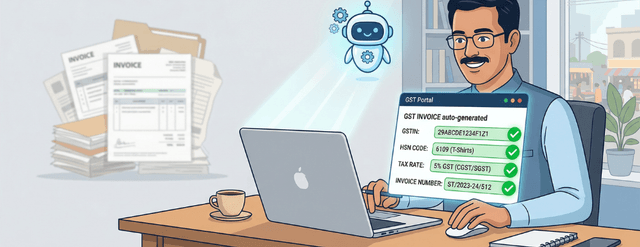
GST compliance is a significant operational burden for Indian eCommerce businesses. Every B2B order requires a GST invoice with the correct GSTIN, HSN code, tax rate, and invoice number sequence. When the order management system and the accounting tool are separate, invoice generation requires either manual re-entry of order data or an unreliable export-import workflow between the two systems. An ERP-integrated platform generates GST-compliant invoices automatically at the point of order confirmation, without any additional data entry.
Purchase Order Automation
When inventory levels for a product drop below a configurable reorder threshold, an ERP-integrated platform can automatically generate a draft purchase order to the preferred vendor for that SKU, routed through an approval workflow if required. The vendor receives the PO, confirms it, and when the goods arrive, the stock receipt is recorded in the system, immediately updating the available inventory across all sales channels. The entire replenishment cycle happens within one system without manual handoffs between tools. Zyfoo s vendor and purchase management module handles this workflow natively for Indian SMBs without any external ERP integration project.
Unified Customer Lifetime Value
A customer who has ordered 12 times over 18 months, returned 2 items, raised 1 support ticket, and responded to a WhatsApp recovery campaign is telling a rich story about their relationship with your brand. When each of those interactions is recorded in a different tool, that story exists nowhere in an actionable form. When they are all captured in an integrated platform, the customer s lifetime value, return behaviour, and engagement history are visible in a single profile that informs every future interaction.
Single-View Sales Reporting
An integrated platform produces a single sales report that covers every channel, every product category, every cost layer, and every time period from one dashboard. Comparing the performance of your website channel against your WhatsApp channel against your mobile app, net of fulfilment cost and returns, is a 10-second query rather than a 2-hour spreadsheet exercise.
Inventory as the Central Nervous System of ERP-Integrated Commerce
Among the five functions that need to be connected in an ERP-integrated eCommerce platform, inventory sits at the centre because it connects to everything else. Every sale depletes inventory. Every purchase order replenishes it. Every return adds back to it conditionally. Every promotion affects the velocity at which it moves. When inventory data is accurate and live, every other business function downstream benefits. When it is inaccurate or delayed, the errors propagate.
The Oversell Problem at Scale
The oversell incident, where a customer pays for an item that is not actually in stock, is the most visible symptom of inventory data that is not connected to the sales channel in real time. For an SMB processing 50 orders per month manually, an oversell is a recoverable inconvenience. For one processing 500 orders per month across multiple channels, it is a recurring customer service crisis that damages brand reputation and seller ratings with every occurrence.
The structural solution is not more careful manual checking. It is connecting the inventory record directly to every sales channel so that the moment a purchase is confirmed, the available quantity is decremented automatically and the updated availability is reflected across every other channel within the same transaction. This is only possible when the storefront and the inventory module are part of the same platform.
FIFO, Batch Tracking, and Expiry Management
For Indian eCommerce businesses in food, health, beauty, and pharmaceuticals, inventory management must go beyond simple quantity tracking. FIFO (First In, First Out) batch management ensures that older stock is fulfilled first, reducing expiry risk. Batch and lot tracking allows a business to trace which specific stock received on which date was used to fulfil which orders, which is essential for any business subject to quality recalls or regulatory compliance requirements.
Zyfoo s inventory module supports batch tracking and FIFO fulfilment sequencing natively, capabilities that most standalone inventory tools reserve for higher-tier paid plans and that require complex manual configuration in disconnected tool stacks. Details are available on the Zyfoo features page.
Multi-Location Inventory
Indian SMBs that operate a physical retail store alongside their online channel, or that have a warehouse in addition to a home-based stocking location, need inventory to be tracked per location and orders to be fulfilled from the most efficient location based on the customer s pin code. Managing this across separate tools requires a level of manual coordination that breaks down reliably at moderate order volumes. An integrated platform manages multi-location inventory as a core function, routing fulfilment to the optimal location automatically.
GST Compliance and Accounts: The Hidden Drain on Founder Time
GST compliance is one of the most significant operational burdens for Indian eCommerce businesses, particularly for those who sell across multiple categories with different tax rates, to both B2B and B2C customers, and across multiple states with varying tax treatment. When the accounting function is disconnected from the order management function, GST compliance is a monthly manual exercise that is prone to error and consumes time that should go to business growth.
- Invoice numbering sequences managed in a separate accounting tool must be manually reconciled with order IDs from the eCommerce platform, creating a mapping exercise at every filing period.
- HSN code assignment for each product must be maintained consistently in both the product catalogue and the accounting tool. When products are added to the store without updating the accounting tool, HSN mismatches create filing errors.
- B2B orders requiring GSTIN-linked invoices must be identified in the order management system and then manually flagged in the accounting tool for different invoice treatment.
- Credit notes for returns must be raised in the accounting tool manually against the original invoice, a multi-step process that is frequently delayed when the tools are not connected, creating reconciliation gaps.
How Integration Solves the GST Problem
In an ERP-integrated platform, every order confirmation triggers an automatic invoice generation with the correct HSN code drawn from the product catalogue, the correct tax rate applied based on the product category and customer GSTIN, and the invoice numbered in a compliant sequential series. Returns generate credit notes automatically against the original invoice. Monthly GSTR-1 and GSTR-3B data is compiled from the same integrated record, reducing the filing exercise to a review and submission rather than a data assembly project.
For Indian SMB founders who spend 2 to 3 days every month on GST-related data compilation, this represents a meaningful return of founder time that can go toward higher-value activities.
| GST Task | Disconnected Tools | ERP-Integrated Platform |
| Invoice generation per order | Manual entry in accounting tool | Automatic on order confirmation |
| HSN code consistency | Manual sync between catalogue and accounts | Single product record, single source |
| B2B GSTIN invoice handling | Manual identification and flagging | Automatic based on customer type |
| Credit note for returns | Manual raise in accounts after return confirmed | Automatic on return approval |
| GSTR-1 data compilation | Export from store, import to accounts, reconcile | Generated from unified order record |
| Monthly reconciliation time | 2 to 4 days per month | Review and submission only |
Vendor Management: The Function Most SMBs Are Running on WhatsApp
If you ask an Indian SMB owner how they manage their vendor relationships, the honest answer for most is a combination of WhatsApp messages, a shared spreadsheet, and memory. Purchase orders are sent as WhatsApp messages or PDFs. Delivery confirmations arrive as phone calls. Payment due dates are tracked in a notebook or a mental list. This is the reality of vendor management for a large share of Indian SMBs, and it works until it does not.
The moment a vendor dispute arises over a quantity discrepancy, or a payment is delayed because the due date was not tracked, or a reorder is missed because nobody noticed the stock running low, the informal vendor management model shows its structural weakness. These incidents cost real money and real time, and they become more frequent as the number of vendors and the volume of purchase orders grows.
What Integrated Vendor Management Looks Like
- Vendor master records with contact details, payment terms, lead times, and preferred product catalogue maintained in one place
- Purchase orders raised directly from the inventory system when stock falls below reorder threshold, referencing the vendor s price list automatically
- PO approval workflow for orders above a value threshold, routed to the appropriate approver before the order is sent to the vendor
- Goods received note raised against the PO when stock arrives, automatically updating inventory and triggering the vendor payment timeline
- Vendor payment schedule visible as a dashboard item showing amounts due, amounts paid, and overdue payments across all vendors
- Vendor performance tracking showing on-time delivery rate, quality rejection rate, and average lead time per vendor over a selectable time period
For Indian SMBs managing 5 or more active vendors, moving vendor management into an integrated platform removes the single biggest source of informal operational risk in the supply chain. Zyfoo s vendor module connects vendor management directly to inventory, accounts, and purchase orders so that the entire procurement cycle is visible and tracked without any informal workarounds.
Business Intelligence Without the Business Intelligence Budget
Large enterprises invest significantly in business intelligence infrastructure, data warehouses, ETL pipelines, and BI tools to produce the kind of cross-functional reports that allow leadership to make informed decisions. For Indian SMBs, the equivalent of that infrastructure has historically been a founder sitting with three browser tabs open, exporting data from each tool into a spreadsheet, and trying to make sense of the numbers across the three different formats. ERP-integrated eCommerce removes this dependency on manual data assembly by keeping all the data in one place from the start. The reports that would require hours to produce from a fragmented tool stack are available as standard dashboard views in an integrated platform.
Reports That Change How You Run the Business
- Product profitability report: Revenue minus cost of goods sold minus fulfilment cost minus return losses per SKU, showing which products are actually profitable and which are margin diluters
- Channel contribution report: Gross margin by sales channel (website, WhatsApp, app, marketplace) showing which channels deliver the highest quality revenue, not just the highest volume
- Inventory turn rate by category: How many times each product category turns over in a defined period, identifying slow-moving stock before it becomes a write-off problem
- Vendor performance summary: On-time delivery, quality rejection, and price variance per vendor over the last 90 days, informing supplier negotiation and qualification decisions
- Customer cohort analysis: Revenue and repeat purchase rate by customer acquisition month, showing whether the customers acquired in a specific campaign period have good or poor long-term value
When to Make the Move: Signals That the Fragmented Model Has Run Its Course
Not every SMB at every stage needs an ERP-integrated platform. In the earliest validation phase, a simple storefront and a manual process is appropriate and sufficient. The signal to move is not a specific order volume. It is a specific operational experience: the moment when the cost and friction of keeping your tools synchronised exceeds the cost of consolidating them.
Concrete Signals to Watch For
- You or a team member spends more than 1 hour per day updating stock quantities, reconciling orders, or entering data that already exists in another tool
- You have experienced at least one oversell incident in the past 90 days where a customer paid for an item that was out of stock
- Your monthly GST filing requires more than half a day of data compilation from multiple sources
- You cannot answer the question what is my gross margin on this product? without opening at least two separate tools and calculating manually
- You have missed a vendor payment or a reorder because the information was not visible in one place
- Your team is growing and new members need to be trained on multiple different tools and login credentials
- You are adding a new sales channel such as a mobile app or WhatsApp and the prospect of synchronising it with your existing tools is the primary obstacle
If three or more of the above apply to your operation today, the fragmented model is already costing you more than the consolidation would. The right time to address it is before the next scaling milestone, not after the next operational crisis.
| Business Stage | Appropriate Setup | Signal to Upgrade |
| 0 to 50 orders per month | Simple storefront with manual tracking | When manual tracking takes more than 30 mins/day |
| 50 to 200 orders per month | Storefront plus separate inventory and accounts | When reconciliation takes more than 1 day/month |
| 200 to 1,000 orders per month | Integrated platform covering all 5 functions | When vendor and CRM data cannot be managed separately |
| 1,000+ orders per month | Full ERP-integrated commerce platform | When channel reporting and margin visibility are needed daily |
How Zyfoo Delivers ERP-Integrated Commerce for Indian SMBs
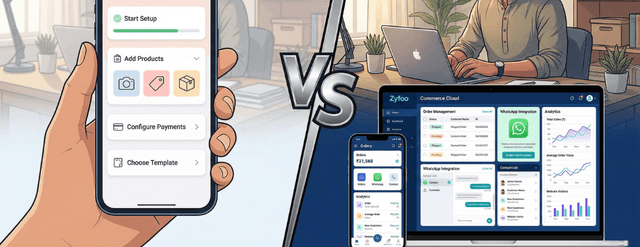
Zyfoo Commerce Cloud is built as a single unified platform that covers every function an Indian SMB eCommerce business needs without requiring external ERP integration. The platform is not an eCommerce storefront with bolt-on ERP modules added later. It was architected from the ground up with the assumption that inventory, orders, accounts, vendors, and customers all need to share the same data layer. Every feature on the Zyfoo platform operates from that unified data foundation.
What Is Included in the Zyfoo Commerce Cloud
- Multi-channel storefront: website, mobile app, and WhatsApp commerce from a single product catalogue
- Real-time inventory management with multi-location support, batch tracking, and automatic reorder alerts
- Unified order management with automated courier assignment, AWB generation, and tracking notification
- Integrated accounts with automatic GST invoice generation, credit note processing, and GSTR data compilation
- Vendor and purchase order management with approval workflows and goods receipt tracking
- Built-in CRM with customer lifetime value, order history, and communication preferences in one record
- Sales and profitability reporting across channels, categories, and time periods without manual data assembly
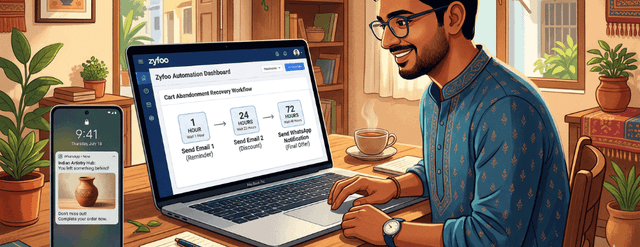
- Cart abandonment recovery automation with WhatsApp, email, and push notification sequences
The Indian SMB Difference
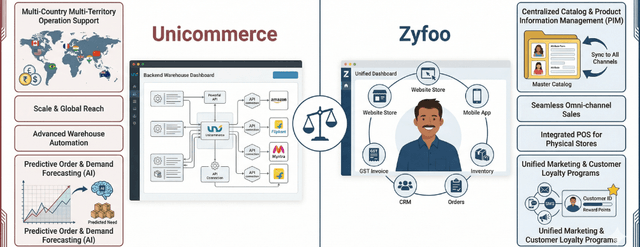
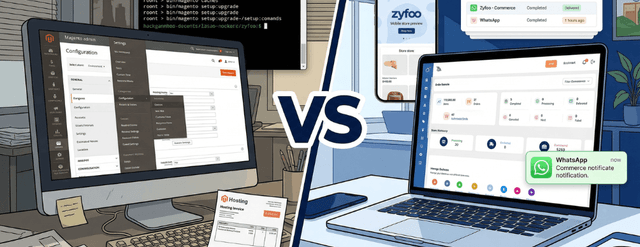
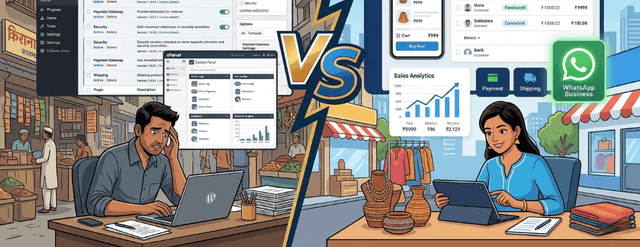
What distinguishes Zyfoo s implementation from a generic ERP-eCommerce integration is that every module is built for the specific conditions of Indian commerce: UPI and COD payment processing, Indian courier integrations, GST-compliant invoice formats, vernacular language storefronts, and WhatsApp as a primary commerce and communication channel. There is no configuration required to make these Indian-specific functions work. They are the default. For Indian SMBs who have evaluated international ERP platforms and found them requiring significant localisation work, or who have looked at Indian ERP tools that do not connect to their eCommerce storefront natively, Zyfoo s unified architecture removes the integration project entirely. Compare how this model differs from running separate tools by reading Zyfoo s comparison with WooCommerce, which covers the total cost of ownership question in detail.
The most common reason Indian SMB owners delay consolidating their tool stack is the fear of migration disruption. The concern is legitimate: moving a live business off tools it depends on carries risk if not managed carefully. However, the migration concern is frequently overestimated relative to the ongoing operational cost of staying on fragmented tools.
What a Structured Migration Covers
- Product catalogue migration: Every SKU with its description, images, variants, pricing, and HSN code is migrated to the new platform before go-live.
- Historical order data: Order history is imported for records and analytics baseline purposes, enabling cohort reporting from day one on the new platform.
- Customer records: Customer contact information, order history, and communication preferences are migrated to the CRM module.
- Opening inventory balances: Current stock counts are entered as opening balances in the new inventory module, with a physical stock count verification recommended at the point of cutover.
- Vendor master data: Vendor contacts, payment terms, and product associations are configured in the vendor module before the first purchase order is raised on the new platform.
- Accounting opening balances: Current receivables, payables, and account balances are entered as opening entries so the accounts module starts with an accurate financial position.
Recommended Cutover Approach
The most reliable migration approach for a live eCommerce business is a parallel run of 5 to 7 business days where the new platform is configured and tested in a staging environment while the existing tools continue to handle live orders. Once the staging environment has been verified against a complete test order cycle, the cutover happens on a low-volume day such as a Monday morning, with the old tools placed in read-only mode for reference during the first week on the new platform.
Zyfoo s onboarding team manages this migration process for Indian SMBs moving from fragmented tool stacks. The typical full migration timeline for a business with up to 500 active SKUs is 5 to 10 business days.
Speak to the Zyfoo team to start the assessment.
The tools a business runs on are not neutral. They shape what decisions are easy to make, what processes are possible to automate, and how much of the organisation s cognitive bandwidth goes to operations management versus growth. A fragmented tool stack that requires constant manual synchronisation trains the organisation to be reactive. An integrated platform that keeps all business data in one place creates the conditions for the organisation to be deliberate. For Indian SMB eCommerce operators who have built their operations on a collection of individually rational tool choices, the argument for consolidation is not that the individual tools are bad. It is that the gaps between them, the manual steps, the reconciliation exercises, the synchronisation errors, and the delayed decisions, accumulate into an operational tax that compounds with every order of additional scale. For Indian SMBs where operations staff are often the founder themselves, that overhead reduction translates directly to founder time freed for the activities that actually grow the business. The practical next step is a structured assessment of what your current tool stack actually costs, both in direct subscriptions and in staff time, compared to what a unified platform would cost and deliver. Zyfoo s Commerce Cloud is built to make that comparison straightforward for Indian SMBs at every stage of growth.