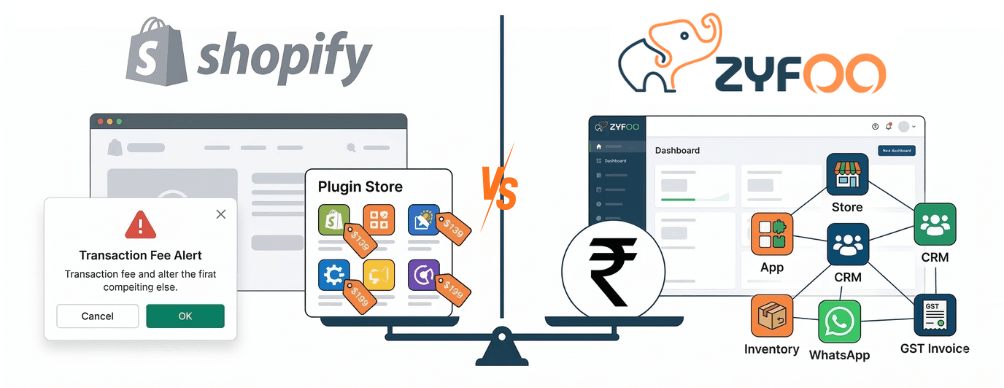
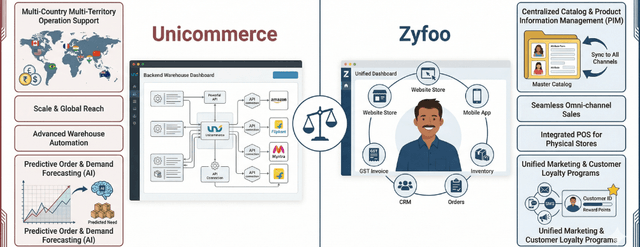
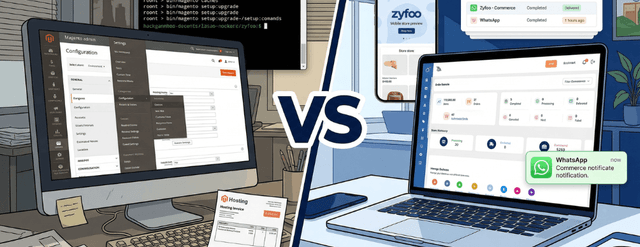
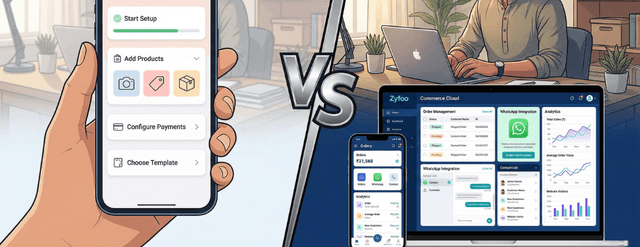
If you are an Indian seller evaluating ecommerce platforms in 2026, Shopify is almost certainly on your list. It is the most widely recognized ecommerce platform globally, and that name recognition carries weight when you are making a decision that will affect every order your business processes. But recognition and the right fit for your business are two different things. Shopify was built for a global market, and many of the assumptions baked into its pricing, payment model, and feature set reflect the needs of merchants in the US, UK, and Western Europe. Indian sellers have specific requirements around payment gateways, GST compliance, regional language support, WhatsApp commerce, and cost structure that a global platform may not address the way a platform built specifically for India does. This comparison looks at both platforms honestly, across the dimensions that matter most to Indian online sellers: pricing, features, payment handling, mobile readiness, ease of use, and who each platform is genuinely built for.
| Category | Shopify | Zyfoo |
| Built for | Global merchants | Indian commerce businesses |
| Primary market | US, UK, EU with India support | India, South Asia |
| Mobile app for customers | Requires third-party or custom build | ✔ Included out of the box |
| GST-compliant invoicing | Via paid apps | ✔ Built in natively |
| WhatsApp commerce | Via paid integrations | ✔ Native integration |
| ERP / inventory built in | Via paid apps | ✔ Part of the same platform |
| CRM built in | Basic, advanced via apps | ✔ Full CRM included |
| Pricing model | Tiered, monthly + transaction fees | Commerce-focused, India pricing |
Pricing: What You Actually Pay Each Month
Pricing is often the first point of comparison, and it is also where the most confusion arises with Shopify in India. The advertised plan prices are only part of the story.
Shopify Pricing in India
Shopify s current plans in India are structured as follows, billed annually:
| Shopify Plan | Monthly Cost (Annual Billing) |
| Starter | Rs. 399 per month |
| Basic | Rs. 1,499 per month |
| Grow (Standard) | Rs. 5,599 per month |
| Advanced | Rs. 22,680 per month |
| Plus (Enterprise) | Rs. 1,75,000 per month |
However, the monthly plan cost is not your total cost. As confirmed by Shopify s own pricing documentation, Indian merchants cannot use Shopify Payments because it is not available in India. This means every seller must use a third-party payment gateway such as Razorpay or PayU, which triggers an additional transaction fee on top of the gateway s own charges. On the Basic plan, that additional transaction fee is 2 percent per order. On the Grow plan it drops to 1 percent, and on Advanced it is 0.5 percent. Multiple independent analyses of Shopify s India costs show that when you combine the subscription fee, the Shopify transaction fee, the gateway processing fee (typically 1.8 to 2.36 percent with Razorpay), and essential apps, the real monthly cost for a Basic plan store doing Rs. 3 to 5 lakh in monthly sales can reach Rs. 6,000 to Rs. 15,000 per month. Additionally, features that Indian businesses commonly need, such as abandoned cart recovery, advanced analytics, customer review systems, and loyalty programs, are not included in any base plan and require paid app subscriptions that each add to your monthly bill.
Zyfoo Pricing
Zyfoo s pricing is structured around the full commerce platform, covering the website store, mobile app, order management, inventory, CRM, vendor management, and reporting as an integrated bundle. Indian sellers do not pay separately for a mobile app, a CRM tool, or an ERP add-on because all of these are part of the same platform. Visit Zyfoo s pricing page for the current plan breakdown specific to your business size and order volume.
Verdict:
Zyfoo wins on total cost of ownership. When you account for Shopify s unavoidable third-party gateway fees, app costs for features that Zyfoo includes natively, and the mobile app requirement, Zyfoo s bundled model delivers more functionality at a lower real monthly cost for most Indian SMBs.
Payment Gateway Handling: A Critical Difference for Indian Sellers
This is one of the most important factors for Indian sellers that often gets underweighted in generic Shopify vs alternatives comparisons. Shopify Payments, Shopify s own payment processing system, is simply not available in India. Every Indian Shopify merchant must use a third-party gateway. This is not a temporary situation. As of 2026, there is no confirmed timeline for Shopify Payments becoming available to Indian sellers. The practical consequence is that every single order your store processes carries an extra layer of fees: the gateway s own processing rate plus Shopify s additional transaction fee for using a non-Shopify payment provider. Zyfoo is built around the payment infrastructure that Indian buyers already use. UPI, net banking, credit and debit cards, and popular wallets are all handled natively, and the integration works without the additional platform transaction fee that Shopify applies when you use a third-party gateway.
| Payment Factor | Shopify | Zyfoo |
| Native Indian payment gateway | Not available | ✔ Built in |
| UPI support | Via third-party gateway | ✔ Direct |
| Additional platform transaction fee | 2% (Basic) to 0.5% (Advanced) | None on Indian gateways |
| COD (Cash on Delivery) support | Via apps or manual setup | ✔ Native support |
| Razorpay / PayU integration | Supported but adds Shopify fee | Supported without extra platform fee |
Verdict:
Zyfoo wins on payment cost. The compulsory additional transaction fee for Indian Shopify merchants adds up to thousands of rupees per month at moderate sales volumes. Zyfoo removes this layer entirely.
Mobile App for Customers: Built-In vs Add-On
India is a mobile-first commerce market. According to CNBC, over 70 percent of Indians use mobile devices for online shopping, and that figure continues to rise. A branded mobile app gives your customers a faster, more loyalty-building shopping experience than a mobile browser. With Shopify, a custom branded mobile app is not part of any standard plan. You either build one through a third-party app development service at a significant upfront and ongoing cost, or you use a white-label app builder from the Shopify App Store, which adds another monthly subscription to your costs. Zyfoo includes a customer-facing branded mobile app as a core part of the platform. When you set up your Zyfoo store, your mobile app is configured simultaneously from the same dashboard. Your product catalog, inventory, and orders are all connected to the app automatically. There is no separate app development cost and no additional monthly fee.
| Mobile App Factor | Shopify | Zyfoo |
| Branded customer app included | No, requires third-party service | ✔ Yes, included |
| App development cost | Rs. 30,000 to Rs. 2,00,000+ | Included in platform |
| App and website sync | Requires integration setup | ✔ Automatic, same dashboard |
| App update management | Separate process | ✔ Managed within Zyfoo |
Verdict:
Zyfoo wins for Indian mobile-first sellers. A branded app is table stakes for Indian D2C brands in 2026. Zyfoo includes it. Shopify charges extra for it.
GST Compliance and Indian Invoicing
Every Indian business that sells above the GST threshold must issue GST-compliant invoices for every order. This includes the correct GSTIN, HSN codes, tax breakdown, and invoice format as specified under Indian law. Shopify does not handle Indian GST compliance natively. To generate GST-compliant invoices, Shopify sellers typically use paid apps from the App Store, which add to the monthly cost and require configuration. If the app is not set up correctly, invoices may not meet Indian tax requirements, creating compliance risk. Zyfoo generates GST-compliant invoices automatically for every order, formatted to Indian tax requirements, without any additional app or configuration. The invoice is generated the moment an order is confirmed and is available to both the seller and the buyer immediately.
Verdict:
Zyfoo wins on compliance. Native GST invoicing removes a recurring administrative burden and eliminates the compliance risk that comes with relying on third-party apps for a legally required business function.
WhatsApp Commerce: Meeting Indian Buyers Where They Are
WhatsApp is not just a messaging app in India. For a large segment of Indian online buyers, it is the primary channel through which they discover products, ask questions, and make purchase decisions. Sellers who can receive and process orders through WhatsApp reach a broader segment of Indian buyers than sellers who rely exclusively on a website or app. Shopify supports WhatsApp integration through third-party apps, but these integrations vary in quality, require separate configuration, and add to the monthly app spend. The experience is not native to the Shopify platform. Zyfoo s WhatsApp commerce integration is built into the platform, allowing sellers to share product catalogs through WhatsApp, receive order inquiries, and process purchases without requiring the buyer to navigate to a website. This is the kind of feature that reflects a genuine understanding of how Indian commerce actually works.
Verdict:
Zyfoo wins for WhatsApp-first Indian sellers. Native WhatsApp commerce is a significant advantage in a market where conversational selling is mainstream.
Inventory, ERP, and Backend Operations
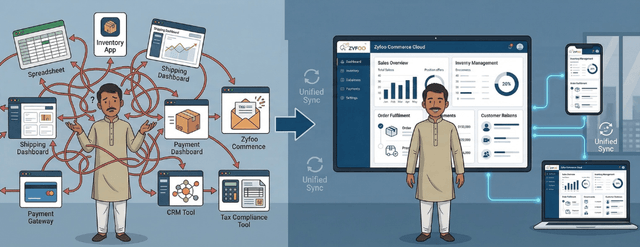
A growing Indian ecommerce business needs more than a storefront. It needs inventory management that updates in real time, order processing that is visible to the fulfilment team, vendor management for restocking, expense tracking, and sales reports that give a clear picture of business performance. On Shopify, basic inventory management is included in all plans, but the depth of functionality available for Indian commerce operations, particularly around multi-location inventory, vendor management, and expense tracking, requires paid apps or higher-tier plans. The result is that a Shopify store managing complex operations inevitably becomes an assemblage of separately billed tools. Zyfoo Commerce Cloud is built on an ERP foundation, meaning these capabilities are not add-ons. Inventory management, order processing, vendor management, expense tracking, CRM, and sales reporting are all part of the same system. You are not managing multiple subscriptions or dealing with data sync between separate tools. If you have been running on spreadsheets and want to understand what the full transition to a cloud ERP looks like, the Zyfoo Commerce Cloud overview covers the complete feature set in detail.
| Backend Feature | Shopify | Zyfoo |
| Real-time inventory sync | Yes (basic) | ✔ Yes (advanced, multi-location) |
| Vendor / supplier management | Via paid apps | ✔ Built in |
| Expense tracking | Not included | ✔ Built in |
| Sales reports and dashboard | Basic (advanced via paid plans) | ✔ Live dashboard included |
| CRM | Basic contact management | ✔ Full CRM with purchase history |
| ERP integration | Via third-party, paid | ✔ Native ERP foundation |
Verdict:
Zyfoo wins for operations-heavy sellers. When backend operations matter as much as the storefront, Zyfoo s integrated ERP approach eliminates the app-stacking that increases Shopify s real cost and complexity.
Ease of Use and Setup Time
Both platforms are designed for non-technical users, and both can be set up without a developer for a basic store. The difference becomes apparent when you factor in the configuration required to get Shopify to the feature level that Zyfoo provides out of the box. Setting up a Shopify store to include GST invoicing, WhatsApp integration, a mobile app, abandoned cart recovery, and advanced inventory management requires identifying, installing, configuring, and paying for multiple apps, each with its own settings and support team. The total setup time for a fully functional Indian Shopify store with these features can stretch to several days. Zyfoo s setup process covers all of these capabilities in a single guided configuration. The one-day launch guide for Zyfoo walks through exactly how this works in practice.
| Setup Factor | Shopify | Zyfoo |
| Time to basic store | Hours | Hours |
| Time to fully featured Indian store | Days to weeks (app configuration) | ✔ Same day |
| Developer required | No for basic, yes for custom | No |
| Apps needed for India compliance | Multiple paid apps | ✔ None, built in |
Who Should Choose Shopify, and Who Should Choose Zyfoo
No platform is objectively better for every seller. The right choice depends on your business profile, your technical resources, and your operational requirements.
Shopify is a stronger fit if you:
- Are selling internationally and need a globally recognized storefront with multi-currency and multi-language support at scale
- Have the budget for a developer and monthly app subscriptions to build a customized Indian commerce stack on top of the Shopify base
- Need very specific functionality available only in Shopify s extensive app ecosystem
- Are operating at enterprise scale (Shopify Plus) and need the integrations that come with that tier
Zyfoo is a stronger fit if you:
- Are an Indian SMB, D2C brand, or retail business that wants a platform built around Indian commerce requirements from day one
- Want a mobile app for your customers without paying for separate app development
- Need GST-compliant invoicing, WhatsApp commerce, and Indian payment gateways working natively without app configuration
- Want your inventory, CRM, vendor management, and sales reporting in the same system as your storefront
- Are starting out and want to be live within a day without a developer
- Want to avoid paying an additional per-transaction fee on top of your payment gateway s charges
The Bottom Line for Indian Sellers in 2026
Shopify is a powerful platform that has helped millions of businesses launch online. For Indian sellers, the challenge is that its cost model and feature set require meaningful adaptation to work for the Indian market. That adaptation costs money in apps and transaction fees, and it costs time in configuration. Zyfoo is not a compromise or a budget alternative. It is a commerce platform built with Indian businesses as the primary design consideration, not as an afterthought. The features Indian sellers need, including native UPI and Indian gateway support without extra fees, GST invoicing, WhatsApp commerce, a built-in customer mobile app, and an integrated ERP backend, are part of the platform by default. For a first-time founder comparing options, Zyfoo removes the complexity and the hidden costs. For an established seller who has felt the friction of managing multiple Shopify apps to cover India-specific requirements, Zyfoo represents a consolidation that simplifies operations while reducing monthly overhead. You can also explore how Zyfoo compares against other platforms commonly evaluated by Indian sellers, including Zyfoo vs WooCommerce and Zyfoo vs Dukaan, to complete your evaluation before making a decision.