Every bootstrapped seller in India faces the same pressure at the start: how do you get a functional online store up quickly, with minimal investment, before you have validated whether the product will sell? That pressure pushes many first-time sellers toward platforms that promise instant setup and zero upfront cost. Dukaan built an entire category by solving for exactly that need. But the calculus changes as a business grows. The platform that was perfect for a 10-order week begins to feel constraining at 100 orders a week. The features that were absent when you were too early to need them become urgent when you are trying to scale WhatsApp orders, manage inventory across channels, or understand why your conversion rate is stagnating. This comparison between Zyfoo and Dukaan is written for Indian sellers who are either evaluating their first platform or re-evaluating a platform they outgrew. Both are built for the Indian market. Both are accessible to non-technical founders. But they make very different bets on what a bootstrapped Indian seller actually needs, and understanding those bets clearly is more useful than a feature checklist. Zyfoo s full platform overview covers the specific capabilities discussed throughout this article.
Before comparing features line by line, it is worth understanding the founding intent of each platform because that intent shapes every product decision that follows.
Dukaan: Speed to First Store
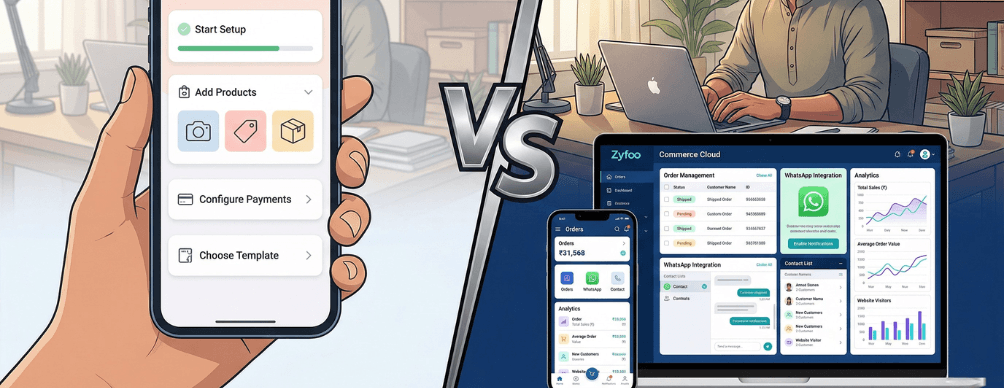
Dukaan was founded in 2020 with a clear and focused mission: make it possible for any Indian merchant, including a kirana owner with no prior digital experience, to have an online store within minutes. The product experience was deliberately simplified. You add your products, share a link, and start receiving orders. The friction of setup was reduced as far as it could go. That philosophy produced a product that was extremely well suited to the early phase of India s D2C wave, when a large number of offline sellers were looking for the fastest possible path to an online presence. Dukaan s growth was rapid and the platform served that specific moment well. The question for sellers in 2026 is whether that founding philosophy continues to serve them as their ambitions grow beyond a simple link-based storefront.
Zyfoo: Built for the Full Commerce Lifecycle
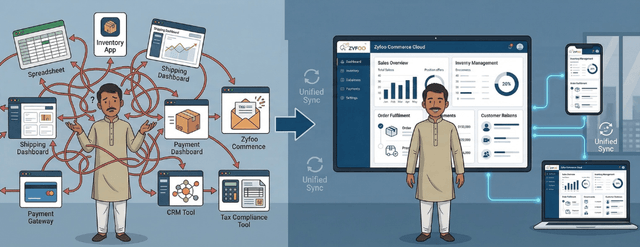
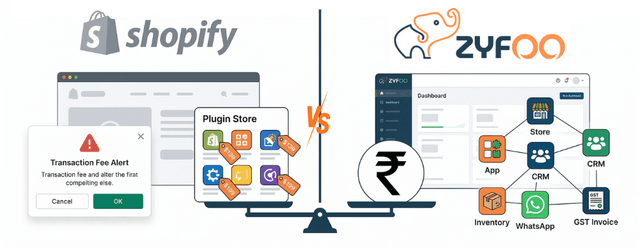
Zyfoo was built with a different question in mind: what does an Indian SMB actually need to run a complete, scalable online commerce operation? The platform s architecture reflects that question. Rather than optimizing purely for setup speed, Zyfoo was designed to cover the full commerce lifecycle from storefront to order management, inventory control, WhatsApp commerce, CRM, courier integration, and analytics in a single unified platform. The setup experience is still accessible to non-technical founders, but the platform is engineered to grow with the business rather than requiring a platform change at the next scaling milestone. The practical difference is that Dukaan asks you to add capability through third-party integrations as you grow, while Zyfoo includes that capability in the core platform from the start. Depending on where your business is today, that difference is either irrelevant or critical.
Feature-by-Feature Comparison
| Feature | Zyfoo | Dukaan |
| Store setup and go-live | 1 to 3 days (full platform) | Under 30 minutes (basic store) |
| Hosting and infrastructure | Fully managed, included | Fully managed, included |
| Custom domain support | Yes, included | Yes, on paid plans |
| Indian payment gateways (UPI, Razorpay, COD) | Native, no extra cost | Native on paid plans; COD on higher tiers |
| WhatsApp commerce integration | Native, catalog and order flow | Limited; primarily link sharing |
| Branded Android mobile app | Included in platform | Available on select paid plans |
| Multi-channel order management | Unified dashboard | Basic, single storefront focus |
| Real-time inventory management | Native, multi-channel sync | Basic inventory tracking |
| Courier integrations (Delhivery, Shiprocket etc.) | Native integrations included | Via Shiprocket plugin, additional cost |
| CRM and customer management | Built-in CRM module | Basic customer list, limited CRM |
| Sales analytics and reporting | Advanced, built-in dashboard | Basic order and revenue reports |
| ERP and accounting integration | Built-in ERP module | Third-party integration required |
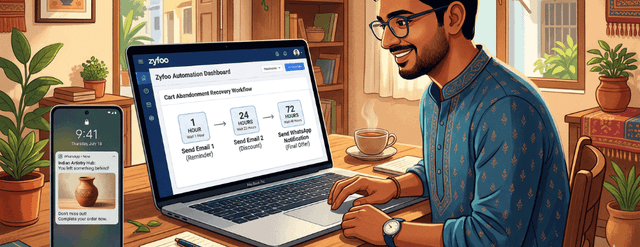
| Abandoned cart recovery | Native automation | Available on higher-tier plans |
| Vernacular language storefront | Built-in multilingual support | Limited language options |
| Dedicated customer support | Included with subscription | Tiered by plan level |
For a bootstrapped seller, the first 30 days on a platform are decisive. This is the period where you are testing whether your product has market demand, experimenting with pricing, and figuring out which channels your customers actually use. The platform needs to support this experimentation without becoming an obstacle.
Dukaan s Onboarding Experience
Dukaan s onboarding is genuinely fast. You create an account, upload product photos, set prices, and share your store link within a session. For a seller who needs to show a proof of concept to potential customers or test a product idea before investing more deeply, this speed is real value. There is minimal decision-making required upfront, which reduces cognitive load for first-time online sellers. The limitation surfaces when the seller starts receiving enough orders to require structured processes. Dukaan s order management, inventory tracking, and customer communication tools are functional but basic on entry-level plans. As order volume grows, the gaps in automation and integration become visible.
Zyfoo s Onboarding Experience
Zyfoo s setup takes longer than Dukaan s, typically 1 to 3 days to configure the storefront, payment gateways, courier integrations, and product catalog properly. That additional setup time is an upfront investment that pays forward. A seller who takes 2 days to configure Zyfoo correctly at launch does not face a platform migration 6 months later when order volume requires capabilities the simpler platform cannot provide. For bootstrapped sellers who want to validate quickly and then scale without switching, Zyfoo s onboarding process is a one-time investment rather than a recurring constraint. The Zyfoo onboarding team provides hands-on setup assistance so sellers without technical backgrounds can complete configuration correctly from the start.
Pricing: What You Pay and What You Actually Get
Pricing comparisons between eCommerce platforms are frequently misleading because headline plan costs do not reflect the total expenditure required to run a functional store. Both Dukaan and Zyfoo have tiered pricing structures, and the relevant comparison is what each tier delivers, not just what it costs.
How Dukaan s Pricing Works
Dukaan offers a free plan that covers the core storefront and basic product listing. Paid plans add features including custom domain, payment gateway integration beyond basic UPI, advanced analytics, additional staff accounts, and priority support. As of 2026, Dukaan s paid plans are positioned at accessible price points for early-stage sellers, which was central to its market positioning. The limitation for growing sellers is that several features that are standard requirements for a functioning business at scale, including advanced courier integration, abandoned cart recovery, and detailed analytics, are either unavailable on entry plans or require upgrading to higher-tier subscriptions. A bootstrapped seller who starts on the free or entry plan and grows to 200 or more orders per month will typically find themselves needing either a plan upgrade or a combination of Dukaan plus additional third-party tools.
How Zyfoo s Pricing Works
Zyfoo operates on a subscription model where the plan fee covers the complete platform including storefront, order management, inventory, CRM, courier integrations, WhatsApp commerce, mobile app, and analytics. There are no feature-gated tiers where critical commerce capabilities require a plan upgrade mid-growth. For current plan details and pricing, visit Zyfoo s pricing page at zyfoo.tech. The practical implication for bootstrapped sellers is that Zyfoo s cost is predictable. You pay the subscription and you have the full platform. There is no moment 4 months into growth where you discover that the feature you need most is on the next plan tier.
| Cost Consideration | Dukaan | Zyfoo |
| Entry cost to go live | Free plan available | Paid subscription from setup |
| Full commerce features | Requires higher-tier plan | Included in standard plan |
| Third-party tool additions needed at scale | Likely (courier, CRM, analytics) | Not required, built-in |
| Courier integration cost | Via Shiprocket (separate subscription) | Included in platform |
| Mobile app cost | Plan-dependent | Included |
| Total cost predictability at 500 orders/month | Variable, tool-stack dependent | Fixed subscription |
WhatsApp Commerce: A Critical Differentiator for Indian Sellers
For bootstrapped Indian sellers, WhatsApp is not a peripheral channel. For a significant share of orders in the early growth phase of a D2C brand, WhatsApp is the primary sales interface. Customers discover a product through Instagram, reach out via WhatsApp, get a catalog link, confirm an order in the chat, and pay via UPI. This is not an edge case. It is the dominant purchase flow for many Indian D2C categories including fashion, food, handmade goods, and home decor. How each platform handles WhatsApp commerce is therefore not a secondary feature comparison. It is one of the most important operational questions for the Indian bootstrapped seller context.
WhatsApp Commerce on Dukaan
Dukaan allows sellers to share their store link over WhatsApp, and customers can browse and checkout through the browser. This is functional but it is not true WhatsApp commerce. The customer leaves WhatsApp to complete the purchase, which introduces friction and breaks the conversational context of the sale. Dukaan does not currently offer a native in-WhatsApp catalog browsing and order placement workflow that keeps the customer within the WhatsApp interface throughout the transaction.
WhatsApp Commerce on Zyfoo
Zyfoo s WhatsApp commerce integration is a native feature of the platform. A customer can receive a catalog broadcast, browse products, select variants, place an order, receive an order summary with a payment link, and get automated order status updates entirely within WhatsApp. The seller s Zyfoo dashboard shows WhatsApp orders alongside website orders in a unified queue, with the same inventory deduction, courier assignment, and fulfillment workflow applied to both. For a bootstrapped seller building a personal relationship with their customer base through WhatsApp, this is a structural advantage. Orders placed via WhatsApp have higher conversion rates and significantly higher repeat purchase rates than anonymous website orders because the channel is inherently personal and relationship-based.
| WhatsApp Capability | Zyfoo | Dukaan |
| In-WhatsApp catalog browsing | Yes, native | No, redirects to browser |
| Order placement within WhatsApp | Yes, full flow | No, browser checkout only |
| Automated order status updates via WhatsApp | Yes, automated | Manual or limited |
| Inventory sync with WhatsApp orders | Real-time, unified | Not applicable |
| WhatsApp broadcast to customer segments | Yes, built-in | Basic sharing only |
Order Management: Handling Growth Without Breaking Operations
The difference between a platform that supports early-stage validation and one that supports a scaling business becomes most visible in order management. When a bootstrapped seller moves from 20 orders per week to 200, the operational requirements change fundamentally.
Order Management on Dukaan
Dukaan s order management interface is clean and accessible for low to moderate order volumes. Orders are visible in a list, can be marked as processing or shipped, and basic customer communication can be sent. For a seller processing under 50 orders per week, this is adequate. At higher volumes, the absence of automated workflows becomes a real constraint. Shipping label generation, courier assignment, tracking status push to customers, and return management all require more manual steps on Dukaan than on a platform with native automation. Sellers who reach 150 or more orders per day on Dukaan frequently report that operations management becomes the primary constraint on further growth.
Order Management on Zyfoo
Zyfoo s order management is designed for volume. The unified dashboard aggregates orders from every channel, automates confirmation notifications, assigns couriers based on pin code and weight, generates AWB numbers, and pushes tracking updates to customers without manual intervention. For the full breakdown of how Zyfoo handles the order lifecycle, the Zyfoo order management guide published covers each stage in detail. The operational impact for a bootstrapped seller scaling through 100 to 500 orders per day is that the team can stay small. Automation handles the repetitive steps so the seller s time goes to product development, customer relationships, and marketing rather than to operational firefighting.
Inventory Management: The Hidden Scaling Constraint
Inventory management is one of the least exciting topics in eCommerce until the moment it breaks. For bootstrapped sellers managing stock manually or across disconnected tools, the oversell incident, where a customer pays for an item that is no longer in stock, is a rite of passage that usually happens at the worst possible time.
Inventory on Dukaan
Dukaan provides basic inventory tracking where sellers can set stock quantities per product and receive low-stock alerts. For a single-channel seller with a small catalog, this is functional. The limitation appears when the seller is taking orders through multiple channels simultaneously. Dukaan s inventory does not natively sync in real time with orders coming from WhatsApp conversations, Instagram DMs, or any channel outside the Dukaan storefront itself. Manual reconciliation is required, which introduces the risk of overselling at scale.
Inventory on Zyfoo
Zyfoo s inventory management operates as a single source of truth that decrements in real time across every sales channel the moment a purchase is confirmed. Whether the order originates from the website, the mobile app, a WhatsApp conversation, or a direct phone order entered by the seller, the same inventory pool is drawn from and updated immediately. This eliminates the oversell problem structurally rather than through manual discipline. For bootstrapped sellers who are managing a growing catalog with multiple variants, colors, and sizes, Zyfoo s inventory module also provides batch updates, low-stock alerts with automated reorder triggers, and a complete stock movement history that makes reconciliation and planning straightforward.
Analytics: Making Decisions With Data vs Making Decisions With Instinct
Bootstrapped sellers frequently make inventory, pricing, and marketing decisions based on intuition in the early stages. That is appropriate when order volumes are low and the founder is close to every transaction. As volume grows, intuition-based decisions become increasingly risky and increasingly expensive when they are wrong.
Analytics on Dukaan
Dukaan provides basic analytics including total orders, revenue over time, and top-selling products. For a seller who wants a quick snapshot of whether the business is growing, this is adequate. The reports do not provide the depth needed to answer questions like which customer segments have the highest lifetime value, which product categories have the highest return rates, which acquisition channels produce the most repeat buyers, or how conversion rate varies by device type and traffic source.
Analytics on Zyfoo
Zyfoo s analytics dashboard goes significantly deeper. Sales reports are broken down by channel, category, customer segment, and time period. Order management data feeds into the analytics layer so that fulfillment performance, return rates, and average processing times are visible alongside revenue and GMV figures. The Zyfoo reporting module is designed for SMB owners who want to make data-informed decisions without hiring a data analyst or configuring a separate analytics platform.
| Analytics Capability | Zyfoo | Dukaan |
| Revenue and order trend reports | Detailed, multi-period | Basic summary |
| Channel-wise sales breakdown | Yes, per channel | Single storefront only |
| Customer lifetime value tracking | Yes, CRM integrated | Not available |
| Return rate by product category | Yes, built-in | Not available |
| Conversion funnel analysis | Yes, step-by-step | Limited |
| Exportable reports for accountant/investor | Yes, multiple formats | Basic CSV export |
Branded Mobile App: A Real Advantage or a Nice-to-Have?
For bootstrapped sellers in 2026, a branded mobile app is no longer exclusively a large-brand asset. The data on app-versus-browser behavior among Indian mobile shoppers is consistent: app users convert at higher rates, place larger orders, and have significantly higher repeat purchase rates than browser-based mobile visitors.
Mobile App on Dukaan
Dukaan provides a seller app for managing the store from a smartphone. A branded customer-facing storefront app, meaning an app that the seller s customers download and use to shop from that specific brand, is available on select Dukaan plans. The availability and customization depth of this feature varies by plan tier and has been subject to product changes over time.
Mobile App on Zyfoo
Zyfoo includes a branded Android app for the seller s customers as a core feature of the platform. The app is fully branded with the seller s logo and store identity, listed on the Google Play Store under the seller s brand name, and functions as a complete mobile storefront with the same product catalog, payment options, and order management backend as the website. For bootstrapped sellers who want to build a brand presence on customers home screens without an app development budget, this is a meaningful capability. Details are available on the Zyfoo features page.
Courier and Logistics: Where Operational Reality Sets In
For a bootstrapped Indian seller, logistics is the dimension of eCommerce operations that most frequently causes visible customer-facing problems. Delayed shipments, failed deliveries, and slow return pickups are the events that generate negative reviews and reduce repeat purchase rates, regardless of how good the product is.
Courier Integration on Dukaan
Dukaan integrates with Shiprocket as its primary logistics partner, giving sellers access to Shiprocket s multi-courier network for rate comparison and booking. This is a practical integration that covers the majority of pin codes in India. The limitation is that it adds a separate subscription and a separate dashboard to the seller s operational workflow. Shiprocket s own pricing structure includes additional per-order charges that affect the effective fulfillment cost, particularly for low-average-order-value categories.
Courier Integration on Zyfoo
Zyfoo includes native integrations with major Indian courier partners including Delhivery, XpressBees, Ecom Express, and Shiprocket within the platform. Pin-code serviceability checking, rate comparison across courier partners, AWB generation, and tracking status updates are all handled within the Zyfoo order management workflow. There is no separate logistics dashboard to manage and no additional subscription fee for accessing the courier integrations. For bootstrapped sellers who are sensitive to per-order cost and operational complexity, the integrated logistics model avoids the situation where a third-party logistics platform adds cost and workflow friction as order volume scales.
| Logistics Capability | Zyfoo | Dukaan |
| Courier partners available | Delhivery, XpressBees, Ecom Express, Shiprocket | Primarily via Shiprocket |
| Integration model | Native, no extra subscription | Shiprocket subscription required |
| Pin-code serviceability check | Real-time within platform | Via Shiprocket interface |
| Automatic AWB generation | Yes, within order workflow | Yes, via Shiprocket |
| Tracking push to customer | Automated via platform | Manual or via Shiprocket notifications |
| Return logistics management | Built-in reverse logistics | Via Shiprocket reverse |
Neither platform is objectively superior for every seller. The right choice depends on your current order volume, your technical comfort level, your channel mix, and your growth trajectory. Here is a practical framework for making the decision.
Dukaan Is a Strong Fit If
- You are in the absolute earliest stage of testing whether your product will sell online and need a storefront live within the hour
- Your sales volume is under 20 to 30 orders per week and you manage orders manually without needing automation
- You operate on a single channel (your own storefront link) and do not yet take orders through WhatsApp, Instagram, or a mobile app
- You want to test the market before committing to a platform subscription and the free plan s capabilities are sufficient for your current needs
- Your business model is purely product-link based and you do not require inventory management, CRM, or courier automation
Zyfoo Is a Strong Fit If
- You are past the validation stage and are building toward 100 or more orders per week within the next 6 months
- You sell or plan to sell through multiple channels including website, WhatsApp, and mobile app simultaneously
- You want WhatsApp commerce where the entire order flow happens within WhatsApp, not through a browser redirect
- You need real-time inventory sync across all channels to prevent overselling
- You want a branded Android app for your customers without a development investment
- You need native Indian courier integrations without a separate logistics platform subscription
- You want the analytics depth to make informed decisions about inventory, pricing, and marketing as your business grows
- You are building a brand rather than just a product and want the platform infrastructure to reflect that ambition
Moving From Dukaan to Zyfoo: What the Transition Involves
Sellers who started on Dukaan and are now ready to move to a more capable platform typically have the following assets that need to be transferred: a product catalog, a customer base, an order history for records, and an existing storefront URL if it has been shared with customers.
What Transfers Smoothly
- Product catalog including titles, descriptions, images, prices, and stock quantities
- Customer contact information for WhatsApp and email marketing continuity
- Order history exported from Dukaan for records and analytics baseline
What Requires Planning
- If customers have bookmarked or saved your Dukaan storefront link, a transition message sent via WhatsApp or email announcing the new storefront URL manages the migration smoothly for your existing buyer base
- If you have social media profiles linking to your Dukaan store, update the bio links to the new Zyfoo storefront URL as part of the launch
- Product photography that performed well on Dukaan can be directly reused on Zyfoo, so there is no need to reshoot
The Zyfoo onboarding team supports catalog import from Dukaan and provides a structured migration checklist to ensure nothing is missed during the transition. Most sellers complete the full migration within 2 to 4 business days. Speak to the Zyfoo team to start the process.
Dukaan solved a real problem at a real moment in India s D2C history: the problem of getting online quickly when you have no technical background and no budget. That contribution to the Indian seller ecosystem is genuine. The question for bootstrapped sellers in 2026 is not just how quickly you can get your first store online. It is how many platform migrations you want to go through over the next three years as your business grows. Every platform migration costs time, carries SEO risk, disrupts the customer experience, and requires a new learning curve. Choosing a platform with the depth to support your business from validation to scale is not a luxury. It is an efficiency decision. For Indian bootstrapped sellers who are building a brand with multi-channel ambitions, WhatsApp at the center of their customer relationships, and a growth target that goes beyond 100 orders per week, Zyfoo s architecture is built for exactly that journey. Explore the complete platform at zyfoo.tech and see what a fully configured Indian commerce operation looks like before committing to the next stage of your growth.