Most Indian eCommerce store owners spend the majority of their marketing budget trying to bring new visitors to their store. They optimise their Meta ads, refine their Google Shopping campaigns, work with influencers, and track every rupee of customer acquisition cost. And then, on average, more than 70 percent of the shoppers who add a product to their cart leave without buying. That number is not a hypothetical. Cart abandonment rates in Indian eCommerce consistently sit between 70 and 80 percent across categories, and the figure is even higher on mobile devices where checkout friction is greatest. For every ten customers who show clear purchase intent by adding to cart, seven or eight walk out of your virtual store before completing the transaction. The practical implication is significant. Cart abandonment recovery is not a marginal optimisation. It is one of the highest-return activities available to an eCommerce operator because the traffic cost has already been paid. You have already spent money acquiring these visitors. Recovering even 10 to 15 percent of abandoned carts through smart automation converts sunk marketing spend into incremental revenue without any additional acquisition cost. This guide covers how Indian SMB eCommerce operators can build an effective cart abandonment recovery system using Zyfoo s built-in automation features, what sequences work in the Indian market context, how to write recovery messages that convert, and how to measure the impact of your recovery programme over time.
Why Indian Shoppers Abandon Carts: The Real Reasons
Before building a recovery strategy, it is worth understanding why abandonment happens in the first place. Not all abandoned carts are the same, and the reason for abandonment should influence the recovery message you send.
Browsing and Price Comparison
A large share of Indian online shoppers, particularly in fashion, electronics, and home goods, routinely add products to cart as a bookmarking behaviour rather than with immediate purchase intent. They are comparing prices across platforms, saving items to review later, or building a wish list across multiple sessions. These shoppers are not lost. They are in a consideration phase, and a well-timed reminder with the right message can move them to conversion.
Unexpected Costs at Checkout
The single biggest checkout-specific abandonment trigger in Indian eCommerce is discovering a shipping charge that was not communicated clearly on the product page. A shopper who has mentally committed to paying Rs 599 for a product feels a strong negative reaction when the checkout total shows Rs 649 after adding Rs 50 in shipping. The transaction no longer feels like the deal they agreed to. Free shipping thresholds, clearly communicated on the product page and in the cart, reduce this friction significantly.
Payment Method Unavailability or Failure
India s payment landscape is diverse and payment failures are more common than on more homogeneous payment markets. A shopper who prefers a specific UPI app and finds it not listed, or whose card is declined due to a bank OTP timeout, or who expects to see a BNPL option and cannot find it, will often abandon rather than try an alternative payment method. Recovery messages for this segment need to address the payment friction directly.
Checkout Process Length
Multi-step checkouts that require account creation, address form completion, and multiple confirmation screens add enough friction to push undecided buyers out. In mobile commerce particularly, every additional screen is a drop-off point. Checkout processes that require more than three taps from cart to payment confirmation are losing measurable conversion at each step.
Distraction and Forgetfulness
A meaningful share of abandonment is simply the result of a shopper being interrupted mid-session, switching to another app, and not returning. There was no objection to the purchase. The customer was ready to buy and got distracted. For this segment, a simple reminder within the first hour is often sufficient to complete the sale.
| Abandonment Reason | Recovery Approach | Optimal Channel |
| Just browsing or comparing | Social proof message with
reviews and rating count | WhatsApp or email
at 24 hours |
| Unexpected shipping cost | Free shipping offer or
minimum order threshold reminder | WhatsApp at 1 hour |
| Payment failure or friction | Payment help message with
alternative options listed | WhatsApp
within 30 minutes |
| Checkout too long | One-click return to cart
link with saved progress | WhatsApp or SMS
at 1 hour |
| Distracted and forgot | Simple friendly reminder
with product image | WhatsApp or push
at 1 hour |
| Price comparison shopping | Time-limited discount
or bundle offer | Email or WhatsApp
at 24-48 hours |
What Cart Abandonment Is Actually Costing Your Business
The revenue impact of unrecovered cart abandonment is straightforward to calculate and the result is consistently sobering for store owners who have not looked at the numbers before.
A Simple Revenue Loss Calculation
Consider an Indian SMB eCommerce store generating 300 sessions per day with a 5 percent add-to-cart rate and a 70 percent cart abandonment rate. That means 15 shoppers add to cart each day and approximately 10.5 of them leave without purchasing. At an average order value of Rs 1,200, that is Rs 12,600 in potential daily revenue walking out the door, or approximately Rs 4.6 lakhs per month in unrealised revenue from visitors who had already demonstrated purchase intent. If a recovery automation programme converts just 12 percent of those abandoned carts, that is Rs 55,000 in additional monthly revenue from a customer base you have already paid to acquire. For a bootstrapped Indian SMB, that figure represents a meaningful contribution to monthly profitability without any increase in marketing spend.
| Metric | Value |
| Daily sessions | 300 |
| Add-to-cart rate | 5 percent (15 carts/day) |
| Cart abandonment rate | 70 percent (10.5 abandoned/day) |
| Average order value | Rs 1,200 |
| Daily abandoned cart value | Rs 12,600 |
| Monthly abandoned cart value | Approx Rs 3.8 lakhs |
| Recovery at 12 percent conversion | Approx Rs 46,000 additional/month |
| Recovery at 20 percent conversion | Approx Rs 76,000 additional/month |
These are conservative assumptions. Indian D2C brands with higher average order values, stronger brand recognition, and well-crafted recovery sequences consistently report recovery rates of 15 to 25 percent of abandoned carts, with WhatsApp-based recovery performing at the upper end of that range.
The Three-Touch Recovery Sequence That Works for Indian Stores
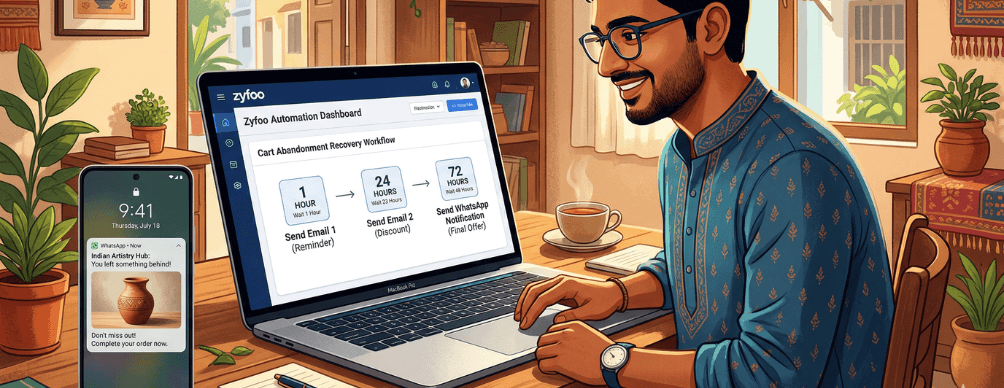
A single recovery message is better than nothing, but a structured multi-touch sequence that escalates the incentive and changes the message angle across three contact points consistently outperforms single-message approaches. The following sequence is designed specifically for the Indian eCommerce context, taking into account WhatsApp as the primary communication channel, the importance of social proof for Indian buyers, and the price sensitivity that makes time-limited offers effective.
Touch 1: The One-Hour Reminder (No Discount, No Pressure)
The first recovery message should arrive within 60 minutes of abandonment while the product is still fresh in the shopper s mind. At this stage, the message should be warm, personal, and frictionless. Do not lead with a discount. A shopper who abandoned due to distraction does not need a discount to come back. They need a gentle nudge with a direct link back to their cart. For Indian eCommerce, WhatsApp is the most effective channel for the one-hour touch. Open rates on WhatsApp business messages that are sent to opted-in customers routinely exceed 85 percent, compared to 20 to 25 percent for email. The message tone should feel like a message from a person, not a broadcast from a brand. Example message format for the one-hour WhatsApp touch: a product image, the product name, a brief message acknowledging that the customer left something in their cart, and a single clear link back to checkout. The message should be under 100 words. Zyfoo s WhatsApp automation handles the trigger, personalisation, and delivery of this message automatically the moment a cart is abandoned by an identified customer.
Touch 2: The 24-Hour Social Proof Message
If the shopper did not return after the first touch, the second message at 24 hours should shift the angle. The customer may be hesitating because they are comparing alternatives or because they are unsure about the product quality. Social proof addresses both objections. The 24-hour message should include the product image, the average star rating and total review count for that specific product, a brief excerpt from a positive customer review (your own customer s words, not a fabricated testimonial), and a return-to-cart link. If your store offers a free exchange or easy return policy, this message is the right place to reinforce it clearly. At this stage, a small incentive is optional but can be effective for higher-value items. A free shipping offer for orders completed within the next 24 hours adds urgency without the margin impact of a percentage discount. Reserve the discount for the third touch.
Touch 3: The 72-Hour Final Offer
The third touch, sent 72 hours after abandonment, is the last message in the standard sequence. By this point, shoppers who will convert with a simple reminder have already done so. The third touch is for the price-sensitive and the genuinely uncertain. This message should carry your strongest incentive: a time-limited discount of 5 to 10 percent, a bundle offer that adds value to the original cart, or free shipping on the specific order with a clear expiry time. The expiry time is important. An offer with a vague end date creates no urgency. An offer that expires in 12 or 24 hours creates a reason to act now rather than later. The message should be direct: your cart is still available, here is what we would like to offer you, the offer expires at a specific time. Keep the copy short, the call to action prominent, and the return-to-cart link impossible to miss.
| Touch | Timing | Message Angle | Incentive |
| Touch 1 | 60 minutes after
abandonment | Friendly reminder,
your cart is waiting | No discount,
direct return link |
| Touch 2 | 24 hours after
abandonment | Social proof, reviews,
return policy reminder | Optional free shipping |
| Touch 3 | 72 hours after
abandonment | Final offer with
urgency and expiry | 5 to 10 percent
discount or bundle |
Choosing the Right Recovery Channel for Indian Customers
The channel through which you send recovery messages matters as much as the message content. Indian eCommerce customers in 2026 interact with brands primarily through three channels for post-session communication: WhatsApp, email, and push notifications from a branded app. Each has different characteristics that make it more or less appropriate for different segments of your customer base.
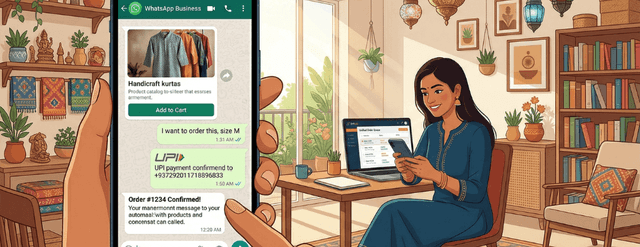
WhatsApp is the dominant recovery channel for Indian eCommerce because it is where Indian consumers spend the most time and where they have the lowest barrier to engagement. A WhatsApp message from a brand they have opted in with is seen, opened, and acted upon at rates that no other channel in the Indian market can match. The requirement for WhatsApp recovery automation is that the customer must have provided their WhatsApp number at checkout or opted in through a prior interaction. This makes WhatsApp recovery most effective for return customers or customers who complete the contact information fields before abandoning at the payment step. For first-time visitors who abandon before entering any contact details, WhatsApp recovery is not available without a prior opt-in.
Email: Effective for Higher-Value and Considered Purchases
Email recovery works best for higher average order value categories where the purchase decision involves more deliberation: electronics, furniture, appliances, jewellery, and premium fashion. Email allows for richer formatting, more detailed product information, and longer-form social proof than WhatsApp. Open rates for abandoned cart emails in India average 35 to 45 percent when subject lines are personalised with the product name. Email also works well for customers who provided an email address during account creation but have not opted in to WhatsApp business communication. Building your email list alongside your WhatsApp contact list gives you a recovery channel for every identified customer regardless of their communication preference.
Push Notifications: Instant and Low-Cost for App Users
For customers who have downloaded your branded app, push notifications are the fastest and most cost-effective recovery channel. A push notification arrives on the customer s home screen within seconds of being triggered, requires no additional per-message cost, and achieves open rates of 30 to 40 percent for personalised cart recovery messages. Zyfoo s branded Android app enables push notification recovery as a native feature for all app-based customers without any additional configuration.
| Recovery Channel | Average Open Rate India | Best Use Case |
| WhatsApp (opted-in) | 80 to 90 percent | All categories, returning customers,
impulse products |
| Email | 35 to 45 percent | High AOV, considered purchases,
account holders |
| Push notification (app) | 30 to 40 percent | App users, frequent buyers,
flash sale reminders |
| SMS | 60 to 70 percent (read rate) | Backup for customers without
WhatsApp opt-in |
Writing Recovery Messages That Convert in the Indian Market
The copy inside your recovery messages determines whether a warm lead becomes a completed order. Indian shoppers respond to specific tonal and structural elements that differ from Western eCommerce markets, and understanding these preferences gives your recovery sequence a meaningful conversion edge.
Tone: Personal Over Corporate
Indian buyers, particularly in the D2C and social commerce space, have a higher tolerance for personal, conversational brand communication than formal corporate messaging. A WhatsApp recovery message that reads as though a real person from the brand sent it, with a first name, a product name, and a direct question, performs better than a message that reads like an automated broadcast. This does not mean deceptive personalisation. It means warm, direct, and human in its tone.
Language: Match the Customer s Preference
If you sell to customers in Tamil Nadu, a recovery message in Tamil or Tamil-inflected English will outperform a generic English message. The same principle applies across regional markets. Where you have data on a customer s language preference from their browsing behaviour or their prior communication with you, use it in the recovery sequence. Vernacular recovery messages consistently outperform English-only messages for tier-2 and tier-3 market customers.
Product Specificity: Name What They Left Behind
A generic message that says you left something in your cart without naming or showing the specific product is significantly less effective than a message that includes the product image, name, and variant. Specificity re-activates the desire that led the customer to add the item in the first place. The product image is the most important element in a WhatsApp recovery message.
Urgency: Real Scarcity Over Manufactured Deadlines
Urgency works in recovery messages but only when it is credible. If you genuinely have limited stock of the abandoned item, saying only 3 left in stock is a truthful and effective urgency driver. If stock is not limited, manufactured scarcity erodes trust when the customer sees the same item available at full stock levels the following week. Time-limited offers with a specific expiry time are more credible than stock-scarcity claims for items with abundant inventory.
Fixing the Checkout Before Recovering the Cart
Cart abandonment recovery automation is the right response to a percentage of your abandonment rate. But before investing in recovery sequences, it is worth auditing your checkout experience to identify abandonment causes that can be eliminated at the source rather than recovered from downstream. A well-structured checkout optimisation review will typically identify 3 to 5 changes that reduce abandonment rate by 10 to 20 percent without requiring any recovery automation. These structural fixes deliver permanent improvement to conversion, while recovery automation captures additional revenue on top of the improved baseline.
Display Total Cost Upfront
The most high-impact single change most Indian eCommerce stores can make is showing the complete order total, including any shipping charge, as early as possible in the shopping journey. Display estimated shipping cost on the product page, clearly show the free shipping threshold in the cart view, and never introduce a shipping charge for the first time at the final checkout step.
Offer Guest Checkout
Requiring account creation before purchase is one of the highest-friction checkpoints in eCommerce checkout flows. Offer a guest checkout path that requires only a delivery address, phone number, and payment. Invite the customer to create an account post-purchase as an option, not a requirement. The incremental account creation rate from post-purchase invitations is lower than mandatory pre-purchase creation, but the checkout completion rate is significantly higher.
Make UPI the Prominent Default
Indian mobile shoppers expect to see UPI as the primary payment option. A checkout that leads with a credit card form and buries UPI options below the fold creates unnecessary friction for the majority of Indian buyers who prefer UPI. Restructure your payment options so UPI, including GPay, PhonePe, and Paytm, appears first and prominently.
Every unnecessary form field in the checkout process is a potential abandonment point. Audit your checkout form and remove any field that is not required to complete the delivery and payment. Middle name, fax number, and company name fields on a B2C checkout are common examples of unnecessary friction. Auto-fill address fields from pin code to reduce typing burden on mobile devices.
Show Trust Signals at the Payment Step
The payment step is where buyer anxiety peaks. Displaying recognisable payment gateway logos, a brief free returns reminder, and a visible customer support contact at the payment step reduces the anxiety-driven abandonment that happens when a customer hesitates at the final click.
| Checkout Optimisation | Estimated Abandonment Reduction |
| Display shipping cost on product page | 8 to 12 percent reduction |
| Add guest checkout option | 10 to 15 percent reduction |
| Make UPI the default payment option | 6 to 10 percent reduction |
| Reduce checkout form to essential fields only | 5 to 8 percent reduction |
| Show trust signals at payment step | 3 to 6 percent reduction |
Setting Up Cart Recovery Automation on Zyfoo: Step by Step
Zyfoo s automation module handles the entire cart recovery workflow without requiring any external tool, API configuration, or marketing automation platform subscription. The following steps cover the complete setup process for a standard three-touch recovery sequence.
Step 1: Define Your Abandonment Trigger
In the Zyfoo automation dashboard, the cart abandonment trigger is configured based on session inactivity time. The standard setting triggers the recovery sequence when a customer who added items to cart has not completed checkout after 30 minutes of inactivity. You can adjust this window based on your category, with longer windows appropriate for higher-value considered purchases where the customer may be doing research across multiple sessions.
Recovery automation can only reach identified customers, meaning those who have provided a contact detail at some point in the session. Zyfoo captures the customer s WhatsApp number and email address as soon as they are entered in the checkout flow, even if the customer does not complete the purchase. This means a customer who fills in their contact details and then abandons at the payment step is recoverable, while a customer who browses anonymously without entering any contact information is not. To maximise your recoverable audience, consider adding a WhatsApp opt-in prompt early in the checkout flow, before the payment step, and an email capture during account creation with an explicit opt-in consent for marketing communication.
Step 3: Build the Message Templates
Within Zyfoo s automation module, you create message templates for each touch in the recovery sequence. WhatsApp message templates require prior approval from WhatsApp Business API before they can be sent to customers. Zyfoo s platform handles the template submission process and tracks approval status. For the standard three-touch sequence, three WhatsApp templates need to be created and approved: the one-hour reminder, the 24-hour social proof message, and the 72-hour final offer. The Zyfoo features documentation covers the template creation interface in detail.
Step 4: Set Timing and Channel Priority
Configure the delay between each touch and the channel priority for each message. The recommended setup for most Indian eCommerce stores is WhatsApp as the primary channel for all three touches, with email as a fallback for customers who have an email address on file but no WhatsApp opt-in. Push notifications for app users can be set as the primary channel in parallel with WhatsApp for customers who have both the app installed and WhatsApp opted in.
For the third touch in the sequence, configure the discount or offer to be applied automatically when the customer returns via the recovery link. Zyfoo s automation module can generate a unique discount code per abandoned cart session so that the offer is non-transferable and cannot be shared on coupon aggregator sites. Set an expiry time on the code that matches the urgency language in your message.
Step 6: Test Before Going Live
Before activating the sequence for live customers, run a full test using a test account that goes through the abandonment flow. Confirm that the trigger fires at the correct inactivity window, that the messages arrive in the correct order at the correct timing, that the product image and name populate correctly in the message template, and that the return-to-cart link lands on a correctly restored cart with the original items still present.
- Define the abandonment trigger window (recommended: 30 minutes of inactivity after add-to-cart)
- Configure customer identification and opt-in capture points in the checkout flow
- Build and submit WhatsApp message templates for the three recovery touches
- Set channel priority: WhatsApp primary, email fallback, push notification parallel for app users
- Configure unique discount codes for the third touch with expiry time matching message urgency
- Run a complete test through the abandonment and recovery flow before activating for live traffic
Advanced Cart Recovery Tactics for Growing Indian Stores
Once the standard three-touch recovery sequence is live and performing consistently, there are several additional tactics that higher-volume Indian eCommerce stores use to improve recovery rates further and extract more value from the recovery channel.
Segment by Abandonment Reason
Not all abandoned carts should receive the same recovery sequence. Zyfoo s automation module can trigger different sequences based on the customer s behaviour during the abandoned session. A customer who reached the payment step and dropped off gets a payment-focused recovery message. A customer who browsed multiple products before adding to cart and then leaving gets a product-comparison focused message. Segmented sequences consistently outperform generic ones by 20 to 35 percent on recovery conversion rates.
Personalise by Cart Value
A shopper who abandoned a Rs 500 cart does not need the same incentive as one who abandoned a Rs 8,000 cart. High-value abandoned carts justify a more generous recovery offer, including a personal call from the brand s customer support team for purchases above a certain threshold. Zyfoo s automation rules allow you to set cart value thresholds that trigger different recovery sequences or escalation actions.
Use Browse Abandonment as an Early Signal
Browse abandonment, where a customer views a product page multiple times without adding to cart, is an earlier signal of purchase intent than cart abandonment. Capturing this signal and sending a softer nudge, such as a WhatsApp message noting that the customer has been viewing a product, with a positive review and a direct link, can intercept intent before it reaches the cart abandonment stage altogether.
A/B Test Message Variants
Recovery message optimisation is an ongoing process rather than a one-time setup. Testing two variants of the one-hour message, one with a discount badge and one without, or testing two different subject lines for the 24-hour email, gives you data to progressively improve recovery rates. Even a 2 percent improvement in recovery conversion rate on 100 abandoned carts per month is meaningful at the scale of a growing Indian D2C brand.
Connect Recovery Data to CRM
Customers who abandon carts are telling you something specific about their purchase behaviour and price sensitivity. Connecting cart recovery event data to your CRM allows you to segment these customers differently in future campaigns. A customer who responded to a discount offer in a recovery sequence is likely price-sensitive and should be included in promotional campaign audiences. A customer who returned to complete the purchase after a social proof message is likely brand-quality focused and should receive content that reinforces craftsmanship, materials, or origin story. Zyfoo s CRM module receives this data automatically so that recovery behaviour informs future segmentation without manual tagging.
A cart recovery programme without systematic measurement is a black box. You need to know which touch performs best, which channel drives the most completions, and what the incremental revenue impact is compared to the control group that received no recovery messages.
Key Metrics to Track
- Cart abandonment rate: The percentage of add-to-cart sessions that do not result in a purchase. Your baseline before recovery automation is activated.
- Recovery rate: The percentage of abandoned carts that result in a completed purchase after at least one recovery message is received.
- Revenue recovered per month: The total order value generated from recovery automation, measured separately from organic return-to-purchase sessions.
- Recovery rate by touch: Which message in the sequence (1 hour, 24 hours, 72 hours) drives the highest share of recovered orders.
- Recovery rate by channel: Whether WhatsApp, email, or push notification produces the best conversion for your specific customer base.
- Discount utilisation rate on Touch 3: What percentage of recovered orders from the third touch use the discount code, versus returning without the incentive.
| Metric | Healthy Benchmark | Action if Below Benchmark |
| Overall recovery rate | 10 to 20 percent
of abandoned carts | Review message copy and timing;
check checkout friction points |
| Touch 1 recovery share | 40 to 50 percent
of all recoveries | Improve message personalisation
and product image quality |
| Touch 2 recovery share | 25 to 35 percent
of all recoveries | Strengthen social proof elements;
add returns policy reminder |
| Touch 3 recovery share | 15 to 25 percent
of all recoveries | Test offer size;
check expiry urgency language |
| WhatsApp open rate | 75 percent or higher | Review opt-in capture points;
check template approval status |
| Email open rate | 30 percent or higher | Test subject line
personalisation with product name |
Reporting Inside Zyfoo
Zyfoo s analytics dashboard tracks all recovery automation metrics in one place. You can view recovery rate by sequence, by channel, by product category, and by time period without exporting data to a separate analytics tool. For store owners who want to take the analysis further, the Zyfoo reporting module supports data export for use in Google Sheets or any external analytics environment.
Sending Recovery Messages Responsibly: Compliance and Customer Trust
Cart recovery automation is only sustainable as a channel if customers trust that the brand will communicate with them responsibly. Over-messaging, sending recovery sequences to customers who have not opted in, or continuing to send messages after a customer has unsubscribed are all practices that erode trust and reduce future engagement rates.
WhatsApp Opt-In Requirements
WhatsApp s Business Messaging Policy requires explicit opt-in consent before a brand can send marketing or promotional messages to a customer. This consent must be clearly separate from the purchase transaction consent. The most effective way to collect this consent in an Indian eCommerce context is a visible opt-in checkbox on the checkout page, a pop-up on the first visit from a mobile device, or an opt-in prompt in the post-purchase confirmation message.
Frequency Capping
Sending all three recovery touches to a customer within 72 hours is appropriate for a single abandonment event. Sending recovery sequences for every subsequent visit where the same customer browses without purchasing creates a negative brand experience. Set a frequency cap in your automation rules so that a customer does not receive recovery messages more than once every 7 to 14 days regardless of how many sessions they have.
Easy Unsubscribe
Every WhatsApp recovery message should include a clear unsubscribe option. Not only is this required under WhatsApp s business policies, but a customer who unsubscribes cleanly is preferable to one who marks your messages as spam, which can affect your WhatsApp Business API rating and deliverability for all other customers on your list. For broader guidance on digital marketing compliance in India, the Information Technology Act and the Digital Personal Data Protection Act 2023 guidelines from MeitY outline the consent and data handling requirements that apply to eCommerce businesses collecting customer contact information for marketing purposes.
Recovery Is a Revenue Channel, Not an Afterthought
The Indian eCommerce stores that grow efficiently in 2026 are not necessarily the ones spending the most on customer acquisition. They are the ones extracting the most value from the customers they have already spent money to reach. Cart abandonment recovery automation sits at the intersection of the highest-intent audience (people who added to cart) and the lowest-cost conversion channel (automated messages to your own opted-in customer list). A well-configured three-touch recovery sequence, built on WhatsApp as the primary channel with email as backup, personalised by abandonment reason and cart value, and measured weekly against clear benchmarks, typically recovers 12 to 20 percent of abandoned carts. For most Indian SMB eCommerce stores, that translates to a meaningful increment of monthly revenue that grows proportionally with order volume. The practical starting point is activating the recovery automation that is already available in your commerce platform. Zyfoo s automation features include the full three-touch recovery sequence, WhatsApp integration, email fallback, and per-cart unique discount code generation without any additional subscription or technical setup. The revenue is already in your abandoned carts. Automation is what collects it.